
Erfurt
Nordhäuser Str. 63, 99089 Erfurt, Deutschland
University of Erfurt | Teaching & Study Programs
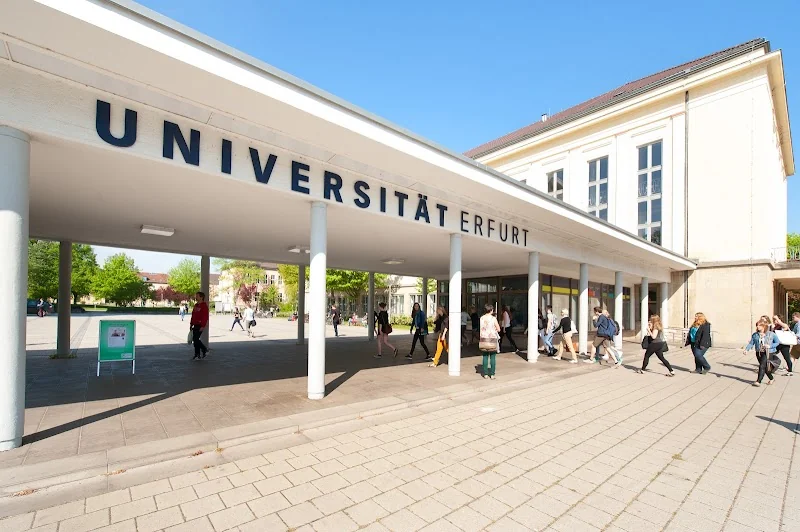
The University of Erfurt is a place where history and the present are remarkably close together. Those looking for a university location that combines scientific tradition, a clear profile, and easily accessible campus life will quickly come across this university in the north of the Thuringian state capital. The campus on Nordhäuser Straße appears modern and clear, while the history of the university reminds us of its roots in the Middle Ages and its re-establishment in the present. This tension makes the University of Erfurt interesting for many inquiries: it's not just about an address or a library, but about study programs, teacher education, psychology, research, career paths, and the unique identity of a reform university. With around 5,700 students, four faculties, the Max Weber College, and a strong focus on humanities, cultural, social, and educational sciences, the university offers a precise academic profile that is well recognizable in the German higher education landscape. ([uni-erfurt.de](https://www.uni-erfurt.de/universitaet/profil/portraet?utm_source=openai))
At the same time, the University of Erfurt presents itself as a very practical university for everyday life. The paths on campus are compact, the connections by tram and car are clearly described, and the university library is also an important argument for all those who want to study, research, and work scientifically in peace. Therefore, terms like address, library, teaching degree, primary school teaching, dual teaching degree, psychology, history, as well as jobs and job offers are searched for particularly frequently. The following description is oriented around these topics: it combines the most important information from the official university website with an SEO structure that remains understandable for students, applicants, parents, researchers, and interested parties. Those searching for the University of Erfurt are usually not just looking for a place to study, but for a concrete decision regarding education, research, and the future. ([uni-erfurt.de](https://www.uni-erfurt.de/universitaet/beratung-service/anreise?utm_source=openai))
Teaching and Study Programs at the University of Erfurt
The search interest surrounding the University of Erfurt is strongly shaped by the study offerings, especially by the terms teaching degree, study programs, primary school teaching, and dual study teaching. The university is known for consistently structuring its teacher education in a bachelor/master format. For primary school teaching, the path begins with a bachelor’s degree and continues with the Master of Education in Primary School. Only after that does the preparatory service follow. This path is clearly described on the official page: the goal is training for the primary school sector, in subjects such as German, mathematics, English, art, music, sports, ethics, or religion. Therefore, those interested in primary school teaching will find at the University of Erfurt not just a single study program, but a systematically structured training model with subject-specific and pedagogical components. ([uni-erfurt.de](https://www.uni-erfurt.de/studium/studienangebot/lehramt/lehramt-grundschule?utm_source=openai))
Additionally, the dual teaching degree for regular schools has also become relevant for many inquiries. The university describes this model as a combination of theoretical courses and accompanied school practice phases, which introduces students early to the realities of the profession. This connection between theory and practice makes the location attractive for future teachers. It is also noticeable that the University of Erfurt repeatedly refers to subject combination possibilities in teacher education, for example, through primary education, German studies, mathematics, or other subjects. Therefore, those searching for university erfurt teaching degree often mean exactly this structure: a clear entry point, a school-specific structure, and an academic environment that prepares for teaching, didactics, and practice. The teacher training is thus not only a study offering but one of the central identity anchors of the university. ([uni-erfurt.de](https://www.uni-erfurt.de/studium/studienangebot/lehramt/lehramt-grundschule?utm_source=openai))
Psychology and the Connection of Learning, Teaching, and Research
The keyword psychology also leads directly to a characteristic profile of the University of Erfurt. The field of psychology there is not designed as a purely classical full degree program, but is closely linked to questions of teaching and learning. According to the official page, psychology at the University of Erfurt primarily deals with individual, social, developmental, and organizational conditions as well as the effects of teaching and learning processes. This focus distinguishes the location from many other universities where psychology is more generally oriented. The university offers a bachelor’s program in Teaching, Learning, and Training Psychology as well as a master’s program in Psychology. This creates a clear bridge between educational research, learning processes, and applied psychology. ([uni-erfurt.de](https://www.uni-erfurt.de/erziehungswissenschaftliche-fakultaet/fakultaet/profil/fachgebiete-und-professuren/psychologie?utm_source=openai))
For seekers, this is particularly valuable from an SEO perspective, as multiple topics are often meant simultaneously: those searching for university erfurt psychology often want to know if there is a specific study program, what the focus looks like, and whether the training is connected to school and learning contexts. The official profiling shows exactly that: psychology at the university works closely with the Center for Teaching, Learning, and Educational Research and the Erfurt School of Education. This fits the overarching self-understanding of the university, which closely links education, school, and scientific reflection. This profile is also interesting for students who later want to work in educational consulting, training contexts, or research-related fields. It is not psychology at the edge of the campus, but a central component of the university's overall concept. ([uni-erfurt.de](https://www.uni-erfurt.de/erziehungswissenschaftliche-fakultaet/fakultaet/profil/fachgebiete-und-professuren/psychologie?utm_source=openai))
Address, Arrival, and Free Parking on Campus
Those searching for the address of the University of Erfurt receive a very clear answer: the campus is located at Nordhäuser Straße 63 in 99089 Erfurt. This address appears multiple times on the official information pages, including arrival, imprint, and other contact information. For route planning, it is also important that the university has a good tram connection. According to official arrival information, tram lines 3 towards Europaplatz and 6 towards Rieth run from the train station; the main entrance of the university is directly opposite the university stop. This makes the location particularly easily accessible for students, staff, and guests. Those arriving by car also receive precise orientation: for the navigation system, the address An der Parkharfe should be entered instead of the campus address. ([uni-erfurt.de](https://www.uni-erfurt.de/universitaet/beratung-service/anreise?utm_source=openai))
When it comes to parking, the university distinguishes between visitor parking and regular campus areas. Behind the premises, there is a visitor parking lot where, according to the official arrival page, sufficient free parking spaces are available. On the campus itself, there are additionally marked parking spaces that may only be used with parking authorization. Thus, the parking concept is clearly regulated, but at the same time uncomplicated for visitors. For many inquiries regarding parking, parking lot, or arrival, this information is crucial as it solves a real everyday hurdle. The note that the university uses additional properties outside the main campus is also practically relevant, for example, for subject areas located at other addresses in Erfurt or Gotha. Therefore, those planning an appointment, consultation, or university visit benefit from the clear official directions and good signage towards the center, main clinic, and university. ([uni-erfurt.de](https://www.uni-erfurt.de/universitaet/beratung-service/anreise?utm_source=openai))
University Library, Learning Spaces, and Opening Hours
The university library is one of the most important places at the University of Erfurt and a central search topic for all those looking for library, study spaces, or workrooms. The library sees itself as a service facility for study, teaching, and research and offers much more than just bookshelves. Officially, it includes Discovery, online catalog, library account, acquisition suggestions, learning videos, room reservations, group study rooms, carrels, and a scanning service, among others. Those who regularly work scientifically will find here a well-structured infrastructure for research, group work, and individual learning phases. Particularly noteworthy is the size of the reading room, which, according to the library page, forms the largest publicly accessible area of the building and encompasses the entire structure. ([uni-erfurt.de](https://www.uni-erfurt.de/bibliothek/?utm_source=openai))
The usage areas are also interesting for seekers as they answer specific questions: Where can you work in peace? Where are there group rooms? Where can you reserve for a bachelor’s or master’s thesis for a longer period? The library offers text book collection, course bibliographies, group study rooms, carrels, lockers, a family room, and a multimedia area with PCs and technical devices. For students with written assignments, it is particularly important that carrels for theses can be booked for an extended period and that work cabins and group rooms can be reserved with login. The current opening hours are very generous: Monday to Friday from 9 am to 10 pm, Saturday from 10 am to 6 pm, and Sunday from 1 pm to 6 pm. Thus, the library is not only a lending point but a real learning and gathering place on campus. ([uni-erfurt.de](https://www.uni-erfurt.de/bibliothek/ueber-die-ub/kontakt/oeffnungszeiten?utm_source=openai))
History, Foundation, and Current Profile
The history of the University of Erfurt is one of the strongest reasons why the location is known far beyond Thuringia. The university officially refers to a founding privilege from 1379 and therefore describes itself as the oldest university in present-day Germany. At the same time, the medieval university was closed in 1816 and only re-established in 1994. This double chronology makes the university so special: it is historically very old and institutionally very young at the same time. This is exactly why the frequently used self-description as one of the oldest and youngest universities in Germany fits. In the cityscape, this coexistence of past and present is particularly evident in the historic main building Collegium Maius in the old town and the modern campus on Nordhäuser Straße. For many visitors, this is not just a detail but an essential part of the Erfurt university feeling. ([uni-erfurt.de](https://www.uni-erfurt.de/universitaet/profil/geschichte?utm_source=openai))
The current profile of the university is closely linked to its re-establishment as a reform university. According to the official portrait page, since 1994 it has established itself with a clear cultural and social science profile and focuses on interdisciplinarity, bachelor and master structures, as well as on emphases in religion, humanities and cultural sciences, society, and teacher education. This is complemented by four faculties, the Max Weber College for cultural and social science studies, and the research structures in Gotha. The library's history also shows this development: the university library was already established in 1993 before the re-establishment, the new building was laid in 1998 and occupied in 2000. Since 1999, the Gotha Research Library has been closely associated with the university. Therefore, those who find the University of Erfurt through history or foundation encounter a university that consciously works with tradition while having created a modern research and study landscape. ([uni-erfurt.de](https://www.uni-erfurt.de/universitaet/profil/portraet?utm_source=openai))
Job Offers, Jobs, and Study and Teaching
The topic of jobs also plays an important role at the University of Erfurt, as many seekers not only want to study but also work there. For students and graduates, there is a job board through the student council with JobTeaser. There, part-time jobs, internships, student jobs, theses, and other positions are offered. The use is free of charge and is expressly aimed at students of the University of Erfurt. Additionally, the university offers its own job offers for research, teaching, and administration. This covers both short-term part-time jobs and academic and administrative career paths. This distinction is particularly important for inquiries such as job offers, jobs, or studying and working, as it addresses different target groups. ([uni-erfurt.de](https://www.uni-erfurt.de/stura/projekte-und-veranstaltungen/job-boerse/jobboerse?utm_source=openai))
The overarching motive behind this is the university's self-understanding as a modern employer and learning environment. On its official career page, it describes itself as an open and versatile university that emphasizes diversity and equality and publishes current positions for both scientific and administrative tasks. For students, the JobTeaser portal is particularly attractive because it not only offers positions but also events, application information, and career guidance. Thus, the University of Erfurt connects study and teaching with concrete pathways into the job market. Therefore, those searching for university erfurt job offers often mean not only classic job postings but also the question of how to intelligently link a study, practical phases, and the entry into the profession. This intersection is one of the great advantages of the university: it is not only a place of learning but also a place where the transition into the profession is actively supported. ([uni-erfurt.de](https://www.uni-erfurt.de/en/university/working-at-the-university/job-offers?utm_source=openai))
Sources:
- History of the University of Erfurt ([uni-erfurt.de](https://www.uni-erfurt.de/universitaet/profil/geschichte?utm_source=openai))
- Portrait of the University of Erfurt ([uni-erfurt.de](https://www.uni-erfurt.de/universitaet/profil/portraet?utm_source=openai))
- Arrival at the University of Erfurt and Parking ([uni-erfurt.de](https://www.uni-erfurt.de/universitaet/beratung-service/anreise?utm_source=openai))
- University Library Erfurt: Offers and Opening Hours ([uni-erfurt.de](https://www.uni-erfurt.de/bibliothek/?utm_source=openai))
- Teaching at the University of Erfurt ([uni-erfurt.de](https://www.uni-erfurt.de/studium/studienangebot/lehramt/lehramt-grundschule?utm_source=openai))
- Field of Psychology at the University of Erfurt ([uni-erfurt.de](https://www.uni-erfurt.de/erziehungswissenschaftliche-fakultaet/fakultaet/profil/fachgebiete-und-professuren/psychologie?utm_source=openai))
- Job Board and Job Offers of the University of Erfurt ([uni-erfurt.de](https://www.uni-erfurt.de/stura/projekte-und-veranstaltungen/job-boerse/jobboerse?utm_source=openai))
Mehr anzeigenWeniger anzeigen
University of Erfurt | Teaching & Study Programs
The University of Erfurt is a place where history and the present are remarkably close together. Those looking for a university location that combines scientific tradition, a clear profile, and easily accessible campus life will quickly come across this university in the north of the Thuringian state capital. The campus on Nordhäuser Straße appears modern and clear, while the history of the university reminds us of its roots in the Middle Ages and its re-establishment in the present. This tension makes the University of Erfurt interesting for many inquiries: it's not just about an address or a library, but about study programs, teacher education, psychology, research, career paths, and the unique identity of a reform university. With around 5,700 students, four faculties, the Max Weber College, and a strong focus on humanities, cultural, social, and educational sciences, the university offers a precise academic profile that is well recognizable in the German higher education landscape. ([uni-erfurt.de](https://www.uni-erfurt.de/universitaet/profil/portraet?utm_source=openai))
At the same time, the University of Erfurt presents itself as a very practical university for everyday life. The paths on campus are compact, the connections by tram and car are clearly described, and the university library is also an important argument for all those who want to study, research, and work scientifically in peace. Therefore, terms like address, library, teaching degree, primary school teaching, dual teaching degree, psychology, history, as well as jobs and job offers are searched for particularly frequently. The following description is oriented around these topics: it combines the most important information from the official university website with an SEO structure that remains understandable for students, applicants, parents, researchers, and interested parties. Those searching for the University of Erfurt are usually not just looking for a place to study, but for a concrete decision regarding education, research, and the future. ([uni-erfurt.de](https://www.uni-erfurt.de/universitaet/beratung-service/anreise?utm_source=openai))
Teaching and Study Programs at the University of Erfurt
The search interest surrounding the University of Erfurt is strongly shaped by the study offerings, especially by the terms teaching degree, study programs, primary school teaching, and dual study teaching. The university is known for consistently structuring its teacher education in a bachelor/master format. For primary school teaching, the path begins with a bachelor’s degree and continues with the Master of Education in Primary School. Only after that does the preparatory service follow. This path is clearly described on the official page: the goal is training for the primary school sector, in subjects such as German, mathematics, English, art, music, sports, ethics, or religion. Therefore, those interested in primary school teaching will find at the University of Erfurt not just a single study program, but a systematically structured training model with subject-specific and pedagogical components. ([uni-erfurt.de](https://www.uni-erfurt.de/studium/studienangebot/lehramt/lehramt-grundschule?utm_source=openai))
Additionally, the dual teaching degree for regular schools has also become relevant for many inquiries. The university describes this model as a combination of theoretical courses and accompanied school practice phases, which introduces students early to the realities of the profession. This connection between theory and practice makes the location attractive for future teachers. It is also noticeable that the University of Erfurt repeatedly refers to subject combination possibilities in teacher education, for example, through primary education, German studies, mathematics, or other subjects. Therefore, those searching for university erfurt teaching degree often mean exactly this structure: a clear entry point, a school-specific structure, and an academic environment that prepares for teaching, didactics, and practice. The teacher training is thus not only a study offering but one of the central identity anchors of the university. ([uni-erfurt.de](https://www.uni-erfurt.de/studium/studienangebot/lehramt/lehramt-grundschule?utm_source=openai))
Psychology and the Connection of Learning, Teaching, and Research
The keyword psychology also leads directly to a characteristic profile of the University of Erfurt. The field of psychology there is not designed as a purely classical full degree program, but is closely linked to questions of teaching and learning. According to the official page, psychology at the University of Erfurt primarily deals with individual, social, developmental, and organizational conditions as well as the effects of teaching and learning processes. This focus distinguishes the location from many other universities where psychology is more generally oriented. The university offers a bachelor’s program in Teaching, Learning, and Training Psychology as well as a master’s program in Psychology. This creates a clear bridge between educational research, learning processes, and applied psychology. ([uni-erfurt.de](https://www.uni-erfurt.de/erziehungswissenschaftliche-fakultaet/fakultaet/profil/fachgebiete-und-professuren/psychologie?utm_source=openai))
For seekers, this is particularly valuable from an SEO perspective, as multiple topics are often meant simultaneously: those searching for university erfurt psychology often want to know if there is a specific study program, what the focus looks like, and whether the training is connected to school and learning contexts. The official profiling shows exactly that: psychology at the university works closely with the Center for Teaching, Learning, and Educational Research and the Erfurt School of Education. This fits the overarching self-understanding of the university, which closely links education, school, and scientific reflection. This profile is also interesting for students who later want to work in educational consulting, training contexts, or research-related fields. It is not psychology at the edge of the campus, but a central component of the university's overall concept. ([uni-erfurt.de](https://www.uni-erfurt.de/erziehungswissenschaftliche-fakultaet/fakultaet/profil/fachgebiete-und-professuren/psychologie?utm_source=openai))
Address, Arrival, and Free Parking on Campus
Those searching for the address of the University of Erfurt receive a very clear answer: the campus is located at Nordhäuser Straße 63 in 99089 Erfurt. This address appears multiple times on the official information pages, including arrival, imprint, and other contact information. For route planning, it is also important that the university has a good tram connection. According to official arrival information, tram lines 3 towards Europaplatz and 6 towards Rieth run from the train station; the main entrance of the university is directly opposite the university stop. This makes the location particularly easily accessible for students, staff, and guests. Those arriving by car also receive precise orientation: for the navigation system, the address An der Parkharfe should be entered instead of the campus address. ([uni-erfurt.de](https://www.uni-erfurt.de/universitaet/beratung-service/anreise?utm_source=openai))
When it comes to parking, the university distinguishes between visitor parking and regular campus areas. Behind the premises, there is a visitor parking lot where, according to the official arrival page, sufficient free parking spaces are available. On the campus itself, there are additionally marked parking spaces that may only be used with parking authorization. Thus, the parking concept is clearly regulated, but at the same time uncomplicated for visitors. For many inquiries regarding parking, parking lot, or arrival, this information is crucial as it solves a real everyday hurdle. The note that the university uses additional properties outside the main campus is also practically relevant, for example, for subject areas located at other addresses in Erfurt or Gotha. Therefore, those planning an appointment, consultation, or university visit benefit from the clear official directions and good signage towards the center, main clinic, and university. ([uni-erfurt.de](https://www.uni-erfurt.de/universitaet/beratung-service/anreise?utm_source=openai))
University Library, Learning Spaces, and Opening Hours
The university library is one of the most important places at the University of Erfurt and a central search topic for all those looking for library, study spaces, or workrooms. The library sees itself as a service facility for study, teaching, and research and offers much more than just bookshelves. Officially, it includes Discovery, online catalog, library account, acquisition suggestions, learning videos, room reservations, group study rooms, carrels, and a scanning service, among others. Those who regularly work scientifically will find here a well-structured infrastructure for research, group work, and individual learning phases. Particularly noteworthy is the size of the reading room, which, according to the library page, forms the largest publicly accessible area of the building and encompasses the entire structure. ([uni-erfurt.de](https://www.uni-erfurt.de/bibliothek/?utm_source=openai))
The usage areas are also interesting for seekers as they answer specific questions: Where can you work in peace? Where are there group rooms? Where can you reserve for a bachelor’s or master’s thesis for a longer period? The library offers text book collection, course bibliographies, group study rooms, carrels, lockers, a family room, and a multimedia area with PCs and technical devices. For students with written assignments, it is particularly important that carrels for theses can be booked for an extended period and that work cabins and group rooms can be reserved with login. The current opening hours are very generous: Monday to Friday from 9 am to 10 pm, Saturday from 10 am to 6 pm, and Sunday from 1 pm to 6 pm. Thus, the library is not only a lending point but a real learning and gathering place on campus. ([uni-erfurt.de](https://www.uni-erfurt.de/bibliothek/ueber-die-ub/kontakt/oeffnungszeiten?utm_source=openai))
History, Foundation, and Current Profile
The history of the University of Erfurt is one of the strongest reasons why the location is known far beyond Thuringia. The university officially refers to a founding privilege from 1379 and therefore describes itself as the oldest university in present-day Germany. At the same time, the medieval university was closed in 1816 and only re-established in 1994. This double chronology makes the university so special: it is historically very old and institutionally very young at the same time. This is exactly why the frequently used self-description as one of the oldest and youngest universities in Germany fits. In the cityscape, this coexistence of past and present is particularly evident in the historic main building Collegium Maius in the old town and the modern campus on Nordhäuser Straße. For many visitors, this is not just a detail but an essential part of the Erfurt university feeling. ([uni-erfurt.de](https://www.uni-erfurt.de/universitaet/profil/geschichte?utm_source=openai))
The current profile of the university is closely linked to its re-establishment as a reform university. According to the official portrait page, since 1994 it has established itself with a clear cultural and social science profile and focuses on interdisciplinarity, bachelor and master structures, as well as on emphases in religion, humanities and cultural sciences, society, and teacher education. This is complemented by four faculties, the Max Weber College for cultural and social science studies, and the research structures in Gotha. The library's history also shows this development: the university library was already established in 1993 before the re-establishment, the new building was laid in 1998 and occupied in 2000. Since 1999, the Gotha Research Library has been closely associated with the university. Therefore, those who find the University of Erfurt through history or foundation encounter a university that consciously works with tradition while having created a modern research and study landscape. ([uni-erfurt.de](https://www.uni-erfurt.de/universitaet/profil/portraet?utm_source=openai))
Job Offers, Jobs, and Study and Teaching
The topic of jobs also plays an important role at the University of Erfurt, as many seekers not only want to study but also work there. For students and graduates, there is a job board through the student council with JobTeaser. There, part-time jobs, internships, student jobs, theses, and other positions are offered. The use is free of charge and is expressly aimed at students of the University of Erfurt. Additionally, the university offers its own job offers for research, teaching, and administration. This covers both short-term part-time jobs and academic and administrative career paths. This distinction is particularly important for inquiries such as job offers, jobs, or studying and working, as it addresses different target groups. ([uni-erfurt.de](https://www.uni-erfurt.de/stura/projekte-und-veranstaltungen/job-boerse/jobboerse?utm_source=openai))
The overarching motive behind this is the university's self-understanding as a modern employer and learning environment. On its official career page, it describes itself as an open and versatile university that emphasizes diversity and equality and publishes current positions for both scientific and administrative tasks. For students, the JobTeaser portal is particularly attractive because it not only offers positions but also events, application information, and career guidance. Thus, the University of Erfurt connects study and teaching with concrete pathways into the job market. Therefore, those searching for university erfurt job offers often mean not only classic job postings but also the question of how to intelligently link a study, practical phases, and the entry into the profession. This intersection is one of the great advantages of the university: it is not only a place of learning but also a place where the transition into the profession is actively supported. ([uni-erfurt.de](https://www.uni-erfurt.de/en/university/working-at-the-university/job-offers?utm_source=openai))
Sources:
- History of the University of Erfurt ([uni-erfurt.de](https://www.uni-erfurt.de/universitaet/profil/geschichte?utm_source=openai))
- Portrait of the University of Erfurt ([uni-erfurt.de](https://www.uni-erfurt.de/universitaet/profil/portraet?utm_source=openai))
- Arrival at the University of Erfurt and Parking ([uni-erfurt.de](https://www.uni-erfurt.de/universitaet/beratung-service/anreise?utm_source=openai))
- University Library Erfurt: Offers and Opening Hours ([uni-erfurt.de](https://www.uni-erfurt.de/bibliothek/?utm_source=openai))
- Teaching at the University of Erfurt ([uni-erfurt.de](https://www.uni-erfurt.de/studium/studienangebot/lehramt/lehramt-grundschule?utm_source=openai))
- Field of Psychology at the University of Erfurt ([uni-erfurt.de](https://www.uni-erfurt.de/erziehungswissenschaftliche-fakultaet/fakultaet/profil/fachgebiete-und-professuren/psychologie?utm_source=openai))
- Job Board and Job Offers of the University of Erfurt ([uni-erfurt.de](https://www.uni-erfurt.de/stura/projekte-und-veranstaltungen/job-boerse/jobboerse?utm_source=openai))
University of Erfurt | Teaching & Study Programs
The University of Erfurt is a place where history and the present are remarkably close together. Those looking for a university location that combines scientific tradition, a clear profile, and easily accessible campus life will quickly come across this university in the north of the Thuringian state capital. The campus on Nordhäuser Straße appears modern and clear, while the history of the university reminds us of its roots in the Middle Ages and its re-establishment in the present. This tension makes the University of Erfurt interesting for many inquiries: it's not just about an address or a library, but about study programs, teacher education, psychology, research, career paths, and the unique identity of a reform university. With around 5,700 students, four faculties, the Max Weber College, and a strong focus on humanities, cultural, social, and educational sciences, the university offers a precise academic profile that is well recognizable in the German higher education landscape. ([uni-erfurt.de](https://www.uni-erfurt.de/universitaet/profil/portraet?utm_source=openai))
At the same time, the University of Erfurt presents itself as a very practical university for everyday life. The paths on campus are compact, the connections by tram and car are clearly described, and the university library is also an important argument for all those who want to study, research, and work scientifically in peace. Therefore, terms like address, library, teaching degree, primary school teaching, dual teaching degree, psychology, history, as well as jobs and job offers are searched for particularly frequently. The following description is oriented around these topics: it combines the most important information from the official university website with an SEO structure that remains understandable for students, applicants, parents, researchers, and interested parties. Those searching for the University of Erfurt are usually not just looking for a place to study, but for a concrete decision regarding education, research, and the future. ([uni-erfurt.de](https://www.uni-erfurt.de/universitaet/beratung-service/anreise?utm_source=openai))
Teaching and Study Programs at the University of Erfurt
The search interest surrounding the University of Erfurt is strongly shaped by the study offerings, especially by the terms teaching degree, study programs, primary school teaching, and dual study teaching. The university is known for consistently structuring its teacher education in a bachelor/master format. For primary school teaching, the path begins with a bachelor’s degree and continues with the Master of Education in Primary School. Only after that does the preparatory service follow. This path is clearly described on the official page: the goal is training for the primary school sector, in subjects such as German, mathematics, English, art, music, sports, ethics, or religion. Therefore, those interested in primary school teaching will find at the University of Erfurt not just a single study program, but a systematically structured training model with subject-specific and pedagogical components. ([uni-erfurt.de](https://www.uni-erfurt.de/studium/studienangebot/lehramt/lehramt-grundschule?utm_source=openai))
Additionally, the dual teaching degree for regular schools has also become relevant for many inquiries. The university describes this model as a combination of theoretical courses and accompanied school practice phases, which introduces students early to the realities of the profession. This connection between theory and practice makes the location attractive for future teachers. It is also noticeable that the University of Erfurt repeatedly refers to subject combination possibilities in teacher education, for example, through primary education, German studies, mathematics, or other subjects. Therefore, those searching for university erfurt teaching degree often mean exactly this structure: a clear entry point, a school-specific structure, and an academic environment that prepares for teaching, didactics, and practice. The teacher training is thus not only a study offering but one of the central identity anchors of the university. ([uni-erfurt.de](https://www.uni-erfurt.de/studium/studienangebot/lehramt/lehramt-grundschule?utm_source=openai))
Psychology and the Connection of Learning, Teaching, and Research
The keyword psychology also leads directly to a characteristic profile of the University of Erfurt. The field of psychology there is not designed as a purely classical full degree program, but is closely linked to questions of teaching and learning. According to the official page, psychology at the University of Erfurt primarily deals with individual, social, developmental, and organizational conditions as well as the effects of teaching and learning processes. This focus distinguishes the location from many other universities where psychology is more generally oriented. The university offers a bachelor’s program in Teaching, Learning, and Training Psychology as well as a master’s program in Psychology. This creates a clear bridge between educational research, learning processes, and applied psychology. ([uni-erfurt.de](https://www.uni-erfurt.de/erziehungswissenschaftliche-fakultaet/fakultaet/profil/fachgebiete-und-professuren/psychologie?utm_source=openai))
For seekers, this is particularly valuable from an SEO perspective, as multiple topics are often meant simultaneously: those searching for university erfurt psychology often want to know if there is a specific study program, what the focus looks like, and whether the training is connected to school and learning contexts. The official profiling shows exactly that: psychology at the university works closely with the Center for Teaching, Learning, and Educational Research and the Erfurt School of Education. This fits the overarching self-understanding of the university, which closely links education, school, and scientific reflection. This profile is also interesting for students who later want to work in educational consulting, training contexts, or research-related fields. It is not psychology at the edge of the campus, but a central component of the university's overall concept. ([uni-erfurt.de](https://www.uni-erfurt.de/erziehungswissenschaftliche-fakultaet/fakultaet/profil/fachgebiete-und-professuren/psychologie?utm_source=openai))
Address, Arrival, and Free Parking on Campus
Those searching for the address of the University of Erfurt receive a very clear answer: the campus is located at Nordhäuser Straße 63 in 99089 Erfurt. This address appears multiple times on the official information pages, including arrival, imprint, and other contact information. For route planning, it is also important that the university has a good tram connection. According to official arrival information, tram lines 3 towards Europaplatz and 6 towards Rieth run from the train station; the main entrance of the university is directly opposite the university stop. This makes the location particularly easily accessible for students, staff, and guests. Those arriving by car also receive precise orientation: for the navigation system, the address An der Parkharfe should be entered instead of the campus address. ([uni-erfurt.de](https://www.uni-erfurt.de/universitaet/beratung-service/anreise?utm_source=openai))
When it comes to parking, the university distinguishes between visitor parking and regular campus areas. Behind the premises, there is a visitor parking lot where, according to the official arrival page, sufficient free parking spaces are available. On the campus itself, there are additionally marked parking spaces that may only be used with parking authorization. Thus, the parking concept is clearly regulated, but at the same time uncomplicated for visitors. For many inquiries regarding parking, parking lot, or arrival, this information is crucial as it solves a real everyday hurdle. The note that the university uses additional properties outside the main campus is also practically relevant, for example, for subject areas located at other addresses in Erfurt or Gotha. Therefore, those planning an appointment, consultation, or university visit benefit from the clear official directions and good signage towards the center, main clinic, and university. ([uni-erfurt.de](https://www.uni-erfurt.de/universitaet/beratung-service/anreise?utm_source=openai))
University Library, Learning Spaces, and Opening Hours
The university library is one of the most important places at the University of Erfurt and a central search topic for all those looking for library, study spaces, or workrooms. The library sees itself as a service facility for study, teaching, and research and offers much more than just bookshelves. Officially, it includes Discovery, online catalog, library account, acquisition suggestions, learning videos, room reservations, group study rooms, carrels, and a scanning service, among others. Those who regularly work scientifically will find here a well-structured infrastructure for research, group work, and individual learning phases. Particularly noteworthy is the size of the reading room, which, according to the library page, forms the largest publicly accessible area of the building and encompasses the entire structure. ([uni-erfurt.de](https://www.uni-erfurt.de/bibliothek/?utm_source=openai))
The usage areas are also interesting for seekers as they answer specific questions: Where can you work in peace? Where are there group rooms? Where can you reserve for a bachelor’s or master’s thesis for a longer period? The library offers text book collection, course bibliographies, group study rooms, carrels, lockers, a family room, and a multimedia area with PCs and technical devices. For students with written assignments, it is particularly important that carrels for theses can be booked for an extended period and that work cabins and group rooms can be reserved with login. The current opening hours are very generous: Monday to Friday from 9 am to 10 pm, Saturday from 10 am to 6 pm, and Sunday from 1 pm to 6 pm. Thus, the library is not only a lending point but a real learning and gathering place on campus. ([uni-erfurt.de](https://www.uni-erfurt.de/bibliothek/ueber-die-ub/kontakt/oeffnungszeiten?utm_source=openai))
History, Foundation, and Current Profile
The history of the University of Erfurt is one of the strongest reasons why the location is known far beyond Thuringia. The university officially refers to a founding privilege from 1379 and therefore describes itself as the oldest university in present-day Germany. At the same time, the medieval university was closed in 1816 and only re-established in 1994. This double chronology makes the university so special: it is historically very old and institutionally very young at the same time. This is exactly why the frequently used self-description as one of the oldest and youngest universities in Germany fits. In the cityscape, this coexistence of past and present is particularly evident in the historic main building Collegium Maius in the old town and the modern campus on Nordhäuser Straße. For many visitors, this is not just a detail but an essential part of the Erfurt university feeling. ([uni-erfurt.de](https://www.uni-erfurt.de/universitaet/profil/geschichte?utm_source=openai))
The current profile of the university is closely linked to its re-establishment as a reform university. According to the official portrait page, since 1994 it has established itself with a clear cultural and social science profile and focuses on interdisciplinarity, bachelor and master structures, as well as on emphases in religion, humanities and cultural sciences, society, and teacher education. This is complemented by four faculties, the Max Weber College for cultural and social science studies, and the research structures in Gotha. The library's history also shows this development: the university library was already established in 1993 before the re-establishment, the new building was laid in 1998 and occupied in 2000. Since 1999, the Gotha Research Library has been closely associated with the university. Therefore, those who find the University of Erfurt through history or foundation encounter a university that consciously works with tradition while having created a modern research and study landscape. ([uni-erfurt.de](https://www.uni-erfurt.de/universitaet/profil/portraet?utm_source=openai))
Job Offers, Jobs, and Study and Teaching
The topic of jobs also plays an important role at the University of Erfurt, as many seekers not only want to study but also work there. For students and graduates, there is a job board through the student council with JobTeaser. There, part-time jobs, internships, student jobs, theses, and other positions are offered. The use is free of charge and is expressly aimed at students of the University of Erfurt. Additionally, the university offers its own job offers for research, teaching, and administration. This covers both short-term part-time jobs and academic and administrative career paths. This distinction is particularly important for inquiries such as job offers, jobs, or studying and working, as it addresses different target groups. ([uni-erfurt.de](https://www.uni-erfurt.de/stura/projekte-und-veranstaltungen/job-boerse/jobboerse?utm_source=openai))
The overarching motive behind this is the university's self-understanding as a modern employer and learning environment. On its official career page, it describes itself as an open and versatile university that emphasizes diversity and equality and publishes current positions for both scientific and administrative tasks. For students, the JobTeaser portal is particularly attractive because it not only offers positions but also events, application information, and career guidance. Thus, the University of Erfurt connects study and teaching with concrete pathways into the job market. Therefore, those searching for university erfurt job offers often mean not only classic job postings but also the question of how to intelligently link a study, practical phases, and the entry into the profession. This intersection is one of the great advantages of the university: it is not only a place of learning but also a place where the transition into the profession is actively supported. ([uni-erfurt.de](https://www.uni-erfurt.de/en/university/working-at-the-university/job-offers?utm_source=openai))
Sources:
- History of the University of Erfurt ([uni-erfurt.de](https://www.uni-erfurt.de/universitaet/profil/geschichte?utm_source=openai))
- Portrait of the University of Erfurt ([uni-erfurt.de](https://www.uni-erfurt.de/universitaet/profil/portraet?utm_source=openai))
- Arrival at the University of Erfurt and Parking ([uni-erfurt.de](https://www.uni-erfurt.de/universitaet/beratung-service/anreise?utm_source=openai))
- University Library Erfurt: Offers and Opening Hours ([uni-erfurt.de](https://www.uni-erfurt.de/bibliothek/?utm_source=openai))
- Teaching at the University of Erfurt ([uni-erfurt.de](https://www.uni-erfurt.de/studium/studienangebot/lehramt/lehramt-grundschule?utm_source=openai))
- Field of Psychology at the University of Erfurt ([uni-erfurt.de](https://www.uni-erfurt.de/erziehungswissenschaftliche-fakultaet/fakultaet/profil/fachgebiete-und-professuren/psychologie?utm_source=openai))
- Job Board and Job Offers of the University of Erfurt ([uni-erfurt.de](https://www.uni-erfurt.de/stura/projekte-und-veranstaltungen/job-boerse/jobboerse?utm_source=openai))
Upcoming Events
No events found
Frequently Asked Questions
Reviews
Tahsin Tabish Khan
30. March 2024
Nestled in the heart of Erfurt, Germany, the University of Erfurt stands as a beacon of academic excellence and community vibrancy. As a resident of one of their dormitories, I've had the privilege of experiencing firsthand the enriching environment that this esteemed institution offers. From the moment I stepped foot onto the campus grounds, I was struck by the palpable energy and sense of purpose that permeates the air. The university boasts a diverse and inclusive community, where students from all walks of life come together to pursue their academic passions. The campus itself is a sight to behold, with modern facilities and green spaces that provide the perfect backdrop for learning and leisure. From state-of-the-art lecture halls to cozy study nooks, the university offers a variety of spaces tailored to meet the diverse needs of its student body. Moreover, the campus is conveniently located within walking distance of the city center, allowing students to easily access a wealth of cultural and recreational activities. As a resident of one of the university's dormitories, I have found the accommodation to be comfortable, safe, and conducive to both studying and socializing. The dormitory staff are friendly and attentive, creating a supportive living environment that feels like a home away from home.
Aamir Hussain Shahani
30. May 2021
Went there to participate in an international workshop. Environment and facilities in the university were cool but we didn't like most of the foods of cafeteria. In attached picture there are Participants and team members of the educational workshop. These members belong to Germany, Pakistan, Arminia, America, Iran, Russia, Geogria and some other countries.
Jawaria Abbasi
22. October 2025
Beautiful place. It gives you all the feels of Victorian era.
Sharon Gitau
31. August 2023
Long processing time for applications, very kind during selection interviews but low chances of admission. Please make sure to have applications with many other universities as they give rejection letters when deadlines have passed. I met the admission requirements and still missed a spot so for international applicants, you must be really good or lucky to get admission.
Rebin RAJAN VARGHESE
3. January 2022
A great environment for studies and all cultural activities.