
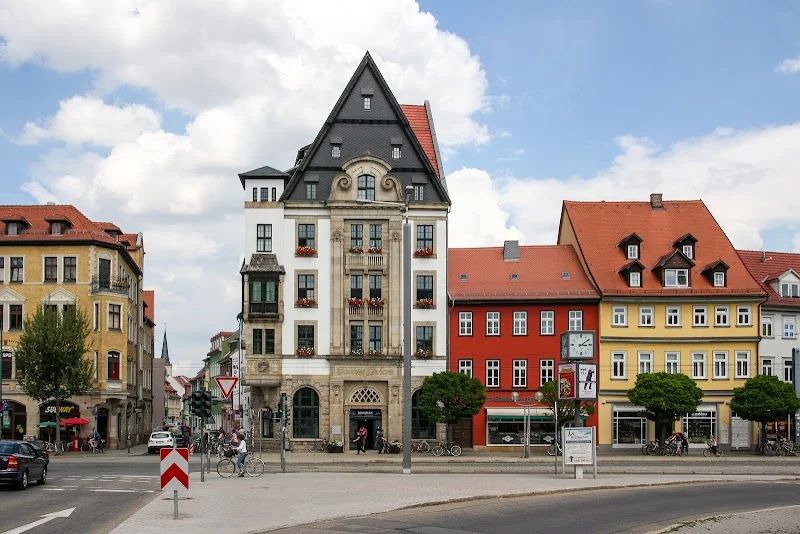
Dompl. 1, Erfurt-Altstadt
Dompl. 1, 99084 Erfurt, Germany
City and Regional Library Erfurt | Opening Hours & Catalog
The City and Regional Library Erfurt is more than just a place to borrow books at Domplatz. It is a central meeting point for learning, reading, working, and digital research, embedded in the historic city center and closely connected to the everyday life of many Erfurt residents. As the largest public library in the Free State of Thuringia, it combines traditional library work with modern services, clear opening hours, spacious work areas, and a diverse range of events. The main library at Domplatz, the children's and youth library on Marktstraße, and other locations in the network make access to media and knowledge easy and accessible for many target groups. Those looking for opening hours, catalog, OPAC, parking, or special offers will find a library that consciously understands itself as an open, vibrant place. It is centrally located, easily accessible, and offers suitable spaces, media, and services for different age groups. ([erfurt.de](https://www.erfurt.de/bibliothek?utm_source=openai))
Opening Hours of the City and Regional Library Erfurt
For many visitors, the first question is quite practical: When is the City and Regional Library Erfurt open? The answer is clear and user-friendly. The main library at Domplatz and the children's and youth library are open Monday to Friday from 10:00 AM to 6:00 PM, and Saturday from 10:00 AM to 1:00 PM. These times are confirmed by the official location page and the press release regarding the extension of opening hours since May 5, 2025, for the central facilities in the city center. This continuous opening on weekdays is a significant advantage for working professionals, students, schoolchildren, and families, as visits are possible without complicated time slots. The CaféThek can also be used longer, making the stay more pleasant and strengthening the library as a place to linger. Those wishing to return media can additionally use the return boxes, which are available Monday to Friday from 7:30 AM, even before regular opening hours. In practice, this means: The library is not a hard-to-access administrative place, but a clearly timed, reliable learning and cultural space that can be easily integrated into everyday life. The facility is closed on Sundays, which is common for a public city library in Germany, but the generous weekday hours and Saturday morning compensate for this very well. This creates a manageable mix of service, tranquility, and reliability. ([erfurt.de](https://www.erfurt.de/ef/de/leben/bildung/sturb/standorte/110068.html))
The opening hours are also relevant because the library consciously understands itself as a low-threshold place. Those who want to quickly return media before work, learn after school, or research specifically on Saturday mornings will find a robust time model at Domplatz. The official communication emphasizes that the extended hours respond to feedback from the public and aim to improve the quality of stay. This is relevant for SEO, but above all important for users: The library wants not only to manage but to be accessible. So, those wondering if a visit is worthwhile can read the answer from the opening hours. They are long enough for focused work, but compact enough to keep the building structured and clear. For many occasions, a short visit after work or a planned Saturday appointment is sufficient. Combined with good transport links and the inner-city location, it becomes a place that does not need to be organized separately but fits into the daily routine. ([erfurt.de](https://www.erfurt.de/ef/de/service/aktuelles/pm/2025/151048.html?utm_source=openai))
Online Catalog, OPAC, and Digital Online Services
If you are looking for the catalog or OPAC of the City and Regional Library Erfurt, you usually want to quickly know whether a specific book, magazine, film, or digital medium is available. That is exactly what the online catalog is for, which is linked directly on the official location page under the section “More on the Internet.” Additionally, the library offers its own page for online services, which can explicitly be used from home or on the go, worldwide and around the clock. This is a significant advantage for everyone who wants to research not only on-site but also keep track of their loans, reservations, or digital content independently of opening hours. With a valid library card, the use of many services is free of charge. This includes, among other things, PressReader for newspapers and magazines, Thuebibnet with over 90,000 e-media, Genios as a press portal, freegal with more than 18 million music tracks, Rosetta Stone for language courses, Brockhaus for learning and knowledge content, and an online portal for classical music. The library thus connects the classic catalog with a broad digital ecosystem that goes far beyond simple book searches. ([erfurt.de](https://www.erfurt.de/ef/de/leben/bildung/sturb/standorte/110068.html))
For the search intentions around “catalog,” “OPAC,” and “online services,” it is also important that the City and Regional Library not only lists media but also structures access to knowledge. Older press releases already show that the electronic catalog is also used for e-books, audio, and video files and that digital media can be directly downloaded to devices. In the current service world, this means: The OPAC is not an isolated inventory mirror but the entrance door to physical and digital holdings alike. So, if you are looking for a title, an author, or a topic, you can not only determine whether something is available but often also take the next step immediately. Additionally, the library understands itself as a strong advisory place and regularly explains digital offerings in events. For example, in 2025, compact information offerings on online services were presented, where users could bring their questions directly. This creates a professional overall picture for seekers: The catalog is not only searchable but part of a service package that brings together media, advice, and digital use. ([erfurt.de](https://www.erfurt.de/ef/de/leben/bildung/sturb/standorte/110068.html))
Even for people who only associate the keyword “opac” or “catalog” with a specific book search, it is worth taking a look at the whole system. The City and Regional Library Erfurt offers not only the main library at Domplatz but also a library network with several branches. This allows for thinking about the library card, research, and use across locations. A library card is valid for all public facilities in the network, which significantly facilitates the search and borrowing process. This is particularly practical for readers who regularly switch between the main library, children's and youth library, and the district libraries. As a result, the OPAC is not just a technical term but the digital core of the entire library use. Once understood, it allows for easier media finding, quicker assessment of offers, and significantly more efficient use of the library. That is why the catalog is one of the strongest search concerns surrounding this location. ([erfurt.de](https://www.erfurt.de/ef/de/leben/bildung/sturb/standorte/index.html))
Directions, Map, and Parking at Domplatz
The City and Regional Library Erfurt is centrally located at Domplatz 1, 99084 Erfurt, right in the old town. This location is one of the library's greatest advantages, as it makes visiting uncomplicated for both locals and guests. You can reach the main library by tram via lines 2, 3, and 6; additionally, the city bus line 90 goes to the Domplatz stop. For drivers, parking is available in the parking garage at Domplatz. The official pages also point out that parking spaces are limited and subject to fees, which is normal for a central city location. So, if you are coming by car, you should plan some buffer time. Often, arriving by public transport is even more pleasant, as the walk from the stop is short, and you can reach Domplatz without searching for parking. This combination of city center location, public transport connection, and parking garage makes the location very practical. ([erfurt.de](https://www.erfurt.de/ef/de/leben/bildung/sturb/standorte/110068.html))
Orientation on-site is also well taken care of. The location page offers a map link, and the main library has a clear building with several floors. All floors are accessible by elevator, with the ExtraThek on the mezzanine being the only exception to this rule. This is an important note for people with mobility impairments, families with strollers, or visitors who want to plan their stay as comfortably as possible. The library's central location also makes it easier to combine with other errands in the old town. Those who are in the city center can combine a library visit with shopping, a walk, or an appointment. The address Domplatz 1 is thus not just a point on the map but a well-integrated stop in everyday life. For SEO users searching for “map,” “directions,” or “parking,” it is particularly relevant: The library is visible, well-connected, and practically easy to reach. ([erfurt.de](https://www.erfurt.de/ef/de/leben/bildung/sturb/standorte/110068.html))
Additionally, the main library is structurally designed for high public traffic. The official location page mentions about 1,200 visitors daily and describes the library as the most visited extracurricular educational and cultural institution. This also explains why the approach is so clearly organized: Such frequency requires reliable pathways, understandable signage, and a location that intuitively unfolds. Those looking for initial orientation photos will find a gallery on the location page, and Erfurt.de also offers a virtual tour of the Domplatz library. This makes it visible before the first visit how the building is structured and what atmosphere awaits. This is a significant advantage for new visitors, as the path does not remain abstract but becomes tangible in advance. ([erfurt.de](https://www.erfurt.de/ef/de/leben/bildung/sturb/standorte/110068.html))
Rooms, Reading Terrace, and Meeting Points in the Building
The strength of the City and Regional Library Erfurt lies not only in its media collection but also in the quality of its spaces. Across three floors, around 90,000 freely accessible media are available, complemented by free Wi-Fi, copiers, printers, book scanners, and numerous workspaces for individuals and groups. This mix of collection and infrastructure makes the main library a true workplace. Those who want to study focused will find quiet spots. Those working together on a project can use group workspaces. Those needing to research, scan, or print have the right tools available. Additionally, the main library does not feel sterile but consciously offers a pleasant stay with the CaféThek, daily newspapers, snacks, and cakes. The place is thus not only functional but also enjoyable. This interplay is crucial for many visitors, as libraries today are no longer defined solely by their collections but also by the experience on-site. ([erfurt.de](https://www.erfurt.de/ef/de/leben/bildung/sturb/standorte/110068.html))
Particularly notable is the ExtraThek on the mezzanine. There, hundreds of board games are available for playing on-site or borrowing home, and groups regularly meet there for communal gaming. This is a strong signal that the library thinks far beyond the classic bookshelf. Additionally, there is a reading terrace on the first floor during the summer months, which further connects the stay with tranquility and atmosphere. For many, this combination of indoor and outdoor space is attractive: concentrate inside, breathe outside. In the same area, the regional studies department with media on Erfurt, North and Central Thuringia, and a specialized department with media on all fields of knowledge are located. Thus, the library covers both local identity and general information needs. On the second floor, thousands of films, audiobooks, music CDs, and scores can also be found. The fireplace room with an electric piano makes the character of the building even more special and shows how broadly the concept of culture is understood here. ([erfurt.de](https://www.erfurt.de/ef/de/leben/bildung/sturb/standorte/110068.html))
The room names themselves are also search-strong and shape the perception of the library: CaféThek, ExtraThek, Reading Terrace, Crime Lounge, Fireplace Room, Student Center, TechnoThek, Gaming Zone, and other meeting points create an image of a library that feels more like an open cultural campus than a quiet archive. This corresponds to the official self-description as an open, non-commercial place and as the “living room of the city.” This is where an important unique selling point lies. The facility invites you to stay longer, orient yourself, and not only take media but also use the space itself. For families, this is interesting because children and young people have their own zones and offers. For students and working professionals, it is attractive because there are reading and workspaces, Wi-Fi, and infrastructure. For culture enthusiasts, the exhibitions, themed rooms, and changing formats provide new reasons to return again and again. ([erfurt.de](https://www.erfurt.de/ef/de/leben/bildung/sturb/service/treffpunkte/index.html?utm_source=openai))
Particularly helpful is the barrier-free structure of the building. The official location page mentions the elevator and the generally good accessibility of the floors. Together with the central location and clear signage, this creates a user-friendly overall picture. So, those searching for photos, images, or an initial impression of the library will find not only visual material but also a clear spatial dramaturgy: ground floor with café and magazines, above that play and reading areas, along with specialized departments and workspaces. This clear order is an advantage for first-time visitors but also for people who come regularly and have their favorite spots in the building. Thus, a place emerges that feels functional, friendly, and also independent. ([erfurt.de](https://www.erfurt.de/ef/de/leben/bildung/sturb/standorte/110068.html))
Events, Media, and Digital Offers for Families and Learners
A key reason why the City and Regional Library Erfurt is so sought after is its events and thematic offerings. The official homepage shows that here not only media are managed, but the house is vibrantly programmed. Examples range from Manga Day to the Night of Libraries to digital consultation hours and thematic actions like the Erfurt Seed Exchange. This mix appeals to different target groups: children and young people, families, hobby gardeners, technology enthusiasts, readers, and people needing digital assistance. The library is thus not just a place to pick up books but a place where knowledge, leisure, and participation come together. This is also in line with the city's self-understanding, as the library should be an open, low-threshold, non-commercial space for all population groups. ([erfurt.de](https://www.erfurt.de/bibliothek?utm_source=openai))
Especially the digital offerings are central to modern library use. The City and Regional Library not only provides e-books, audiobooks, and digital newspapers but also learning, language, and knowledge portals. This is particularly helpful for people who do not want to limit their research to printed media. Through Thuebibnet, PressReader, Genios, freegal, Rosetta Stone, and Brockhaus, a digital offering emerges that combines learning, entertainment, and information. In practice, this means: The library accompanies its visitors even when they are not on-site. That is why the term “online services” is so important for SEO planning. Those searching for the catalog will find not only inventories but also a digital infrastructure that expands the library's everyday operations far beyond the counter. ([erfurt.de](https://www.erfurt.de/ef/de/leben/bildung/sturb/service/onlinedienste/index.html))
Additionally, the library regularly offers formats that combine advice and experience. For digital offerings, there are compact introductions where questions can be clarified directly. For seasonal or thematic topics, events are organized in the buildings, such as in the area of regional studies or targeted offerings for seniors. This shows that the library not only has a collection but actively conveys content. It is thus a cultural actor in the urban space, creating educational access and bringing different generations together. So, those searching for “events” should understand the library not just as a place but as a program. This program is one of the reasons why the institution is so strongly perceived. ([erfurt.de](https://www.erfurt.de/ef/de/service/aktuelles/am/2025/151169.html?utm_source=openai))
The specific focus on young people and families is also clearly visible. The children's and youth library on Marktstraße belongs to the same library network, is publicly accessible, and is supported by the same card structures. This is practical for parents who want to switch between different locations with children and for teenagers who want to combine learning places, comics, media, and digital offers. Overall, this creates a profile that brings together search queries about events, opening hours, photos, reviews, catalog, and offers: Those looking for the City and Regional Library Erfurt are often not just looking for a building but a versatile experience offering. Exactly that is provided here. ([erfurt.de](https://www.erfurt.de/ef/de/leben/bildung/sturb/standorte/index.html))
Management, History, and Profile of the Largest Library in Thuringia
Orientation also includes the question of management. The official contact page lists Mr. Matthias Lange as the acting director or acting head of the City and Regional Library Erfurt. This shows that the library is clearly anchored organizationally and is represented by a named leader. This information is relevant for SEO inquiries such as “management” or “director,” but also practical for anyone with follow-up questions or who wants to better categorize the library as an institution. The main library at Domplatz also provides central services for all branches of the network. Thus, it is not just a single location but the organizational core of the entire structure. The central role also fits the strong visitor frequency and the inner-city significance of the building. ([erfurt.de](https://www.erfurt.de/ef/de/leben/bildung/sturb/standorte/110068.html))
Historically, the library is closely linked to the development of the city. The building at Domplatz has been used as a library location since 1966, and the official location page emphasizes that the main library, with around 1,200 visitors daily, is the most visited extracurricular educational and cultural institution in Erfurt. This is more than just a statistic: it shows how deeply the library is embedded in the everyday life of the city. The official annual report also provides insights into the historical collection. It describes that the historical holdings include media from the 18th century to the modern era, including about 9,000 titles related to Erfurt or printed in Erfurt, a school library from the 19th century with 5,918 books, an extensive collection of horticultural literature, and the Hugo Neumann collection with 3,214 titles. DDR literature and records are also included. These holdings make it clear that the library is not only current but also culturally and historically significant. ([erfurt.de](https://www.erfurt.de/ef/de/leben/bildung/sturb/standorte/110068.html))
The profile of the library becomes particularly interesting: it is simultaneously a contemporary institution and a memory place. On the one hand, it offers free media, Wi-Fi, workspaces, digital services, and event language for different target groups. On the other hand, it preserves historical holdings, regional literature, and thematic collections that go beyond mere lending. This also fits with the connected holdings of the memorial site Topf & Söhne, city archive, and small synagogue, which can be researched via the online catalog. This networking is important because it makes the catalog a larger research tool. Those interested in Erfurt, Thuringia, cultural history, or special topics will find here more than just the usual library holdings. The City and Regional Library thus becomes a place where regional identity is made visible, researchable, and usable. ([erfurt.de](https://www.erfurt.de/ef/de/leben/bildung/sturb/standorte/index.html))
The communicative claim is also high. The library officially sees itself as an open place for all population groups, as a meeting point, communication space, and retreat. This self-description is crucial for perception because it expands the institution from a mere lending point to a public learning and cultural space. In practice, this means: Those visiting the library receive not only media but also an atmosphere that invites them to stay. This applies to quiet learning phases as well as to events, group work, or quick errands. The combination of history, modern equipment, digital offerings, and central location makes the City and Regional Library Erfurt one of the most significant cultural addresses in the city. For search queries regarding photos, reviews, OPAC, parking, or management, it is equally relevant. ([erfurt.de](https://www.erfurt.de/ef/de/leben/bildung/sturb/service/treffpunkte/index.html?utm_source=openai))
So, those who want to understand the library not just as an address but as part of the Erfurt urban space will find here an institution with high everyday relevance and clear cultural identity. The historical depth of the collection, the strong visitor frequency, the central location at Domplatz, the extensive digital services, and the many meeting points in the building make the library a place with rarely dense functionality. This is precisely what is important for seekers: The City and Regional Library Erfurt is not a footnote but a defining public space in the heart of the city. ([erfurt.de](https://www.erfurt.de/ef/de/leben/bildung/sturb/standorte/110068.html))
Sources:
- City and Regional Library Erfurt - Main Library at Domplatz
- City and Regional Library Erfurt - Locations and Opening Hours
- City and Regional Library Erfurt - Online Services
- Erfurt.de - Library Extends Opening Hours from May 2025
- City and Regional Library Erfurt - Meeting Points and Special Offers
- City and Regional Library Erfurt - Annual Report 2015
- Erfurt.de - 3rd Erfurt Seed Exchange
- Erfurt.de - Digital Offers of the Library Presented
- Erfurt.de - Night of Libraries
- Erfurt.de - City and Regional Library Erfurt
Show moreShow less
City and Regional Library Erfurt | Opening Hours & Catalog
The City and Regional Library Erfurt is more than just a place to borrow books at Domplatz. It is a central meeting point for learning, reading, working, and digital research, embedded in the historic city center and closely connected to the everyday life of many Erfurt residents. As the largest public library in the Free State of Thuringia, it combines traditional library work with modern services, clear opening hours, spacious work areas, and a diverse range of events. The main library at Domplatz, the children's and youth library on Marktstraße, and other locations in the network make access to media and knowledge easy and accessible for many target groups. Those looking for opening hours, catalog, OPAC, parking, or special offers will find a library that consciously understands itself as an open, vibrant place. It is centrally located, easily accessible, and offers suitable spaces, media, and services for different age groups. ([erfurt.de](https://www.erfurt.de/bibliothek?utm_source=openai))
Opening Hours of the City and Regional Library Erfurt
For many visitors, the first question is quite practical: When is the City and Regional Library Erfurt open? The answer is clear and user-friendly. The main library at Domplatz and the children's and youth library are open Monday to Friday from 10:00 AM to 6:00 PM, and Saturday from 10:00 AM to 1:00 PM. These times are confirmed by the official location page and the press release regarding the extension of opening hours since May 5, 2025, for the central facilities in the city center. This continuous opening on weekdays is a significant advantage for working professionals, students, schoolchildren, and families, as visits are possible without complicated time slots. The CaféThek can also be used longer, making the stay more pleasant and strengthening the library as a place to linger. Those wishing to return media can additionally use the return boxes, which are available Monday to Friday from 7:30 AM, even before regular opening hours. In practice, this means: The library is not a hard-to-access administrative place, but a clearly timed, reliable learning and cultural space that can be easily integrated into everyday life. The facility is closed on Sundays, which is common for a public city library in Germany, but the generous weekday hours and Saturday morning compensate for this very well. This creates a manageable mix of service, tranquility, and reliability. ([erfurt.de](https://www.erfurt.de/ef/de/leben/bildung/sturb/standorte/110068.html))
The opening hours are also relevant because the library consciously understands itself as a low-threshold place. Those who want to quickly return media before work, learn after school, or research specifically on Saturday mornings will find a robust time model at Domplatz. The official communication emphasizes that the extended hours respond to feedback from the public and aim to improve the quality of stay. This is relevant for SEO, but above all important for users: The library wants not only to manage but to be accessible. So, those wondering if a visit is worthwhile can read the answer from the opening hours. They are long enough for focused work, but compact enough to keep the building structured and clear. For many occasions, a short visit after work or a planned Saturday appointment is sufficient. Combined with good transport links and the inner-city location, it becomes a place that does not need to be organized separately but fits into the daily routine. ([erfurt.de](https://www.erfurt.de/ef/de/service/aktuelles/pm/2025/151048.html?utm_source=openai))
Online Catalog, OPAC, and Digital Online Services
If you are looking for the catalog or OPAC of the City and Regional Library Erfurt, you usually want to quickly know whether a specific book, magazine, film, or digital medium is available. That is exactly what the online catalog is for, which is linked directly on the official location page under the section “More on the Internet.” Additionally, the library offers its own page for online services, which can explicitly be used from home or on the go, worldwide and around the clock. This is a significant advantage for everyone who wants to research not only on-site but also keep track of their loans, reservations, or digital content independently of opening hours. With a valid library card, the use of many services is free of charge. This includes, among other things, PressReader for newspapers and magazines, Thuebibnet with over 90,000 e-media, Genios as a press portal, freegal with more than 18 million music tracks, Rosetta Stone for language courses, Brockhaus for learning and knowledge content, and an online portal for classical music. The library thus connects the classic catalog with a broad digital ecosystem that goes far beyond simple book searches. ([erfurt.de](https://www.erfurt.de/ef/de/leben/bildung/sturb/standorte/110068.html))
For the search intentions around “catalog,” “OPAC,” and “online services,” it is also important that the City and Regional Library not only lists media but also structures access to knowledge. Older press releases already show that the electronic catalog is also used for e-books, audio, and video files and that digital media can be directly downloaded to devices. In the current service world, this means: The OPAC is not an isolated inventory mirror but the entrance door to physical and digital holdings alike. So, if you are looking for a title, an author, or a topic, you can not only determine whether something is available but often also take the next step immediately. Additionally, the library understands itself as a strong advisory place and regularly explains digital offerings in events. For example, in 2025, compact information offerings on online services were presented, where users could bring their questions directly. This creates a professional overall picture for seekers: The catalog is not only searchable but part of a service package that brings together media, advice, and digital use. ([erfurt.de](https://www.erfurt.de/ef/de/leben/bildung/sturb/standorte/110068.html))
Even for people who only associate the keyword “opac” or “catalog” with a specific book search, it is worth taking a look at the whole system. The City and Regional Library Erfurt offers not only the main library at Domplatz but also a library network with several branches. This allows for thinking about the library card, research, and use across locations. A library card is valid for all public facilities in the network, which significantly facilitates the search and borrowing process. This is particularly practical for readers who regularly switch between the main library, children's and youth library, and the district libraries. As a result, the OPAC is not just a technical term but the digital core of the entire library use. Once understood, it allows for easier media finding, quicker assessment of offers, and significantly more efficient use of the library. That is why the catalog is one of the strongest search concerns surrounding this location. ([erfurt.de](https://www.erfurt.de/ef/de/leben/bildung/sturb/standorte/index.html))
Directions, Map, and Parking at Domplatz
The City and Regional Library Erfurt is centrally located at Domplatz 1, 99084 Erfurt, right in the old town. This location is one of the library's greatest advantages, as it makes visiting uncomplicated for both locals and guests. You can reach the main library by tram via lines 2, 3, and 6; additionally, the city bus line 90 goes to the Domplatz stop. For drivers, parking is available in the parking garage at Domplatz. The official pages also point out that parking spaces are limited and subject to fees, which is normal for a central city location. So, if you are coming by car, you should plan some buffer time. Often, arriving by public transport is even more pleasant, as the walk from the stop is short, and you can reach Domplatz without searching for parking. This combination of city center location, public transport connection, and parking garage makes the location very practical. ([erfurt.de](https://www.erfurt.de/ef/de/leben/bildung/sturb/standorte/110068.html))
Orientation on-site is also well taken care of. The location page offers a map link, and the main library has a clear building with several floors. All floors are accessible by elevator, with the ExtraThek on the mezzanine being the only exception to this rule. This is an important note for people with mobility impairments, families with strollers, or visitors who want to plan their stay as comfortably as possible. The library's central location also makes it easier to combine with other errands in the old town. Those who are in the city center can combine a library visit with shopping, a walk, or an appointment. The address Domplatz 1 is thus not just a point on the map but a well-integrated stop in everyday life. For SEO users searching for “map,” “directions,” or “parking,” it is particularly relevant: The library is visible, well-connected, and practically easy to reach. ([erfurt.de](https://www.erfurt.de/ef/de/leben/bildung/sturb/standorte/110068.html))
Additionally, the main library is structurally designed for high public traffic. The official location page mentions about 1,200 visitors daily and describes the library as the most visited extracurricular educational and cultural institution. This also explains why the approach is so clearly organized: Such frequency requires reliable pathways, understandable signage, and a location that intuitively unfolds. Those looking for initial orientation photos will find a gallery on the location page, and Erfurt.de also offers a virtual tour of the Domplatz library. This makes it visible before the first visit how the building is structured and what atmosphere awaits. This is a significant advantage for new visitors, as the path does not remain abstract but becomes tangible in advance. ([erfurt.de](https://www.erfurt.de/ef/de/leben/bildung/sturb/standorte/110068.html))
Rooms, Reading Terrace, and Meeting Points in the Building
The strength of the City and Regional Library Erfurt lies not only in its media collection but also in the quality of its spaces. Across three floors, around 90,000 freely accessible media are available, complemented by free Wi-Fi, copiers, printers, book scanners, and numerous workspaces for individuals and groups. This mix of collection and infrastructure makes the main library a true workplace. Those who want to study focused will find quiet spots. Those working together on a project can use group workspaces. Those needing to research, scan, or print have the right tools available. Additionally, the main library does not feel sterile but consciously offers a pleasant stay with the CaféThek, daily newspapers, snacks, and cakes. The place is thus not only functional but also enjoyable. This interplay is crucial for many visitors, as libraries today are no longer defined solely by their collections but also by the experience on-site. ([erfurt.de](https://www.erfurt.de/ef/de/leben/bildung/sturb/standorte/110068.html))
Particularly notable is the ExtraThek on the mezzanine. There, hundreds of board games are available for playing on-site or borrowing home, and groups regularly meet there for communal gaming. This is a strong signal that the library thinks far beyond the classic bookshelf. Additionally, there is a reading terrace on the first floor during the summer months, which further connects the stay with tranquility and atmosphere. For many, this combination of indoor and outdoor space is attractive: concentrate inside, breathe outside. In the same area, the regional studies department with media on Erfurt, North and Central Thuringia, and a specialized department with media on all fields of knowledge are located. Thus, the library covers both local identity and general information needs. On the second floor, thousands of films, audiobooks, music CDs, and scores can also be found. The fireplace room with an electric piano makes the character of the building even more special and shows how broadly the concept of culture is understood here. ([erfurt.de](https://www.erfurt.de/ef/de/leben/bildung/sturb/standorte/110068.html))
The room names themselves are also search-strong and shape the perception of the library: CaféThek, ExtraThek, Reading Terrace, Crime Lounge, Fireplace Room, Student Center, TechnoThek, Gaming Zone, and other meeting points create an image of a library that feels more like an open cultural campus than a quiet archive. This corresponds to the official self-description as an open, non-commercial place and as the “living room of the city.” This is where an important unique selling point lies. The facility invites you to stay longer, orient yourself, and not only take media but also use the space itself. For families, this is interesting because children and young people have their own zones and offers. For students and working professionals, it is attractive because there are reading and workspaces, Wi-Fi, and infrastructure. For culture enthusiasts, the exhibitions, themed rooms, and changing formats provide new reasons to return again and again. ([erfurt.de](https://www.erfurt.de/ef/de/leben/bildung/sturb/service/treffpunkte/index.html?utm_source=openai))
Particularly helpful is the barrier-free structure of the building. The official location page mentions the elevator and the generally good accessibility of the floors. Together with the central location and clear signage, this creates a user-friendly overall picture. So, those searching for photos, images, or an initial impression of the library will find not only visual material but also a clear spatial dramaturgy: ground floor with café and magazines, above that play and reading areas, along with specialized departments and workspaces. This clear order is an advantage for first-time visitors but also for people who come regularly and have their favorite spots in the building. Thus, a place emerges that feels functional, friendly, and also independent. ([erfurt.de](https://www.erfurt.de/ef/de/leben/bildung/sturb/standorte/110068.html))
Events, Media, and Digital Offers for Families and Learners
A key reason why the City and Regional Library Erfurt is so sought after is its events and thematic offerings. The official homepage shows that here not only media are managed, but the house is vibrantly programmed. Examples range from Manga Day to the Night of Libraries to digital consultation hours and thematic actions like the Erfurt Seed Exchange. This mix appeals to different target groups: children and young people, families, hobby gardeners, technology enthusiasts, readers, and people needing digital assistance. The library is thus not just a place to pick up books but a place where knowledge, leisure, and participation come together. This is also in line with the city's self-understanding, as the library should be an open, low-threshold, non-commercial space for all population groups. ([erfurt.de](https://www.erfurt.de/bibliothek?utm_source=openai))
Especially the digital offerings are central to modern library use. The City and Regional Library not only provides e-books, audiobooks, and digital newspapers but also learning, language, and knowledge portals. This is particularly helpful for people who do not want to limit their research to printed media. Through Thuebibnet, PressReader, Genios, freegal, Rosetta Stone, and Brockhaus, a digital offering emerges that combines learning, entertainment, and information. In practice, this means: The library accompanies its visitors even when they are not on-site. That is why the term “online services” is so important for SEO planning. Those searching for the catalog will find not only inventories but also a digital infrastructure that expands the library's everyday operations far beyond the counter. ([erfurt.de](https://www.erfurt.de/ef/de/leben/bildung/sturb/service/onlinedienste/index.html))
Additionally, the library regularly offers formats that combine advice and experience. For digital offerings, there are compact introductions where questions can be clarified directly. For seasonal or thematic topics, events are organized in the buildings, such as in the area of regional studies or targeted offerings for seniors. This shows that the library not only has a collection but actively conveys content. It is thus a cultural actor in the urban space, creating educational access and bringing different generations together. So, those searching for “events” should understand the library not just as a place but as a program. This program is one of the reasons why the institution is so strongly perceived. ([erfurt.de](https://www.erfurt.de/ef/de/service/aktuelles/am/2025/151169.html?utm_source=openai))
The specific focus on young people and families is also clearly visible. The children's and youth library on Marktstraße belongs to the same library network, is publicly accessible, and is supported by the same card structures. This is practical for parents who want to switch between different locations with children and for teenagers who want to combine learning places, comics, media, and digital offers. Overall, this creates a profile that brings together search queries about events, opening hours, photos, reviews, catalog, and offers: Those looking for the City and Regional Library Erfurt are often not just looking for a building but a versatile experience offering. Exactly that is provided here. ([erfurt.de](https://www.erfurt.de/ef/de/leben/bildung/sturb/standorte/index.html))
Management, History, and Profile of the Largest Library in Thuringia
Orientation also includes the question of management. The official contact page lists Mr. Matthias Lange as the acting director or acting head of the City and Regional Library Erfurt. This shows that the library is clearly anchored organizationally and is represented by a named leader. This information is relevant for SEO inquiries such as “management” or “director,” but also practical for anyone with follow-up questions or who wants to better categorize the library as an institution. The main library at Domplatz also provides central services for all branches of the network. Thus, it is not just a single location but the organizational core of the entire structure. The central role also fits the strong visitor frequency and the inner-city significance of the building. ([erfurt.de](https://www.erfurt.de/ef/de/leben/bildung/sturb/standorte/110068.html))
Historically, the library is closely linked to the development of the city. The building at Domplatz has been used as a library location since 1966, and the official location page emphasizes that the main library, with around 1,200 visitors daily, is the most visited extracurricular educational and cultural institution in Erfurt. This is more than just a statistic: it shows how deeply the library is embedded in the everyday life of the city. The official annual report also provides insights into the historical collection. It describes that the historical holdings include media from the 18th century to the modern era, including about 9,000 titles related to Erfurt or printed in Erfurt, a school library from the 19th century with 5,918 books, an extensive collection of horticultural literature, and the Hugo Neumann collection with 3,214 titles. DDR literature and records are also included. These holdings make it clear that the library is not only current but also culturally and historically significant. ([erfurt.de](https://www.erfurt.de/ef/de/leben/bildung/sturb/standorte/110068.html))
The profile of the library becomes particularly interesting: it is simultaneously a contemporary institution and a memory place. On the one hand, it offers free media, Wi-Fi, workspaces, digital services, and event language for different target groups. On the other hand, it preserves historical holdings, regional literature, and thematic collections that go beyond mere lending. This also fits with the connected holdings of the memorial site Topf & Söhne, city archive, and small synagogue, which can be researched via the online catalog. This networking is important because it makes the catalog a larger research tool. Those interested in Erfurt, Thuringia, cultural history, or special topics will find here more than just the usual library holdings. The City and Regional Library thus becomes a place where regional identity is made visible, researchable, and usable. ([erfurt.de](https://www.erfurt.de/ef/de/leben/bildung/sturb/standorte/index.html))
The communicative claim is also high. The library officially sees itself as an open place for all population groups, as a meeting point, communication space, and retreat. This self-description is crucial for perception because it expands the institution from a mere lending point to a public learning and cultural space. In practice, this means: Those visiting the library receive not only media but also an atmosphere that invites them to stay. This applies to quiet learning phases as well as to events, group work, or quick errands. The combination of history, modern equipment, digital offerings, and central location makes the City and Regional Library Erfurt one of the most significant cultural addresses in the city. For search queries regarding photos, reviews, OPAC, parking, or management, it is equally relevant. ([erfurt.de](https://www.erfurt.de/ef/de/leben/bildung/sturb/service/treffpunkte/index.html?utm_source=openai))
So, those who want to understand the library not just as an address but as part of the Erfurt urban space will find here an institution with high everyday relevance and clear cultural identity. The historical depth of the collection, the strong visitor frequency, the central location at Domplatz, the extensive digital services, and the many meeting points in the building make the library a place with rarely dense functionality. This is precisely what is important for seekers: The City and Regional Library Erfurt is not a footnote but a defining public space in the heart of the city. ([erfurt.de](https://www.erfurt.de/ef/de/leben/bildung/sturb/standorte/110068.html))
Sources:
- City and Regional Library Erfurt - Main Library at Domplatz
- City and Regional Library Erfurt - Locations and Opening Hours
- City and Regional Library Erfurt - Online Services
- Erfurt.de - Library Extends Opening Hours from May 2025
- City and Regional Library Erfurt - Meeting Points and Special Offers
- City and Regional Library Erfurt - Annual Report 2015
- Erfurt.de - 3rd Erfurt Seed Exchange
- Erfurt.de - Digital Offers of the Library Presented
- Erfurt.de - Night of Libraries
- Erfurt.de - City and Regional Library Erfurt
City and Regional Library Erfurt | Opening Hours & Catalog
The City and Regional Library Erfurt is more than just a place to borrow books at Domplatz. It is a central meeting point for learning, reading, working, and digital research, embedded in the historic city center and closely connected to the everyday life of many Erfurt residents. As the largest public library in the Free State of Thuringia, it combines traditional library work with modern services, clear opening hours, spacious work areas, and a diverse range of events. The main library at Domplatz, the children's and youth library on Marktstraße, and other locations in the network make access to media and knowledge easy and accessible for many target groups. Those looking for opening hours, catalog, OPAC, parking, or special offers will find a library that consciously understands itself as an open, vibrant place. It is centrally located, easily accessible, and offers suitable spaces, media, and services for different age groups. ([erfurt.de](https://www.erfurt.de/bibliothek?utm_source=openai))
Opening Hours of the City and Regional Library Erfurt
For many visitors, the first question is quite practical: When is the City and Regional Library Erfurt open? The answer is clear and user-friendly. The main library at Domplatz and the children's and youth library are open Monday to Friday from 10:00 AM to 6:00 PM, and Saturday from 10:00 AM to 1:00 PM. These times are confirmed by the official location page and the press release regarding the extension of opening hours since May 5, 2025, for the central facilities in the city center. This continuous opening on weekdays is a significant advantage for working professionals, students, schoolchildren, and families, as visits are possible without complicated time slots. The CaféThek can also be used longer, making the stay more pleasant and strengthening the library as a place to linger. Those wishing to return media can additionally use the return boxes, which are available Monday to Friday from 7:30 AM, even before regular opening hours. In practice, this means: The library is not a hard-to-access administrative place, but a clearly timed, reliable learning and cultural space that can be easily integrated into everyday life. The facility is closed on Sundays, which is common for a public city library in Germany, but the generous weekday hours and Saturday morning compensate for this very well. This creates a manageable mix of service, tranquility, and reliability. ([erfurt.de](https://www.erfurt.de/ef/de/leben/bildung/sturb/standorte/110068.html))
The opening hours are also relevant because the library consciously understands itself as a low-threshold place. Those who want to quickly return media before work, learn after school, or research specifically on Saturday mornings will find a robust time model at Domplatz. The official communication emphasizes that the extended hours respond to feedback from the public and aim to improve the quality of stay. This is relevant for SEO, but above all important for users: The library wants not only to manage but to be accessible. So, those wondering if a visit is worthwhile can read the answer from the opening hours. They are long enough for focused work, but compact enough to keep the building structured and clear. For many occasions, a short visit after work or a planned Saturday appointment is sufficient. Combined with good transport links and the inner-city location, it becomes a place that does not need to be organized separately but fits into the daily routine. ([erfurt.de](https://www.erfurt.de/ef/de/service/aktuelles/pm/2025/151048.html?utm_source=openai))
Online Catalog, OPAC, and Digital Online Services
If you are looking for the catalog or OPAC of the City and Regional Library Erfurt, you usually want to quickly know whether a specific book, magazine, film, or digital medium is available. That is exactly what the online catalog is for, which is linked directly on the official location page under the section “More on the Internet.” Additionally, the library offers its own page for online services, which can explicitly be used from home or on the go, worldwide and around the clock. This is a significant advantage for everyone who wants to research not only on-site but also keep track of their loans, reservations, or digital content independently of opening hours. With a valid library card, the use of many services is free of charge. This includes, among other things, PressReader for newspapers and magazines, Thuebibnet with over 90,000 e-media, Genios as a press portal, freegal with more than 18 million music tracks, Rosetta Stone for language courses, Brockhaus for learning and knowledge content, and an online portal for classical music. The library thus connects the classic catalog with a broad digital ecosystem that goes far beyond simple book searches. ([erfurt.de](https://www.erfurt.de/ef/de/leben/bildung/sturb/standorte/110068.html))
For the search intentions around “catalog,” “OPAC,” and “online services,” it is also important that the City and Regional Library not only lists media but also structures access to knowledge. Older press releases already show that the electronic catalog is also used for e-books, audio, and video files and that digital media can be directly downloaded to devices. In the current service world, this means: The OPAC is not an isolated inventory mirror but the entrance door to physical and digital holdings alike. So, if you are looking for a title, an author, or a topic, you can not only determine whether something is available but often also take the next step immediately. Additionally, the library understands itself as a strong advisory place and regularly explains digital offerings in events. For example, in 2025, compact information offerings on online services were presented, where users could bring their questions directly. This creates a professional overall picture for seekers: The catalog is not only searchable but part of a service package that brings together media, advice, and digital use. ([erfurt.de](https://www.erfurt.de/ef/de/leben/bildung/sturb/standorte/110068.html))
Even for people who only associate the keyword “opac” or “catalog” with a specific book search, it is worth taking a look at the whole system. The City and Regional Library Erfurt offers not only the main library at Domplatz but also a library network with several branches. This allows for thinking about the library card, research, and use across locations. A library card is valid for all public facilities in the network, which significantly facilitates the search and borrowing process. This is particularly practical for readers who regularly switch between the main library, children's and youth library, and the district libraries. As a result, the OPAC is not just a technical term but the digital core of the entire library use. Once understood, it allows for easier media finding, quicker assessment of offers, and significantly more efficient use of the library. That is why the catalog is one of the strongest search concerns surrounding this location. ([erfurt.de](https://www.erfurt.de/ef/de/leben/bildung/sturb/standorte/index.html))
Directions, Map, and Parking at Domplatz
The City and Regional Library Erfurt is centrally located at Domplatz 1, 99084 Erfurt, right in the old town. This location is one of the library's greatest advantages, as it makes visiting uncomplicated for both locals and guests. You can reach the main library by tram via lines 2, 3, and 6; additionally, the city bus line 90 goes to the Domplatz stop. For drivers, parking is available in the parking garage at Domplatz. The official pages also point out that parking spaces are limited and subject to fees, which is normal for a central city location. So, if you are coming by car, you should plan some buffer time. Often, arriving by public transport is even more pleasant, as the walk from the stop is short, and you can reach Domplatz without searching for parking. This combination of city center location, public transport connection, and parking garage makes the location very practical. ([erfurt.de](https://www.erfurt.de/ef/de/leben/bildung/sturb/standorte/110068.html))
Orientation on-site is also well taken care of. The location page offers a map link, and the main library has a clear building with several floors. All floors are accessible by elevator, with the ExtraThek on the mezzanine being the only exception to this rule. This is an important note for people with mobility impairments, families with strollers, or visitors who want to plan their stay as comfortably as possible. The library's central location also makes it easier to combine with other errands in the old town. Those who are in the city center can combine a library visit with shopping, a walk, or an appointment. The address Domplatz 1 is thus not just a point on the map but a well-integrated stop in everyday life. For SEO users searching for “map,” “directions,” or “parking,” it is particularly relevant: The library is visible, well-connected, and practically easy to reach. ([erfurt.de](https://www.erfurt.de/ef/de/leben/bildung/sturb/standorte/110068.html))
Additionally, the main library is structurally designed for high public traffic. The official location page mentions about 1,200 visitors daily and describes the library as the most visited extracurricular educational and cultural institution. This also explains why the approach is so clearly organized: Such frequency requires reliable pathways, understandable signage, and a location that intuitively unfolds. Those looking for initial orientation photos will find a gallery on the location page, and Erfurt.de also offers a virtual tour of the Domplatz library. This makes it visible before the first visit how the building is structured and what atmosphere awaits. This is a significant advantage for new visitors, as the path does not remain abstract but becomes tangible in advance. ([erfurt.de](https://www.erfurt.de/ef/de/leben/bildung/sturb/standorte/110068.html))
Rooms, Reading Terrace, and Meeting Points in the Building
The strength of the City and Regional Library Erfurt lies not only in its media collection but also in the quality of its spaces. Across three floors, around 90,000 freely accessible media are available, complemented by free Wi-Fi, copiers, printers, book scanners, and numerous workspaces for individuals and groups. This mix of collection and infrastructure makes the main library a true workplace. Those who want to study focused will find quiet spots. Those working together on a project can use group workspaces. Those needing to research, scan, or print have the right tools available. Additionally, the main library does not feel sterile but consciously offers a pleasant stay with the CaféThek, daily newspapers, snacks, and cakes. The place is thus not only functional but also enjoyable. This interplay is crucial for many visitors, as libraries today are no longer defined solely by their collections but also by the experience on-site. ([erfurt.de](https://www.erfurt.de/ef/de/leben/bildung/sturb/standorte/110068.html))
Particularly notable is the ExtraThek on the mezzanine. There, hundreds of board games are available for playing on-site or borrowing home, and groups regularly meet there for communal gaming. This is a strong signal that the library thinks far beyond the classic bookshelf. Additionally, there is a reading terrace on the first floor during the summer months, which further connects the stay with tranquility and atmosphere. For many, this combination of indoor and outdoor space is attractive: concentrate inside, breathe outside. In the same area, the regional studies department with media on Erfurt, North and Central Thuringia, and a specialized department with media on all fields of knowledge are located. Thus, the library covers both local identity and general information needs. On the second floor, thousands of films, audiobooks, music CDs, and scores can also be found. The fireplace room with an electric piano makes the character of the building even more special and shows how broadly the concept of culture is understood here. ([erfurt.de](https://www.erfurt.de/ef/de/leben/bildung/sturb/standorte/110068.html))
The room names themselves are also search-strong and shape the perception of the library: CaféThek, ExtraThek, Reading Terrace, Crime Lounge, Fireplace Room, Student Center, TechnoThek, Gaming Zone, and other meeting points create an image of a library that feels more like an open cultural campus than a quiet archive. This corresponds to the official self-description as an open, non-commercial place and as the “living room of the city.” This is where an important unique selling point lies. The facility invites you to stay longer, orient yourself, and not only take media but also use the space itself. For families, this is interesting because children and young people have their own zones and offers. For students and working professionals, it is attractive because there are reading and workspaces, Wi-Fi, and infrastructure. For culture enthusiasts, the exhibitions, themed rooms, and changing formats provide new reasons to return again and again. ([erfurt.de](https://www.erfurt.de/ef/de/leben/bildung/sturb/service/treffpunkte/index.html?utm_source=openai))
Particularly helpful is the barrier-free structure of the building. The official location page mentions the elevator and the generally good accessibility of the floors. Together with the central location and clear signage, this creates a user-friendly overall picture. So, those searching for photos, images, or an initial impression of the library will find not only visual material but also a clear spatial dramaturgy: ground floor with café and magazines, above that play and reading areas, along with specialized departments and workspaces. This clear order is an advantage for first-time visitors but also for people who come regularly and have their favorite spots in the building. Thus, a place emerges that feels functional, friendly, and also independent. ([erfurt.de](https://www.erfurt.de/ef/de/leben/bildung/sturb/standorte/110068.html))
Events, Media, and Digital Offers for Families and Learners
A key reason why the City and Regional Library Erfurt is so sought after is its events and thematic offerings. The official homepage shows that here not only media are managed, but the house is vibrantly programmed. Examples range from Manga Day to the Night of Libraries to digital consultation hours and thematic actions like the Erfurt Seed Exchange. This mix appeals to different target groups: children and young people, families, hobby gardeners, technology enthusiasts, readers, and people needing digital assistance. The library is thus not just a place to pick up books but a place where knowledge, leisure, and participation come together. This is also in line with the city's self-understanding, as the library should be an open, low-threshold, non-commercial space for all population groups. ([erfurt.de](https://www.erfurt.de/bibliothek?utm_source=openai))
Especially the digital offerings are central to modern library use. The City and Regional Library not only provides e-books, audiobooks, and digital newspapers but also learning, language, and knowledge portals. This is particularly helpful for people who do not want to limit their research to printed media. Through Thuebibnet, PressReader, Genios, freegal, Rosetta Stone, and Brockhaus, a digital offering emerges that combines learning, entertainment, and information. In practice, this means: The library accompanies its visitors even when they are not on-site. That is why the term “online services” is so important for SEO planning. Those searching for the catalog will find not only inventories but also a digital infrastructure that expands the library's everyday operations far beyond the counter. ([erfurt.de](https://www.erfurt.de/ef/de/leben/bildung/sturb/service/onlinedienste/index.html))
Additionally, the library regularly offers formats that combine advice and experience. For digital offerings, there are compact introductions where questions can be clarified directly. For seasonal or thematic topics, events are organized in the buildings, such as in the area of regional studies or targeted offerings for seniors. This shows that the library not only has a collection but actively conveys content. It is thus a cultural actor in the urban space, creating educational access and bringing different generations together. So, those searching for “events” should understand the library not just as a place but as a program. This program is one of the reasons why the institution is so strongly perceived. ([erfurt.de](https://www.erfurt.de/ef/de/service/aktuelles/am/2025/151169.html?utm_source=openai))
The specific focus on young people and families is also clearly visible. The children's and youth library on Marktstraße belongs to the same library network, is publicly accessible, and is supported by the same card structures. This is practical for parents who want to switch between different locations with children and for teenagers who want to combine learning places, comics, media, and digital offers. Overall, this creates a profile that brings together search queries about events, opening hours, photos, reviews, catalog, and offers: Those looking for the City and Regional Library Erfurt are often not just looking for a building but a versatile experience offering. Exactly that is provided here. ([erfurt.de](https://www.erfurt.de/ef/de/leben/bildung/sturb/standorte/index.html))
Management, History, and Profile of the Largest Library in Thuringia
Orientation also includes the question of management. The official contact page lists Mr. Matthias Lange as the acting director or acting head of the City and Regional Library Erfurt. This shows that the library is clearly anchored organizationally and is represented by a named leader. This information is relevant for SEO inquiries such as “management” or “director,” but also practical for anyone with follow-up questions or who wants to better categorize the library as an institution. The main library at Domplatz also provides central services for all branches of the network. Thus, it is not just a single location but the organizational core of the entire structure. The central role also fits the strong visitor frequency and the inner-city significance of the building. ([erfurt.de](https://www.erfurt.de/ef/de/leben/bildung/sturb/standorte/110068.html))
Historically, the library is closely linked to the development of the city. The building at Domplatz has been used as a library location since 1966, and the official location page emphasizes that the main library, with around 1,200 visitors daily, is the most visited extracurricular educational and cultural institution in Erfurt. This is more than just a statistic: it shows how deeply the library is embedded in the everyday life of the city. The official annual report also provides insights into the historical collection. It describes that the historical holdings include media from the 18th century to the modern era, including about 9,000 titles related to Erfurt or printed in Erfurt, a school library from the 19th century with 5,918 books, an extensive collection of horticultural literature, and the Hugo Neumann collection with 3,214 titles. DDR literature and records are also included. These holdings make it clear that the library is not only current but also culturally and historically significant. ([erfurt.de](https://www.erfurt.de/ef/de/leben/bildung/sturb/standorte/110068.html))
The profile of the library becomes particularly interesting: it is simultaneously a contemporary institution and a memory place. On the one hand, it offers free media, Wi-Fi, workspaces, digital services, and event language for different target groups. On the other hand, it preserves historical holdings, regional literature, and thematic collections that go beyond mere lending. This also fits with the connected holdings of the memorial site Topf & Söhne, city archive, and small synagogue, which can be researched via the online catalog. This networking is important because it makes the catalog a larger research tool. Those interested in Erfurt, Thuringia, cultural history, or special topics will find here more than just the usual library holdings. The City and Regional Library thus becomes a place where regional identity is made visible, researchable, and usable. ([erfurt.de](https://www.erfurt.de/ef/de/leben/bildung/sturb/standorte/index.html))
The communicative claim is also high. The library officially sees itself as an open place for all population groups, as a meeting point, communication space, and retreat. This self-description is crucial for perception because it expands the institution from a mere lending point to a public learning and cultural space. In practice, this means: Those visiting the library receive not only media but also an atmosphere that invites them to stay. This applies to quiet learning phases as well as to events, group work, or quick errands. The combination of history, modern equipment, digital offerings, and central location makes the City and Regional Library Erfurt one of the most significant cultural addresses in the city. For search queries regarding photos, reviews, OPAC, parking, or management, it is equally relevant. ([erfurt.de](https://www.erfurt.de/ef/de/leben/bildung/sturb/service/treffpunkte/index.html?utm_source=openai))
So, those who want to understand the library not just as an address but as part of the Erfurt urban space will find here an institution with high everyday relevance and clear cultural identity. The historical depth of the collection, the strong visitor frequency, the central location at Domplatz, the extensive digital services, and the many meeting points in the building make the library a place with rarely dense functionality. This is precisely what is important for seekers: The City and Regional Library Erfurt is not a footnote but a defining public space in the heart of the city. ([erfurt.de](https://www.erfurt.de/ef/de/leben/bildung/sturb/standorte/110068.html))
Sources:
- City and Regional Library Erfurt - Main Library at Domplatz
- City and Regional Library Erfurt - Locations and Opening Hours
- City and Regional Library Erfurt - Online Services
- Erfurt.de - Library Extends Opening Hours from May 2025
- City and Regional Library Erfurt - Meeting Points and Special Offers
- City and Regional Library Erfurt - Annual Report 2015
- Erfurt.de - 3rd Erfurt Seed Exchange
- Erfurt.de - Digital Offers of the Library Presented
- Erfurt.de - Night of Libraries
- Erfurt.de - City and Regional Library Erfurt
Upcoming Events
No events found
Frequently Asked Questions
Reviews
Hatzu
21. May 2025
My favorite library. There's so many floors and quiet spaces to sit at and study.
Jane
7. March 2026
It's a nice library in itself. Unfortunately, the opening hours aren't ideal. It's open until 6 pm on weekdays, until 1 pm on Saturdays, and closed on Sundays. How are people supposed to enjoy it with those hours? Opening until 8 pm would be perfect, in my opinion—or at least until 8 pm one day a week. That way, people who don't finish work at 3 pm could also borrow some books.
Ingolf
23. December 2025
I can't understand the negative reviews about the staff. Perhaps you reap what you sow. I've only had positive experiences so far. I was informed in good time about the expiration of my subscription and the possibility of saving money with the senior citizen pass, which I then received immediately. Even when I accidentally checked out my books to a different customer account because it was still active at the machine, this was resolved quickly and extremely courteously. So, a big thank you to the staff, and keep up the good work!
Rico Kesterke
2. January 2026
Absolutely fantastic!! 20 euros for a year is also incredibly cheap ;) For the entire offer.
Holger Dabow
11. March 2025
The Erfurt City and Regional Library (Domplatz) has an excellent location and an attractive selection of books, and the staff is dedicated. What is incomprehensible, however, are the opening hours. In particular, the early closing at 4 p.m. on Fridays and the closing times during the week are, in my opinion, not appropriate for a knowledge-based society. It would be desirable if the library were open until 7 p.m. without exception on weekdays to better meet the needs of its users.