
Erfurt
Fischmarkt 1, 99084 Erfurt, Deutschland
Town Hall Erfurt | Opening Hours & Events
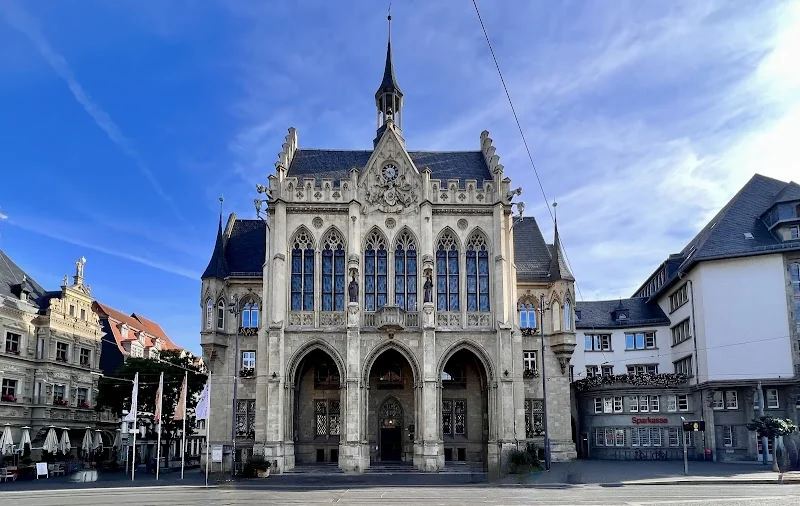
The Town Hall Erfurt is much more than an administrative building. It shapes the Fish Market as one of the most prominent structures of the old town, combining neo-Gothic architecture with political presence and simultaneously acts as a living city museum. Those looking for opening hours, tours, the festival hall, concerts, or parking will find here a place that not only preserves history but makes it visible in everyday life. The current Town Hall stands on the site of older construction phases, and it is precisely this layering that creates its special charm: representative on the outside, richly decorated on the inside, culturally used, and accessible to visitors during valid times. Especially for search intentions around today, events, festival hall, figures, and photos, the Town Hall is a location with many facets that can only be understood when architecture, use, and city history are considered together. ([erfurt.de](https://www.erfurt.de/ef/de/erleben/sehenswertes/rathaus/index?utm_source=openai))
The official visiting and event logic is clear: During the week, organized tours through history and the rooms are conducted, while on weekends, individual visits are possible at defined times, and concerts as well as other formats take place year-round in the festival hall. Practical topics such as access, parking garage Domplatz, barrier-free access, historical wall paintings, and the question of which figures and image programs make the interior so distinctive are also included. This mixture of cultural site, administrative center, and tourist attraction explains why the Town Hall Erfurt is so often associated with opening hours, address, registration, and events in search queries. Those who consciously visit the building experience not only a beautiful old town location but also a piece of Erfurt identity. ([erfurt-tourismus.de](https://www.erfurt-tourismus.de/sehens-wissenswertes/sehenswertes/weitere/rathaus/))
Opening Hours, Tours, and Registration
The most important information for the visit begins with the opening hours. The Town Hall can only be visited from Monday to Friday as part of tours conducted by the Erfurt Tourism and Marketing GmbH. For school classes, prior registration is required, which is officially done via the provided phone numbers. On weekends, the building is open for individual visits, specifically on Saturdays and Sundays from 9:00 AM to 12:00 PM and from 1:00 PM to 4:00 PM. At the same time, an important restriction applies: If events take place in the Town Hall on weekends, visits are not possible. Therefore, those who specifically want to see the Fish Market, the foyer, the staircase, or the festival hall should plan their visit not only by time of day but also according to the event calendar. ([erfurt-tourismus.de](https://www.erfurt-tourismus.de/sehens-wissenswertes/sehenswertes/weitere/rathaus/))
The search terms town hall erfurt today, town hall erfurt appointment, and town hall erfurt registration reflect exactly this practice. Visitors are not only searching for a building but for a reliable time window for access. The Town Hall is an iconic landmark on the outside, but on the inside, it is also a sensitive place with administrative operations, events, and tour offerings. Therefore, the distinction between public tours and targeted registration is important. The official tourism site explicitly states that the building is not regularly open to the public outside the mentioned visiting hours. Those coming with groups should always check in advance whether the visit is planned as a tour, individual visit, or special appointment. Thus, a spontaneous question about opening hours quickly turns into an organized and content-rich visit. ([erfurt-tourismus.de](https://www.erfurt-tourismus.de/sehens-wissenswertes/sehenswertes/weitere/rathaus/))
For the keyword phrase town hall erfurt event today, the official event page is the best anchor. There, current and past Town Hall concerts are documented, including time, genre, and event description. For May 30, 2026, a jazz chamber concert by Duo Pawlik is scheduled from 5:00 PM to 6:30 PM. This shows that the Town Hall is not only exciting during fixed tour times but also as a current cultural address. Those planning a visit on the same day should check in advance whether a concert or another use changes access. This connection between a historic building and ongoing use is what makes the Town Hall appealing. ([erfurt.de](https://www.erfurt.de/ef/de/erleben/sehenswertes/rathaus/rathauskonzerte/index.html))
Parking, Access, and Public Transport to Town Hall Erfurt
The access to Town Hall Erfurt is conveniently central for visitors. The official Erfurt tourism site states that the Town Hall is only 20 meters away from the tram. This makes it clear: Those traveling by public transport can reach the Fish Market extremely directly and do not have to plan long walks. For those arriving by car, the parking garage Domplatz, located at Bechtheimer Straße 1, is particularly recommended. It is located in the center of Erfurt right next to the cathedral and is explicitly listed by the tourism site as a parking lot near the Town Hall. For many city visits, this is the most practical solution, as it allows quick access to both the Fish Market and other old town destinations. ([erfurt.de](https://www.erfurt-tourismus.de/sehens-wissenswertes/sehenswertes/weitere/rathaus/))
The opening hours of the Domplatz parking garage are also helpful for planning: Monday to Saturday from 7:00 AM to 10:00 PM, Sunday and public holidays from 9:00 AM to 10:00 PM, with exit possible at any time. This makes the parking garage particularly attractive for day visits and evening events. Additionally, the official visitor information of the Town Hall points out three disabled parking spaces in the Town Hall parking lot behind the Town Hall. The path there leads over cobblestones, and there are steps at the entrance, but there is also a level access via the main entrance and a solution via the savings bank entrance for wheelchair users. Those searching for town hall erfurt parking thus find a pretty clear answer: central, but it is best to plan with a view of the parking garage, time window, and wayfinding. ([erfurt.de](https://www.erfurt.de/sehens-wissenswertes/sehenswertes/weitere/rathaus/))
The city center itself is also geared towards visitors. Erfurt operates a parking guidance system that shows free parking spaces and directs traffic to the nearest parking garages. A total of about 3,700 parking spaces are available at the edge of the traffic-calmed city center. This is relevant for the Town Hall because, during events or in the old town season, the first available parking space is not always guaranteed. Therefore, those who want to experience the Town Hall, the Fish Market, and the surrounding attractions without stress should either head directly to the Domplatz parking garage or let themselves be guided by the parking guidance system. In many cases, traveling by tram is the most relaxed option, as the building is practically located in the center of the old town and the distances remain short. ([erfurt.de](https://www.erfurt.de/ef/de/leben/verkehr/mobil/auto/parken/index.html?utm_source=openai))
Festival Hall, Concerts, and Events
The festival hall is the cultural heart of the Town Hall. It measures 238 square meters and offers up to 198 seats. This number explains why the room is so frequently used for concerts, weddings, lecture series, tours, and other events. In the official presentation, the hall is described as a historic space with a special ambiance, characterized by wall paintings, chandeliers, and the acoustically suitable Steinway grand piano. This is exactly why the search term town hall erfurt festival hall is so strongly associated with the Town Hall: The room is not only representative but is indeed regularly in use. The combination of size, acoustics, and historical furnishings makes it a place suitable for both festive occasions and musical formats. ([erfurt.de](https://www.erfurt.de/ef/de/erleben/sehenswertes/rathaus/festsaal/index.html))
The Town Hall concerts show how widely the festival hall is used. According to the official site, concerts of various musical genres take place there year-round. Mentioned are, among others, the Chamber Music Association Erfurt e.V., various Erfurt choirs, the Academic Orchestra Erfurt, the music department of the University of Erfurt, and the city's music school. Additionally, the festival hall is used as part of the Thuringian Jazz Mile and during the Christmas season. Thus, the Town Hall caters to both classical concert lovers and an audience that responds more to choir, jazz, or festive programs. Those searching for town hall erfurt events or town hall erfurt concert quickly realize that not only individual events take place here but that a permanent cultural use is maintained. ([erfurt.de](https://www.erfurt.de/ef/de/erleben/sehenswertes/rathaus/rathauskonzerte/index.html))
Particularly attractive is that the events in the festival hall are not limited to a rigid profile. The site describes classical music, song evenings, choir and benefit concerts, lectures, and panel discussions. Sometimes admission is free, which opens the room for low-threshold cultural offerings. The festival hall is presented as a good parlor on the second floor of the Town Hall, which aptly captures its role as a public representation space. Additionally, the historical Steinway grand piano, whose warm, multifaceted, and brilliant sound is explicitly highlighted, adds to its appeal. The piano was technically and acoustically restored in 2017 and has been owned by the city of Erfurt for decades. This is a real added value for music enthusiasts and a strong quality feature for the keyword concert. ([erfurt.de](https://www.erfurt.de/ef/de/erleben/sehenswertes/rathaus/festsaal/index.html))
Wall Paintings, Figures, and Photographic Particularities
The interior design of the Town Hall is one of the main reasons why the building is known far beyond its administrative function. In the festival hall, nine wall paintings created by Peter Janssen between 1878 and 1882 can be seen. The pictorial program is complemented by four chandeliers, ceiling paintings, corner pictures, and sculptures. For the corridors and staircases, the historical wall paintings by Eduard Kämpffer are particularly important. They depict scenes from the legend of the Count of Gleichen, from Luther's life, as well as from the Faust and Tannhäuser legends. This transforms the Town Hall's interior into a kind of narrative urban space where political, literary, and local motifs merge. Those searching for town hall erfurt figures or town hall erfurt wall paintings encounter precisely this interplay of art and history. ([erfurt.de](https://www.erfurt.de/ef/de/erleben/sehenswertes/rathaus/festsaal/index.html))
Particularly striking are the figures in the festival hall: Industria, Justitia, and Benignitas are explicitly mentioned in the captions. They complement the historical ambiance with symbolic layers that are important for the self-representation of the building. In the history of the Erfurt Town Hall, the building is described not only as an administrative building but also as a political center and an unmistakable landmark. This symbolic charge is one reason why so many visitors seek the building not only as architecture enthusiasts but also as a photographic motif. However, caution is important here: The official tourism site explicitly notes in the visitor profile that photography is not permitted. Therefore, those searching for town hall erfurt photos should distinguish between exterior motifs and interior visits. Outside at the Fish Market, the building offers many strong perspectives, but inside, the given rules apply. ([erfurt.de](https://www.erfurt.de/ef/de/erleben/sehenswertes/rathaus/festsaal/index.html))
History and Significance of the Town Hall at the Fish Market
The history of the Erfurt Town Hall dates back much further than the current building. The official city site describes the neo-Gothic Town Hall as a dominant feature of the Fish Market, built between 1869 and 1875 according to plans by August Thiede and Theodor Sommer on the same site where the old Town Hall once stood. The older building complex was constructed between early Gothic and late Renaissance and was initially mostly demolished in 1830, with the remainder being taken down between 1869 and 1870. Only a coat of arms plaque from 1418 remains on one side of the current building. This makes it clear that the Town Hall does not simply embody a single construction phase but represents an entire urban development line. Those searching for town hall erfurt history receive not only a construction date but a piece of urban narrative. ([erfurt.de](https://www.erfurt.de/ef/de/erleben/sehenswertes/rathaus/geschichte/index.html))
The significance of the building also lies in its role as a place of remembrance. According to the city description, the neo-Gothic Town Hall stands for the rise of the old Thuringian trading and industrial city at the turn of the 19th to the 20th century. Its monumental forecourt, the architectural design of the corridors and the staircase, as well as the extension buildings make it an unmistakable part of the cityscape. Particularly the paintings by Eduard Kämpffer and Peter Janssen bring together Erfurt's history, legend world, and political development. Among other things, motifs from the Bonifatius, Luther, Faust, and Tannhäuser traditions, as well as scenes that tell of Erfurt's relationship with the empire, Prussia, and civic life, can be seen. This makes the Town Hall a building that can not only be used but also read. ([erfurt.de](https://www.erfurt.de/ef/de/erleben/sehenswertes/rathaus/geschichte/index.html))
Later extensions also belong to the historical identity. The extension of the east wing created a second staircase, additional office spaces, and the council meeting room in 1904 and 1905. In 1934, the construction of the city savings bank at the Fish Market and Rathausgasse followed according to plans by Johannes Klaß. These architectural additions show how the Town Hall has grown with the demands of the city. It is therefore not just a monument but a permanently adapted functional building. This explains why search intentions around address, appointment, event, and visit are so closely linked here. The Town Hall is an administrative location, cultural space, monument, and tourist attraction at the same time. ([erfurt.de](https://www.erfurt.de/ef/de/erleben/sehenswertes/rathaus/geschichte/index.html))
Address, Contact, and Practical Information
The address is clear and central: Town Hall Erfurt, Fish Market 1, 99084 Erfurt. The official tourism site also provides a contact address as well as phone availability for the visiting and tour area. Practically important is also that there is a scale model of the Erfurt old town in front of the Town Hall for exploring and feeling. This makes the place interesting for barrier-conscious urban experiences. Access is possible via steps; there is also a level access via the main entrance and a separate access via the savings bank entrance for wheelchair users. In the area of accessibility, a ramp to the meeting room, a toilet on the first floor, a public disabled toilet in the Town Hall parking lot, a hearing loop in the festival hall and in the main meeting room, as well as iGuide stations are mentioned. ([erfurt-tourismus.de](https://www.erfurt-tourismus.de/sehens-wissenswertes/sehenswertes/weitere/rathaus/))
Another practical point is the use of the building in everyday life. The tourism site notes that no other services, no animals, and no digital services are offered, and that photography inside the building is not permitted. At the same time, the official Town Hall concert page shows that the festival hall remains an active event venue used for concerts, lectures, and other formats. Therefore, anyone planning a visit should briefly check in advance whether an event on that day will affect access. For search queries like town hall erfurt address, town hall erfurt photos, or town hall erfurt appointment, this mixture of practical rules and cultural use is crucial. The Town Hall is easily accessible, historically significant, and clearly organized at the same time. Those who come with realistic expectations will experience one of the most impressive interiors of the Erfurt old town. ([erfurt-tourismus.de](https://www.erfurt.de/sehens-wissenswertes/sehenswertes/weitere/rathaus/))
Sources:
Show moreShow less
Town Hall Erfurt | Opening Hours & Events
The Town Hall Erfurt is much more than an administrative building. It shapes the Fish Market as one of the most prominent structures of the old town, combining neo-Gothic architecture with political presence and simultaneously acts as a living city museum. Those looking for opening hours, tours, the festival hall, concerts, or parking will find here a place that not only preserves history but makes it visible in everyday life. The current Town Hall stands on the site of older construction phases, and it is precisely this layering that creates its special charm: representative on the outside, richly decorated on the inside, culturally used, and accessible to visitors during valid times. Especially for search intentions around today, events, festival hall, figures, and photos, the Town Hall is a location with many facets that can only be understood when architecture, use, and city history are considered together. ([erfurt.de](https://www.erfurt.de/ef/de/erleben/sehenswertes/rathaus/index?utm_source=openai))
The official visiting and event logic is clear: During the week, organized tours through history and the rooms are conducted, while on weekends, individual visits are possible at defined times, and concerts as well as other formats take place year-round in the festival hall. Practical topics such as access, parking garage Domplatz, barrier-free access, historical wall paintings, and the question of which figures and image programs make the interior so distinctive are also included. This mixture of cultural site, administrative center, and tourist attraction explains why the Town Hall Erfurt is so often associated with opening hours, address, registration, and events in search queries. Those who consciously visit the building experience not only a beautiful old town location but also a piece of Erfurt identity. ([erfurt-tourismus.de](https://www.erfurt-tourismus.de/sehens-wissenswertes/sehenswertes/weitere/rathaus/))
Opening Hours, Tours, and Registration
The most important information for the visit begins with the opening hours. The Town Hall can only be visited from Monday to Friday as part of tours conducted by the Erfurt Tourism and Marketing GmbH. For school classes, prior registration is required, which is officially done via the provided phone numbers. On weekends, the building is open for individual visits, specifically on Saturdays and Sundays from 9:00 AM to 12:00 PM and from 1:00 PM to 4:00 PM. At the same time, an important restriction applies: If events take place in the Town Hall on weekends, visits are not possible. Therefore, those who specifically want to see the Fish Market, the foyer, the staircase, or the festival hall should plan their visit not only by time of day but also according to the event calendar. ([erfurt-tourismus.de](https://www.erfurt-tourismus.de/sehens-wissenswertes/sehenswertes/weitere/rathaus/))
The search terms town hall erfurt today, town hall erfurt appointment, and town hall erfurt registration reflect exactly this practice. Visitors are not only searching for a building but for a reliable time window for access. The Town Hall is an iconic landmark on the outside, but on the inside, it is also a sensitive place with administrative operations, events, and tour offerings. Therefore, the distinction between public tours and targeted registration is important. The official tourism site explicitly states that the building is not regularly open to the public outside the mentioned visiting hours. Those coming with groups should always check in advance whether the visit is planned as a tour, individual visit, or special appointment. Thus, a spontaneous question about opening hours quickly turns into an organized and content-rich visit. ([erfurt-tourismus.de](https://www.erfurt-tourismus.de/sehens-wissenswertes/sehenswertes/weitere/rathaus/))
For the keyword phrase town hall erfurt event today, the official event page is the best anchor. There, current and past Town Hall concerts are documented, including time, genre, and event description. For May 30, 2026, a jazz chamber concert by Duo Pawlik is scheduled from 5:00 PM to 6:30 PM. This shows that the Town Hall is not only exciting during fixed tour times but also as a current cultural address. Those planning a visit on the same day should check in advance whether a concert or another use changes access. This connection between a historic building and ongoing use is what makes the Town Hall appealing. ([erfurt.de](https://www.erfurt.de/ef/de/erleben/sehenswertes/rathaus/rathauskonzerte/index.html))
Parking, Access, and Public Transport to Town Hall Erfurt
The access to Town Hall Erfurt is conveniently central for visitors. The official Erfurt tourism site states that the Town Hall is only 20 meters away from the tram. This makes it clear: Those traveling by public transport can reach the Fish Market extremely directly and do not have to plan long walks. For those arriving by car, the parking garage Domplatz, located at Bechtheimer Straße 1, is particularly recommended. It is located in the center of Erfurt right next to the cathedral and is explicitly listed by the tourism site as a parking lot near the Town Hall. For many city visits, this is the most practical solution, as it allows quick access to both the Fish Market and other old town destinations. ([erfurt.de](https://www.erfurt-tourismus.de/sehens-wissenswertes/sehenswertes/weitere/rathaus/))
The opening hours of the Domplatz parking garage are also helpful for planning: Monday to Saturday from 7:00 AM to 10:00 PM, Sunday and public holidays from 9:00 AM to 10:00 PM, with exit possible at any time. This makes the parking garage particularly attractive for day visits and evening events. Additionally, the official visitor information of the Town Hall points out three disabled parking spaces in the Town Hall parking lot behind the Town Hall. The path there leads over cobblestones, and there are steps at the entrance, but there is also a level access via the main entrance and a solution via the savings bank entrance for wheelchair users. Those searching for town hall erfurt parking thus find a pretty clear answer: central, but it is best to plan with a view of the parking garage, time window, and wayfinding. ([erfurt.de](https://www.erfurt.de/sehens-wissenswertes/sehenswertes/weitere/rathaus/))
The city center itself is also geared towards visitors. Erfurt operates a parking guidance system that shows free parking spaces and directs traffic to the nearest parking garages. A total of about 3,700 parking spaces are available at the edge of the traffic-calmed city center. This is relevant for the Town Hall because, during events or in the old town season, the first available parking space is not always guaranteed. Therefore, those who want to experience the Town Hall, the Fish Market, and the surrounding attractions without stress should either head directly to the Domplatz parking garage or let themselves be guided by the parking guidance system. In many cases, traveling by tram is the most relaxed option, as the building is practically located in the center of the old town and the distances remain short. ([erfurt.de](https://www.erfurt.de/ef/de/leben/verkehr/mobil/auto/parken/index.html?utm_source=openai))
Festival Hall, Concerts, and Events
The festival hall is the cultural heart of the Town Hall. It measures 238 square meters and offers up to 198 seats. This number explains why the room is so frequently used for concerts, weddings, lecture series, tours, and other events. In the official presentation, the hall is described as a historic space with a special ambiance, characterized by wall paintings, chandeliers, and the acoustically suitable Steinway grand piano. This is exactly why the search term town hall erfurt festival hall is so strongly associated with the Town Hall: The room is not only representative but is indeed regularly in use. The combination of size, acoustics, and historical furnishings makes it a place suitable for both festive occasions and musical formats. ([erfurt.de](https://www.erfurt.de/ef/de/erleben/sehenswertes/rathaus/festsaal/index.html))
The Town Hall concerts show how widely the festival hall is used. According to the official site, concerts of various musical genres take place there year-round. Mentioned are, among others, the Chamber Music Association Erfurt e.V., various Erfurt choirs, the Academic Orchestra Erfurt, the music department of the University of Erfurt, and the city's music school. Additionally, the festival hall is used as part of the Thuringian Jazz Mile and during the Christmas season. Thus, the Town Hall caters to both classical concert lovers and an audience that responds more to choir, jazz, or festive programs. Those searching for town hall erfurt events or town hall erfurt concert quickly realize that not only individual events take place here but that a permanent cultural use is maintained. ([erfurt.de](https://www.erfurt.de/ef/de/erleben/sehenswertes/rathaus/rathauskonzerte/index.html))
Particularly attractive is that the events in the festival hall are not limited to a rigid profile. The site describes classical music, song evenings, choir and benefit concerts, lectures, and panel discussions. Sometimes admission is free, which opens the room for low-threshold cultural offerings. The festival hall is presented as a good parlor on the second floor of the Town Hall, which aptly captures its role as a public representation space. Additionally, the historical Steinway grand piano, whose warm, multifaceted, and brilliant sound is explicitly highlighted, adds to its appeal. The piano was technically and acoustically restored in 2017 and has been owned by the city of Erfurt for decades. This is a real added value for music enthusiasts and a strong quality feature for the keyword concert. ([erfurt.de](https://www.erfurt.de/ef/de/erleben/sehenswertes/rathaus/festsaal/index.html))
Wall Paintings, Figures, and Photographic Particularities
The interior design of the Town Hall is one of the main reasons why the building is known far beyond its administrative function. In the festival hall, nine wall paintings created by Peter Janssen between 1878 and 1882 can be seen. The pictorial program is complemented by four chandeliers, ceiling paintings, corner pictures, and sculptures. For the corridors and staircases, the historical wall paintings by Eduard Kämpffer are particularly important. They depict scenes from the legend of the Count of Gleichen, from Luther's life, as well as from the Faust and Tannhäuser legends. This transforms the Town Hall's interior into a kind of narrative urban space where political, literary, and local motifs merge. Those searching for town hall erfurt figures or town hall erfurt wall paintings encounter precisely this interplay of art and history. ([erfurt.de](https://www.erfurt.de/ef/de/erleben/sehenswertes/rathaus/festsaal/index.html))
Particularly striking are the figures in the festival hall: Industria, Justitia, and Benignitas are explicitly mentioned in the captions. They complement the historical ambiance with symbolic layers that are important for the self-representation of the building. In the history of the Erfurt Town Hall, the building is described not only as an administrative building but also as a political center and an unmistakable landmark. This symbolic charge is one reason why so many visitors seek the building not only as architecture enthusiasts but also as a photographic motif. However, caution is important here: The official tourism site explicitly notes in the visitor profile that photography is not permitted. Therefore, those searching for town hall erfurt photos should distinguish between exterior motifs and interior visits. Outside at the Fish Market, the building offers many strong perspectives, but inside, the given rules apply. ([erfurt.de](https://www.erfurt.de/ef/de/erleben/sehenswertes/rathaus/festsaal/index.html))
History and Significance of the Town Hall at the Fish Market
The history of the Erfurt Town Hall dates back much further than the current building. The official city site describes the neo-Gothic Town Hall as a dominant feature of the Fish Market, built between 1869 and 1875 according to plans by August Thiede and Theodor Sommer on the same site where the old Town Hall once stood. The older building complex was constructed between early Gothic and late Renaissance and was initially mostly demolished in 1830, with the remainder being taken down between 1869 and 1870. Only a coat of arms plaque from 1418 remains on one side of the current building. This makes it clear that the Town Hall does not simply embody a single construction phase but represents an entire urban development line. Those searching for town hall erfurt history receive not only a construction date but a piece of urban narrative. ([erfurt.de](https://www.erfurt.de/ef/de/erleben/sehenswertes/rathaus/geschichte/index.html))
The significance of the building also lies in its role as a place of remembrance. According to the city description, the neo-Gothic Town Hall stands for the rise of the old Thuringian trading and industrial city at the turn of the 19th to the 20th century. Its monumental forecourt, the architectural design of the corridors and the staircase, as well as the extension buildings make it an unmistakable part of the cityscape. Particularly the paintings by Eduard Kämpffer and Peter Janssen bring together Erfurt's history, legend world, and political development. Among other things, motifs from the Bonifatius, Luther, Faust, and Tannhäuser traditions, as well as scenes that tell of Erfurt's relationship with the empire, Prussia, and civic life, can be seen. This makes the Town Hall a building that can not only be used but also read. ([erfurt.de](https://www.erfurt.de/ef/de/erleben/sehenswertes/rathaus/geschichte/index.html))
Later extensions also belong to the historical identity. The extension of the east wing created a second staircase, additional office spaces, and the council meeting room in 1904 and 1905. In 1934, the construction of the city savings bank at the Fish Market and Rathausgasse followed according to plans by Johannes Klaß. These architectural additions show how the Town Hall has grown with the demands of the city. It is therefore not just a monument but a permanently adapted functional building. This explains why search intentions around address, appointment, event, and visit are so closely linked here. The Town Hall is an administrative location, cultural space, monument, and tourist attraction at the same time. ([erfurt.de](https://www.erfurt.de/ef/de/erleben/sehenswertes/rathaus/geschichte/index.html))
Address, Contact, and Practical Information
The address is clear and central: Town Hall Erfurt, Fish Market 1, 99084 Erfurt. The official tourism site also provides a contact address as well as phone availability for the visiting and tour area. Practically important is also that there is a scale model of the Erfurt old town in front of the Town Hall for exploring and feeling. This makes the place interesting for barrier-conscious urban experiences. Access is possible via steps; there is also a level access via the main entrance and a separate access via the savings bank entrance for wheelchair users. In the area of accessibility, a ramp to the meeting room, a toilet on the first floor, a public disabled toilet in the Town Hall parking lot, a hearing loop in the festival hall and in the main meeting room, as well as iGuide stations are mentioned. ([erfurt-tourismus.de](https://www.erfurt-tourismus.de/sehens-wissenswertes/sehenswertes/weitere/rathaus/))
Another practical point is the use of the building in everyday life. The tourism site notes that no other services, no animals, and no digital services are offered, and that photography inside the building is not permitted. At the same time, the official Town Hall concert page shows that the festival hall remains an active event venue used for concerts, lectures, and other formats. Therefore, anyone planning a visit should briefly check in advance whether an event on that day will affect access. For search queries like town hall erfurt address, town hall erfurt photos, or town hall erfurt appointment, this mixture of practical rules and cultural use is crucial. The Town Hall is easily accessible, historically significant, and clearly organized at the same time. Those who come with realistic expectations will experience one of the most impressive interiors of the Erfurt old town. ([erfurt-tourismus.de](https://www.erfurt.de/sehens-wissenswertes/sehenswertes/weitere/rathaus/))
Sources:
Town Hall Erfurt | Opening Hours & Events
The Town Hall Erfurt is much more than an administrative building. It shapes the Fish Market as one of the most prominent structures of the old town, combining neo-Gothic architecture with political presence and simultaneously acts as a living city museum. Those looking for opening hours, tours, the festival hall, concerts, or parking will find here a place that not only preserves history but makes it visible in everyday life. The current Town Hall stands on the site of older construction phases, and it is precisely this layering that creates its special charm: representative on the outside, richly decorated on the inside, culturally used, and accessible to visitors during valid times. Especially for search intentions around today, events, festival hall, figures, and photos, the Town Hall is a location with many facets that can only be understood when architecture, use, and city history are considered together. ([erfurt.de](https://www.erfurt.de/ef/de/erleben/sehenswertes/rathaus/index?utm_source=openai))
The official visiting and event logic is clear: During the week, organized tours through history and the rooms are conducted, while on weekends, individual visits are possible at defined times, and concerts as well as other formats take place year-round in the festival hall. Practical topics such as access, parking garage Domplatz, barrier-free access, historical wall paintings, and the question of which figures and image programs make the interior so distinctive are also included. This mixture of cultural site, administrative center, and tourist attraction explains why the Town Hall Erfurt is so often associated with opening hours, address, registration, and events in search queries. Those who consciously visit the building experience not only a beautiful old town location but also a piece of Erfurt identity. ([erfurt-tourismus.de](https://www.erfurt-tourismus.de/sehens-wissenswertes/sehenswertes/weitere/rathaus/))
Opening Hours, Tours, and Registration
The most important information for the visit begins with the opening hours. The Town Hall can only be visited from Monday to Friday as part of tours conducted by the Erfurt Tourism and Marketing GmbH. For school classes, prior registration is required, which is officially done via the provided phone numbers. On weekends, the building is open for individual visits, specifically on Saturdays and Sundays from 9:00 AM to 12:00 PM and from 1:00 PM to 4:00 PM. At the same time, an important restriction applies: If events take place in the Town Hall on weekends, visits are not possible. Therefore, those who specifically want to see the Fish Market, the foyer, the staircase, or the festival hall should plan their visit not only by time of day but also according to the event calendar. ([erfurt-tourismus.de](https://www.erfurt-tourismus.de/sehens-wissenswertes/sehenswertes/weitere/rathaus/))
The search terms town hall erfurt today, town hall erfurt appointment, and town hall erfurt registration reflect exactly this practice. Visitors are not only searching for a building but for a reliable time window for access. The Town Hall is an iconic landmark on the outside, but on the inside, it is also a sensitive place with administrative operations, events, and tour offerings. Therefore, the distinction between public tours and targeted registration is important. The official tourism site explicitly states that the building is not regularly open to the public outside the mentioned visiting hours. Those coming with groups should always check in advance whether the visit is planned as a tour, individual visit, or special appointment. Thus, a spontaneous question about opening hours quickly turns into an organized and content-rich visit. ([erfurt-tourismus.de](https://www.erfurt-tourismus.de/sehens-wissenswertes/sehenswertes/weitere/rathaus/))
For the keyword phrase town hall erfurt event today, the official event page is the best anchor. There, current and past Town Hall concerts are documented, including time, genre, and event description. For May 30, 2026, a jazz chamber concert by Duo Pawlik is scheduled from 5:00 PM to 6:30 PM. This shows that the Town Hall is not only exciting during fixed tour times but also as a current cultural address. Those planning a visit on the same day should check in advance whether a concert or another use changes access. This connection between a historic building and ongoing use is what makes the Town Hall appealing. ([erfurt.de](https://www.erfurt.de/ef/de/erleben/sehenswertes/rathaus/rathauskonzerte/index.html))
Parking, Access, and Public Transport to Town Hall Erfurt
The access to Town Hall Erfurt is conveniently central for visitors. The official Erfurt tourism site states that the Town Hall is only 20 meters away from the tram. This makes it clear: Those traveling by public transport can reach the Fish Market extremely directly and do not have to plan long walks. For those arriving by car, the parking garage Domplatz, located at Bechtheimer Straße 1, is particularly recommended. It is located in the center of Erfurt right next to the cathedral and is explicitly listed by the tourism site as a parking lot near the Town Hall. For many city visits, this is the most practical solution, as it allows quick access to both the Fish Market and other old town destinations. ([erfurt.de](https://www.erfurt-tourismus.de/sehens-wissenswertes/sehenswertes/weitere/rathaus/))
The opening hours of the Domplatz parking garage are also helpful for planning: Monday to Saturday from 7:00 AM to 10:00 PM, Sunday and public holidays from 9:00 AM to 10:00 PM, with exit possible at any time. This makes the parking garage particularly attractive for day visits and evening events. Additionally, the official visitor information of the Town Hall points out three disabled parking spaces in the Town Hall parking lot behind the Town Hall. The path there leads over cobblestones, and there are steps at the entrance, but there is also a level access via the main entrance and a solution via the savings bank entrance for wheelchair users. Those searching for town hall erfurt parking thus find a pretty clear answer: central, but it is best to plan with a view of the parking garage, time window, and wayfinding. ([erfurt.de](https://www.erfurt.de/sehens-wissenswertes/sehenswertes/weitere/rathaus/))
The city center itself is also geared towards visitors. Erfurt operates a parking guidance system that shows free parking spaces and directs traffic to the nearest parking garages. A total of about 3,700 parking spaces are available at the edge of the traffic-calmed city center. This is relevant for the Town Hall because, during events or in the old town season, the first available parking space is not always guaranteed. Therefore, those who want to experience the Town Hall, the Fish Market, and the surrounding attractions without stress should either head directly to the Domplatz parking garage or let themselves be guided by the parking guidance system. In many cases, traveling by tram is the most relaxed option, as the building is practically located in the center of the old town and the distances remain short. ([erfurt.de](https://www.erfurt.de/ef/de/leben/verkehr/mobil/auto/parken/index.html?utm_source=openai))
Festival Hall, Concerts, and Events
The festival hall is the cultural heart of the Town Hall. It measures 238 square meters and offers up to 198 seats. This number explains why the room is so frequently used for concerts, weddings, lecture series, tours, and other events. In the official presentation, the hall is described as a historic space with a special ambiance, characterized by wall paintings, chandeliers, and the acoustically suitable Steinway grand piano. This is exactly why the search term town hall erfurt festival hall is so strongly associated with the Town Hall: The room is not only representative but is indeed regularly in use. The combination of size, acoustics, and historical furnishings makes it a place suitable for both festive occasions and musical formats. ([erfurt.de](https://www.erfurt.de/ef/de/erleben/sehenswertes/rathaus/festsaal/index.html))
The Town Hall concerts show how widely the festival hall is used. According to the official site, concerts of various musical genres take place there year-round. Mentioned are, among others, the Chamber Music Association Erfurt e.V., various Erfurt choirs, the Academic Orchestra Erfurt, the music department of the University of Erfurt, and the city's music school. Additionally, the festival hall is used as part of the Thuringian Jazz Mile and during the Christmas season. Thus, the Town Hall caters to both classical concert lovers and an audience that responds more to choir, jazz, or festive programs. Those searching for town hall erfurt events or town hall erfurt concert quickly realize that not only individual events take place here but that a permanent cultural use is maintained. ([erfurt.de](https://www.erfurt.de/ef/de/erleben/sehenswertes/rathaus/rathauskonzerte/index.html))
Particularly attractive is that the events in the festival hall are not limited to a rigid profile. The site describes classical music, song evenings, choir and benefit concerts, lectures, and panel discussions. Sometimes admission is free, which opens the room for low-threshold cultural offerings. The festival hall is presented as a good parlor on the second floor of the Town Hall, which aptly captures its role as a public representation space. Additionally, the historical Steinway grand piano, whose warm, multifaceted, and brilliant sound is explicitly highlighted, adds to its appeal. The piano was technically and acoustically restored in 2017 and has been owned by the city of Erfurt for decades. This is a real added value for music enthusiasts and a strong quality feature for the keyword concert. ([erfurt.de](https://www.erfurt.de/ef/de/erleben/sehenswertes/rathaus/festsaal/index.html))
Wall Paintings, Figures, and Photographic Particularities
The interior design of the Town Hall is one of the main reasons why the building is known far beyond its administrative function. In the festival hall, nine wall paintings created by Peter Janssen between 1878 and 1882 can be seen. The pictorial program is complemented by four chandeliers, ceiling paintings, corner pictures, and sculptures. For the corridors and staircases, the historical wall paintings by Eduard Kämpffer are particularly important. They depict scenes from the legend of the Count of Gleichen, from Luther's life, as well as from the Faust and Tannhäuser legends. This transforms the Town Hall's interior into a kind of narrative urban space where political, literary, and local motifs merge. Those searching for town hall erfurt figures or town hall erfurt wall paintings encounter precisely this interplay of art and history. ([erfurt.de](https://www.erfurt.de/ef/de/erleben/sehenswertes/rathaus/festsaal/index.html))
Particularly striking are the figures in the festival hall: Industria, Justitia, and Benignitas are explicitly mentioned in the captions. They complement the historical ambiance with symbolic layers that are important for the self-representation of the building. In the history of the Erfurt Town Hall, the building is described not only as an administrative building but also as a political center and an unmistakable landmark. This symbolic charge is one reason why so many visitors seek the building not only as architecture enthusiasts but also as a photographic motif. However, caution is important here: The official tourism site explicitly notes in the visitor profile that photography is not permitted. Therefore, those searching for town hall erfurt photos should distinguish between exterior motifs and interior visits. Outside at the Fish Market, the building offers many strong perspectives, but inside, the given rules apply. ([erfurt.de](https://www.erfurt.de/ef/de/erleben/sehenswertes/rathaus/festsaal/index.html))
History and Significance of the Town Hall at the Fish Market
The history of the Erfurt Town Hall dates back much further than the current building. The official city site describes the neo-Gothic Town Hall as a dominant feature of the Fish Market, built between 1869 and 1875 according to plans by August Thiede and Theodor Sommer on the same site where the old Town Hall once stood. The older building complex was constructed between early Gothic and late Renaissance and was initially mostly demolished in 1830, with the remainder being taken down between 1869 and 1870. Only a coat of arms plaque from 1418 remains on one side of the current building. This makes it clear that the Town Hall does not simply embody a single construction phase but represents an entire urban development line. Those searching for town hall erfurt history receive not only a construction date but a piece of urban narrative. ([erfurt.de](https://www.erfurt.de/ef/de/erleben/sehenswertes/rathaus/geschichte/index.html))
The significance of the building also lies in its role as a place of remembrance. According to the city description, the neo-Gothic Town Hall stands for the rise of the old Thuringian trading and industrial city at the turn of the 19th to the 20th century. Its monumental forecourt, the architectural design of the corridors and the staircase, as well as the extension buildings make it an unmistakable part of the cityscape. Particularly the paintings by Eduard Kämpffer and Peter Janssen bring together Erfurt's history, legend world, and political development. Among other things, motifs from the Bonifatius, Luther, Faust, and Tannhäuser traditions, as well as scenes that tell of Erfurt's relationship with the empire, Prussia, and civic life, can be seen. This makes the Town Hall a building that can not only be used but also read. ([erfurt.de](https://www.erfurt.de/ef/de/erleben/sehenswertes/rathaus/geschichte/index.html))
Later extensions also belong to the historical identity. The extension of the east wing created a second staircase, additional office spaces, and the council meeting room in 1904 and 1905. In 1934, the construction of the city savings bank at the Fish Market and Rathausgasse followed according to plans by Johannes Klaß. These architectural additions show how the Town Hall has grown with the demands of the city. It is therefore not just a monument but a permanently adapted functional building. This explains why search intentions around address, appointment, event, and visit are so closely linked here. The Town Hall is an administrative location, cultural space, monument, and tourist attraction at the same time. ([erfurt.de](https://www.erfurt.de/ef/de/erleben/sehenswertes/rathaus/geschichte/index.html))
Address, Contact, and Practical Information
The address is clear and central: Town Hall Erfurt, Fish Market 1, 99084 Erfurt. The official tourism site also provides a contact address as well as phone availability for the visiting and tour area. Practically important is also that there is a scale model of the Erfurt old town in front of the Town Hall for exploring and feeling. This makes the place interesting for barrier-conscious urban experiences. Access is possible via steps; there is also a level access via the main entrance and a separate access via the savings bank entrance for wheelchair users. In the area of accessibility, a ramp to the meeting room, a toilet on the first floor, a public disabled toilet in the Town Hall parking lot, a hearing loop in the festival hall and in the main meeting room, as well as iGuide stations are mentioned. ([erfurt-tourismus.de](https://www.erfurt-tourismus.de/sehens-wissenswertes/sehenswertes/weitere/rathaus/))
Another practical point is the use of the building in everyday life. The tourism site notes that no other services, no animals, and no digital services are offered, and that photography inside the building is not permitted. At the same time, the official Town Hall concert page shows that the festival hall remains an active event venue used for concerts, lectures, and other formats. Therefore, anyone planning a visit should briefly check in advance whether an event on that day will affect access. For search queries like town hall erfurt address, town hall erfurt photos, or town hall erfurt appointment, this mixture of practical rules and cultural use is crucial. The Town Hall is easily accessible, historically significant, and clearly organized at the same time. Those who come with realistic expectations will experience one of the most impressive interiors of the Erfurt old town. ([erfurt-tourismus.de](https://www.erfurt.de/sehens-wissenswertes/sehenswertes/weitere/rathaus/))
Sources:
Upcoming Events
No events found
Frequently Asked Questions
Reviews
Eddi W.
10. November 2023
Please be aware, this city is at the end of the world. You won't find any Uber here, not even the German Free Now. I mean, if you are able to get a mobile connection, to use any app at all ... You know it's Germany, the world's most advanced 3rd world country ;)
ishan star
4. February 2025
Beautiful town with mesmerizing architecture.
SACHIT VARMA
12. January 2020
A historical landmark building and now the town hall for Erfurt city.
Amanda Christiansen
16. December 2017
Extraordinary square
Is Secret
3. March 2023
Cool!