
Erfurt
Juri-Gagarin-Ring 140a, 99084 Erfurt, Deutschland
Museum of Thuringian Folklore | Tickets & Opening Hours
The Museum of Thuringian Folklore in Erfurt is not a classic showcase that one leaves after a few minutes, but a house for everyday history, memories, and careful observation. It is housed in the manor of the former Great Hospital on Juri-Gagarin-Ring, thus in a historic ensemble in the middle of the city, which already possesses a special atmosphere due to its location. The museum is one of the largest folklore museums in Germany and collects, preserves, and exhibits primarily rural material culture from Thuringia. It is not only about furniture, household goods, or traditional costumes, but also about how people lived between tradition and change, what they owned, what they oriented themselves to, and what traces of that are still visible today. This is precisely what creates the charm of this place: it combines historical depth with a very contemporary narrative and turns seemingly small things into great stories. ([erfurt.de](https://www.erfurt.de/ef/de/erleben/kunst/museen/108327.html))
Those interested in photos, tickets, opening hours, or practical planning will find a mix of urban location, well-calculated visitor times, and a clear content profile. The museum operates with permanent exhibitions, display depots, guided tours, educational offerings, and an audio guide. The connection between scientific collection and illustrative presentation is particularly strong: the house tells of work and living, of food and drink, of clothing, festivals, faith, and social everyday life. Thus, a visit to the museum becomes not just a tour through rooms, but a journey through everyday life in Thuringia. ([volkskundemuseum-erfurt.de](https://www.volkskundemuseum-erfurt.de/vm/de/ausstellungen/dauerausstellungen/index.html))
Tickets, Admission Prices, and Opening Hours
For specific visit planning, the admission prices and opening hours are particularly important, and here the Museum of Thuringian Folklore offers clear conditions. The house is open from Tuesday to Sunday from 10:00 AM to 6:00 PM; it is closed on Mondays. Additionally, there are special regulations on holidays: Easter Monday and Whit Monday are also open. The municipal museums in Erfurt also offer free admission on the first Tuesday of each month, making the visit especially attractive for spontaneous guests, families, or returning visitors. This information is currently displayed on the museum's official visitor service page. ([volkskundemuseum-erfurt.de](https://www.volkskundemuseum-erfurt.de/vm/de/service/besucher-service/index.html))
The pricing is also transparently structured. Adults pay 6 euros, reduced tickets are 4 euros. Groups of ten or more receive a reduced price of 3 euros per person, and school classes as well as kindergartens can visit free of charge from Tuesday to Friday. Families pay 13 euros. Those already traveling with the ErfurtCard or ErfurtTravelCard can visit the museum for free. Different admission prices may apply for special exhibitions. It is also practical for planning that tickets and information are available at the cash desk, information desk, and shop. This makes it easy to organize the visit, whether one comes specifically for a permanent exhibition or lets oneself be guided spontaneously on-site. ([volkskundemuseum-erfurt.de](https://www.volkskundemuseum-erfurt.de/vm/de/service/besucher-service/index.html))
Content-wise, it is worth looking at the current events and exhibitions, as the museum combines permanent exhibitions with a lively program. The homepage regularly announces new offerings, workshops, and events, including formats around paper, textile work, and special exhibitions. Therefore, those looking for tickets for the Museum of Thuringian Folklore should not only plan for admission but also directly consider the appropriate time frame. Especially on free admission days or during action events, the visit becomes particularly attractive. ([volkskundemuseum-erfurt.de](https://www.volkskundemuseum-erfurt.de/))
Directions, Parking, and Central Location on Juri-Gagarin-Ring
The location of the museum is one of its great practical advantages. It is located at Juri-Gagarin-Ring 140a in Erfurt, thus in a central urban position that is easily reachable by public transport or on foot. It is about a five-minute walk from Anger. For the tram, lines 2 with the stop Krämpfertor as well as 1 and 5 with the stop Stadtmuseum/Kaisersaal are mentioned. Those arriving by car should take the A4 exit Erfurt/West towards the city center; parking is available at the Anger parking garage. This makes the journey uncomplicated for visitors from Erfurt as well as for guests who come to the city for a day trip. ([erfurt.de](https://www.erfurt.de/ef/de/erleben/kunst/museen/108327.html))
The architectural surroundings are also relevant for the visit. The museum is located in a historically grown hospital complex with a courtyard and is situated on one of the busiest streets in Erfurt. This contrast of traffic, city, and protected interior shapes the atmosphere. Upon entering the grounds, one noticeably leaves the hustle and bustle of the ring and enters an area that resembles a cultivated cultural site rather than a single exhibition building. The picturesque courtyard and the historical shell enhance the impression that not only objects are displayed here, but a piece of city history has been preserved. This is precisely why the place is so interesting for photos, first impressions, and short breaks. ([volkskundemuseum-erfurt.de](https://www.volkskundemuseum-erfurt.de/vm/de/haus/))
For guests with mobility impairments, it is important to know that the museum is not fully barrier-free. According to visitor service, there is ground-level access to the main entrance, followed by two steps to the cash desk and another three steps to the exhibition rooms on the ground floor. Assistance is offered to guests with walking disabilities. Those planning a visit should consider these architectural circumstances. At the same time, this information also shows that the museum openly communicates its accessibility and offers practical support. For a city center location with historical building stock, this is an honest and helpful service note. ([volkskundemuseum-erfurt.de](https://www.volkskundemuseum-erfurt.de/vm/de/service/besucher-service/index.html))
Exhibitions, Century Cabinet, and Rural Everyday Culture
The thematic heart of the museum beats in the permanent exhibition Experience. Change. Persist. Village Life in the 19th Century. This presentation was developed as the centerpiece of the house and tells, through objects and staging, how people in Thuringia lived between tradition and modernity. The so-called Century Cabinet is more than a pretty symbol: it serves as a dramatic element that brings together objects, sounds, and images and gradually draws the visitor into earlier worlds of life. The museum focuses on the so-called little people, on work, living, celebrating, nutrition, clothing, birth, and death. This perspective gives the exhibition its closeness to everyday life and distinguishes it from purely decorative collections. ([erfurt.de](https://www.erfurt.de/ef/de/erleben/kunst/museen/108327.html))
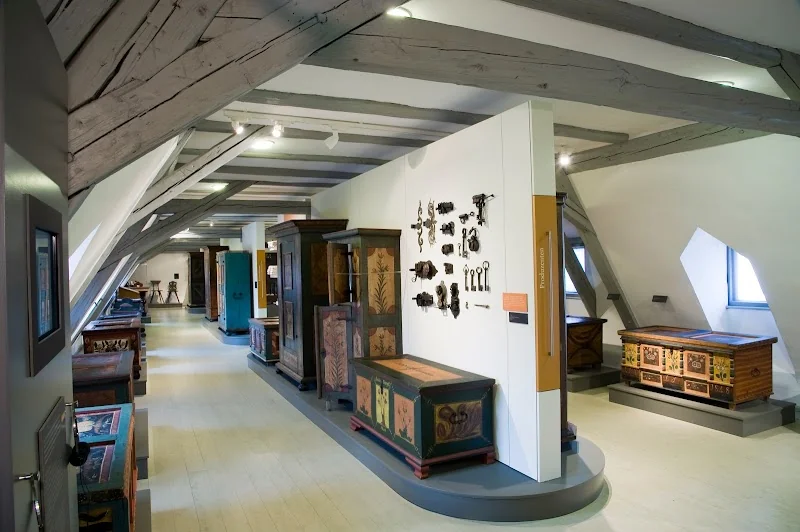
Additionally, the house shows several other permanent exhibitions that refine the profile of the collection. These include Virtual Folk Life: Thuringian Costume Dolls, Painted Furniture – Production. Use. Interpretation, All Costume? Rural Clothing in the 19th and early 20th Century, as well as Historical Workshops with the themes Mask Maker, Glassblower, and Wooden Toy Maker. This makes it clear how broad the museum's work is: it does not only show clothing or furniture in isolation but connects them with questions of production, use, and social significance. Thus, everyday objects become sources of cultural history. For visitors interested in regional identity, craftsmanship, or material culture, this mix is particularly strong. ([volkskundemuseum-erfurt.de](https://www.volkskundemuseum-erfurt.de/vm/de/ausstellungen/dauerausstellungen/index.html))
Digital and playful mediation is also an important element. The museum offers a QR code tour with a puzzle rally and explorer quiz for children aged nine and older. An audio guide for the permanent exhibition is also available for loan at the cash desk. Both offerings complement the classic tour and help to not only see but also understand the content. Especially with topics like clothing, nutrition, work, or festival culture, this is sensible because many details would easily be overlooked without explanation. The museum thus creates a bridge between scientific depth and family-friendly mediation. ([volkskundemuseum-erfurt.de](https://www.volkskundemuseum-erfurt.de/vm/de/ausstellungen/dauerausstellungen/index.html))
Display Depots and Special Collections
A particular strength of the house is the display depots, as they show how deep the collection actually goes. The display depot Historical Textiles was established in 1998 and later spatially expanded. A large part of the textile collection is stored there, especially costumes, costume parts, and accessories from the 19th and early 20th centuries. The objects are stored appropriately and conservationally cared for, but can also be used for clothing history and textile technical consultations. Thus, the depot is not just a storage place but also a knowledge-based workplace. This is attractive for visitors because it makes clear that the museum does not only show what is already staged but also has a very extensive scientific background. ([volkskundemuseum-erfurt.de](https://www.volkskundemuseum-erfurt.de/vm/de/schaudepots/historische-textilien/index.html))
Another important display depot is the South Sea Collection of Dr. Wilhelm Knappe. It was collected in Oceania towards the end of the 19th century and came into municipal ownership in 1889 through civic engagement. Today, it is accessible in the Benary storage facility upon request as part of a tour or guided visit. Particularly noteworthy is the open and sensitive engagement with the colonial context of the collection. This is museum-politically significant because here not only objects are presented, but also their origins, their collection history, and the questions of dealing with colonial heritage are made transparent. For a folklore museum, this is a remarkably reflective approach. ([volkskundemuseum-erfurt.de](https://www.volkskundemuseum-erfurt.de/vm/de/schaudepots/koloniales-erbe/index.html))
The collection spectrum also includes the display depot of ceramics and porcelain in the vaulted cellars of the former manor house. Almost the entire ceramic and porcelain inventory is stored there, using innovative technical solutions for climate control without altering the historical building. At the same time, it is important: for structural reasons, visits to this depot are currently not possible. This is also valuable information as it shows how closely museum presentation, monument protection, and conservation requirements are connected here. Thus, visitors to the museum experience not only exhibitions but a house with multiple levels of collection care. ([volkskundemuseum-erfurt.de](https://www.volkskundemuseum-erfurt.de/vm/de/schaudepots/keramik-porzellan/index.html))
History of the Museum in the Great Hospital
The history of the house dates back significantly further than its current museum designation. In the manor of the Great Hospital, an antiquities museum associated with the City Museum was opened from 1888/90. This early collection concept was typical for the time: it united urban antiquities, costumes, ethnographic pieces, and natural history objects into a then still little organized but culturally historically important fund. Under Alfred Overmann and later Edwin Redslob, the house gradually gained its own profile. By 1924, it had developed into a museum of local history before being closed due to the war in 1939. Even this early development shows that the building was a place of collecting, reinterpreting, and reorganizing for many decades. ([volkskundemuseum-erfurt.de](https://www.volkskundemuseum-erfurt.de/vm/de/haus/geschichte/index.html))
After 1945, the reconstruction of the Erfurt museums began, and in 1955 the Museum of Thuringian Folklore was finally established in the manor house. Initially, it was organized as a department of the Angermuseum. The chronicle of the following decades shows a tumultuous history: political interventions, temporary closures, resumption of exhibition activities, and an increasing professional profile. In the 1970s, the exhibition space grew by more than three times, and the museum became the most visited house in the city. In the early 1990s, Dr. Marina Moritz took over the management and led the museum into a modern professional orientation. From 1997, new permanent exhibitions were created, in 1998 the display depot for Historical Textiles, and in 2001 the core exhibition Experience. Change. Persist. Village Life in the 19th Century. ([volkskundemuseum-erfurt.de](https://www.volkskundemuseum-erfurt.de/vm/de/haus/chronik/index.html))
Later stages show that the museum has continued to grow and has also understood itself as a leading museum. In 2013, the city's strategic cultural concept designates the house as a leading museum of statewide significance. However, during the same phase, structural problems also became apparent, such as the difficult accessibility due to the historical elevator and the structural limitations of individual areas. In 2014, a specialist committee was established for the Great Hospital to further develop usage potentials and perspectives. This mix of monument protection, scientific claims, and practical renewal shapes the house to this day. For this reason, its history is not just a sequence of dates but a narrative about adaptation, preservation, and professional renewal. ([volkskundemuseum-erfurt.de](https://www.volkskundemuseum-erfurt.de/vm/de/haus/chronik/index.html))
Guided Tours, Audio Guide, Photos, and On-Site Service
For those who do not want to explore the museum alone, there is an unusually versatile service offering. The visitor service page lists permanent exhibitions, special exhibitions, educational offerings upon request, display depots upon request, publications from the in-house series, guided tours by prior arrangement, and an audio guide. This is complemented by the shop, where the available publications can be purchased. The house is thus aimed not only at individual visitors but also at groups, school classes, families, and those interested in diving deeper. Especially in a museum with such a strong connection to everyday life and culture, this mediation is a central part of the visitor experience. ([volkskundemuseum-erfurt.de](https://www.volkskundemuseum-erfurt.de/vm/de/service/besucher-service/index.html))
For children and school classes, the house is particularly well prepared. The museum education offers time travels into past worlds of school life, writing, and paper. The workshop Around Paper is aimed at different target groups, from individuals and families to school classes from grade 3. For certain dates, an admission fee is charged, except on the free admission Tuesday, plus a material contribution of 1.50 euros. School classes can book such offerings; for them, admission is free, and only the material fee applies. These clear conditions are practical because they create planning security while also enabling low-threshold access to education and history. ([volkskundemuseum-erfurt.de](https://www.volkskundemuseum-erfurt.de/vm/de/bildung/museumspaedagogik/index.html))
Photos also play a role in the visit. According to Erfurt Tourism, photography is allowed in the museum, which is particularly attractive for visitors interested in architecture, the courtyard, exhibition details, or costume motifs. At the same time, one should respect the architectural framework and adhere to local guidelines. Those wishing to share their visit on social media will find many suitable motifs without the museum losing its scientific character. This balance of visual appeal and factual depth makes the house interesting for a broad audience. Additionally, the museum is currently working on the special exhibition Play Spaces – Dream Play. Textile Art Thuringia, which is announced to run until May 29, 2026, and is complemented by workshops. Thus, the place remains lively beyond the permanent exhibitions. ([erfurt-tourismus.de](https://www.erfurt-tourismus.de/sehenswertes/museen-und-ausstellungen/museen/museum-fuer-thueringer-volkskunde/?cHash=672f7da0632b6552d2a2041f0eda4500&chash=b6171757502a9da993397db7605bf338&sword_list%5B0%5D=parkplatz&utm_source=openai))
In the end, the Museum of Thuringian Folklore is a place where practical visitor questions and content depth come together. Clear information is provided on admission, opening hours, directions, and parking, but also a very independent view of Thuringian everyday culture, rural living environments, textiles, ceramics, furniture, and social memory. Those looking for a museum in Erfurt that is not loud but content-rich will find a very good destination here. The house is suitable for short visits as well as for a longer tour with an audio guide, guided tours, or special exhibitions. This mix is what makes its lasting appeal. ([volkskundemuseum-erfurt.de](https://www.volkskundemuseum-erfurt.de/vm/de/service/besucher-service/index.html))
Sources:
- Erfurt.de – Museum of Thuringian Folklore ([erfurt.de](https://www.erfurt.de/ef/de/erleben/kunst/museen/108327.html))
- Volkskundemuseum Erfurt – Homepage and Visitor Information ([volkskundemuseum-erfurt.de](https://www.volkskundemuseum-erfurt.de/))
- Volkskundemuseum Erfurt – History and Chronicle ([volkskundemuseum-erfurt.de](https://www.volkskundemuseum-erfurt.de/vm/de/haus/geschichte/index.html))
- Volkskundemuseum Erfurt – Permanent Exhibitions, Display Depots, and Museum Education ([volkskundemuseum-erfurt.de](https://www.volkskundemuseum-erfurt.de/vm/de/ausstellungen/dauerausstellungen/index.html))
- Erfurt Tourism – Museum of Thuringian Folklore ([erfurt-tourismus.de](https://www.erfurt-tourismus.de/sehenswertes/museen-und-ausstellungen/museen/museum-fuer-thueringer-volkskunde/))
Show moreShow less
Museum of Thuringian Folklore | Tickets & Opening Hours
The Museum of Thuringian Folklore in Erfurt is not a classic showcase that one leaves after a few minutes, but a house for everyday history, memories, and careful observation. It is housed in the manor of the former Great Hospital on Juri-Gagarin-Ring, thus in a historic ensemble in the middle of the city, which already possesses a special atmosphere due to its location. The museum is one of the largest folklore museums in Germany and collects, preserves, and exhibits primarily rural material culture from Thuringia. It is not only about furniture, household goods, or traditional costumes, but also about how people lived between tradition and change, what they owned, what they oriented themselves to, and what traces of that are still visible today. This is precisely what creates the charm of this place: it combines historical depth with a very contemporary narrative and turns seemingly small things into great stories. ([erfurt.de](https://www.erfurt.de/ef/de/erleben/kunst/museen/108327.html))
Those interested in photos, tickets, opening hours, or practical planning will find a mix of urban location, well-calculated visitor times, and a clear content profile. The museum operates with permanent exhibitions, display depots, guided tours, educational offerings, and an audio guide. The connection between scientific collection and illustrative presentation is particularly strong: the house tells of work and living, of food and drink, of clothing, festivals, faith, and social everyday life. Thus, a visit to the museum becomes not just a tour through rooms, but a journey through everyday life in Thuringia. ([volkskundemuseum-erfurt.de](https://www.volkskundemuseum-erfurt.de/vm/de/ausstellungen/dauerausstellungen/index.html))
Tickets, Admission Prices, and Opening Hours
For specific visit planning, the admission prices and opening hours are particularly important, and here the Museum of Thuringian Folklore offers clear conditions. The house is open from Tuesday to Sunday from 10:00 AM to 6:00 PM; it is closed on Mondays. Additionally, there are special regulations on holidays: Easter Monday and Whit Monday are also open. The municipal museums in Erfurt also offer free admission on the first Tuesday of each month, making the visit especially attractive for spontaneous guests, families, or returning visitors. This information is currently displayed on the museum's official visitor service page. ([volkskundemuseum-erfurt.de](https://www.volkskundemuseum-erfurt.de/vm/de/service/besucher-service/index.html))
The pricing is also transparently structured. Adults pay 6 euros, reduced tickets are 4 euros. Groups of ten or more receive a reduced price of 3 euros per person, and school classes as well as kindergartens can visit free of charge from Tuesday to Friday. Families pay 13 euros. Those already traveling with the ErfurtCard or ErfurtTravelCard can visit the museum for free. Different admission prices may apply for special exhibitions. It is also practical for planning that tickets and information are available at the cash desk, information desk, and shop. This makes it easy to organize the visit, whether one comes specifically for a permanent exhibition or lets oneself be guided spontaneously on-site. ([volkskundemuseum-erfurt.de](https://www.volkskundemuseum-erfurt.de/vm/de/service/besucher-service/index.html))
Content-wise, it is worth looking at the current events and exhibitions, as the museum combines permanent exhibitions with a lively program. The homepage regularly announces new offerings, workshops, and events, including formats around paper, textile work, and special exhibitions. Therefore, those looking for tickets for the Museum of Thuringian Folklore should not only plan for admission but also directly consider the appropriate time frame. Especially on free admission days or during action events, the visit becomes particularly attractive. ([volkskundemuseum-erfurt.de](https://www.volkskundemuseum-erfurt.de/))
Directions, Parking, and Central Location on Juri-Gagarin-Ring
The location of the museum is one of its great practical advantages. It is located at Juri-Gagarin-Ring 140a in Erfurt, thus in a central urban position that is easily reachable by public transport or on foot. It is about a five-minute walk from Anger. For the tram, lines 2 with the stop Krämpfertor as well as 1 and 5 with the stop Stadtmuseum/Kaisersaal are mentioned. Those arriving by car should take the A4 exit Erfurt/West towards the city center; parking is available at the Anger parking garage. This makes the journey uncomplicated for visitors from Erfurt as well as for guests who come to the city for a day trip. ([erfurt.de](https://www.erfurt.de/ef/de/erleben/kunst/museen/108327.html))
The architectural surroundings are also relevant for the visit. The museum is located in a historically grown hospital complex with a courtyard and is situated on one of the busiest streets in Erfurt. This contrast of traffic, city, and protected interior shapes the atmosphere. Upon entering the grounds, one noticeably leaves the hustle and bustle of the ring and enters an area that resembles a cultivated cultural site rather than a single exhibition building. The picturesque courtyard and the historical shell enhance the impression that not only objects are displayed here, but a piece of city history has been preserved. This is precisely why the place is so interesting for photos, first impressions, and short breaks. ([volkskundemuseum-erfurt.de](https://www.volkskundemuseum-erfurt.de/vm/de/haus/))
For guests with mobility impairments, it is important to know that the museum is not fully barrier-free. According to visitor service, there is ground-level access to the main entrance, followed by two steps to the cash desk and another three steps to the exhibition rooms on the ground floor. Assistance is offered to guests with walking disabilities. Those planning a visit should consider these architectural circumstances. At the same time, this information also shows that the museum openly communicates its accessibility and offers practical support. For a city center location with historical building stock, this is an honest and helpful service note. ([volkskundemuseum-erfurt.de](https://www.volkskundemuseum-erfurt.de/vm/de/service/besucher-service/index.html))
Exhibitions, Century Cabinet, and Rural Everyday Culture
The thematic heart of the museum beats in the permanent exhibition Experience. Change. Persist. Village Life in the 19th Century. This presentation was developed as the centerpiece of the house and tells, through objects and staging, how people in Thuringia lived between tradition and modernity. The so-called Century Cabinet is more than a pretty symbol: it serves as a dramatic element that brings together objects, sounds, and images and gradually draws the visitor into earlier worlds of life. The museum focuses on the so-called little people, on work, living, celebrating, nutrition, clothing, birth, and death. This perspective gives the exhibition its closeness to everyday life and distinguishes it from purely decorative collections. ([erfurt.de](https://www.erfurt.de/ef/de/erleben/kunst/museen/108327.html))
Additionally, the house shows several other permanent exhibitions that refine the profile of the collection. These include Virtual Folk Life: Thuringian Costume Dolls, Painted Furniture – Production. Use. Interpretation, All Costume? Rural Clothing in the 19th and early 20th Century, as well as Historical Workshops with the themes Mask Maker, Glassblower, and Wooden Toy Maker. This makes it clear how broad the museum's work is: it does not only show clothing or furniture in isolation but connects them with questions of production, use, and social significance. Thus, everyday objects become sources of cultural history. For visitors interested in regional identity, craftsmanship, or material culture, this mix is particularly strong. ([volkskundemuseum-erfurt.de](https://www.volkskundemuseum-erfurt.de/vm/de/ausstellungen/dauerausstellungen/index.html))
Digital and playful mediation is also an important element. The museum offers a QR code tour with a puzzle rally and explorer quiz for children aged nine and older. An audio guide for the permanent exhibition is also available for loan at the cash desk. Both offerings complement the classic tour and help to not only see but also understand the content. Especially with topics like clothing, nutrition, work, or festival culture, this is sensible because many details would easily be overlooked without explanation. The museum thus creates a bridge between scientific depth and family-friendly mediation. ([volkskundemuseum-erfurt.de](https://www.volkskundemuseum-erfurt.de/vm/de/ausstellungen/dauerausstellungen/index.html))
Display Depots and Special Collections
A particular strength of the house is the display depots, as they show how deep the collection actually goes. The display depot Historical Textiles was established in 1998 and later spatially expanded. A large part of the textile collection is stored there, especially costumes, costume parts, and accessories from the 19th and early 20th centuries. The objects are stored appropriately and conservationally cared for, but can also be used for clothing history and textile technical consultations. Thus, the depot is not just a storage place but also a knowledge-based workplace. This is attractive for visitors because it makes clear that the museum does not only show what is already staged but also has a very extensive scientific background. ([volkskundemuseum-erfurt.de](https://www.volkskundemuseum-erfurt.de/vm/de/schaudepots/historische-textilien/index.html))
Another important display depot is the South Sea Collection of Dr. Wilhelm Knappe. It was collected in Oceania towards the end of the 19th century and came into municipal ownership in 1889 through civic engagement. Today, it is accessible in the Benary storage facility upon request as part of a tour or guided visit. Particularly noteworthy is the open and sensitive engagement with the colonial context of the collection. This is museum-politically significant because here not only objects are presented, but also their origins, their collection history, and the questions of dealing with colonial heritage are made transparent. For a folklore museum, this is a remarkably reflective approach. ([volkskundemuseum-erfurt.de](https://www.volkskundemuseum-erfurt.de/vm/de/schaudepots/koloniales-erbe/index.html))
The collection spectrum also includes the display depot of ceramics and porcelain in the vaulted cellars of the former manor house. Almost the entire ceramic and porcelain inventory is stored there, using innovative technical solutions for climate control without altering the historical building. At the same time, it is important: for structural reasons, visits to this depot are currently not possible. This is also valuable information as it shows how closely museum presentation, monument protection, and conservation requirements are connected here. Thus, visitors to the museum experience not only exhibitions but a house with multiple levels of collection care. ([volkskundemuseum-erfurt.de](https://www.volkskundemuseum-erfurt.de/vm/de/schaudepots/keramik-porzellan/index.html))
History of the Museum in the Great Hospital
The history of the house dates back significantly further than its current museum designation. In the manor of the Great Hospital, an antiquities museum associated with the City Museum was opened from 1888/90. This early collection concept was typical for the time: it united urban antiquities, costumes, ethnographic pieces, and natural history objects into a then still little organized but culturally historically important fund. Under Alfred Overmann and later Edwin Redslob, the house gradually gained its own profile. By 1924, it had developed into a museum of local history before being closed due to the war in 1939. Even this early development shows that the building was a place of collecting, reinterpreting, and reorganizing for many decades. ([volkskundemuseum-erfurt.de](https://www.volkskundemuseum-erfurt.de/vm/de/haus/geschichte/index.html))
After 1945, the reconstruction of the Erfurt museums began, and in 1955 the Museum of Thuringian Folklore was finally established in the manor house. Initially, it was organized as a department of the Angermuseum. The chronicle of the following decades shows a tumultuous history: political interventions, temporary closures, resumption of exhibition activities, and an increasing professional profile. In the 1970s, the exhibition space grew by more than three times, and the museum became the most visited house in the city. In the early 1990s, Dr. Marina Moritz took over the management and led the museum into a modern professional orientation. From 1997, new permanent exhibitions were created, in 1998 the display depot for Historical Textiles, and in 2001 the core exhibition Experience. Change. Persist. Village Life in the 19th Century. ([volkskundemuseum-erfurt.de](https://www.volkskundemuseum-erfurt.de/vm/de/haus/chronik/index.html))
Later stages show that the museum has continued to grow and has also understood itself as a leading museum. In 2013, the city's strategic cultural concept designates the house as a leading museum of statewide significance. However, during the same phase, structural problems also became apparent, such as the difficult accessibility due to the historical elevator and the structural limitations of individual areas. In 2014, a specialist committee was established for the Great Hospital to further develop usage potentials and perspectives. This mix of monument protection, scientific claims, and practical renewal shapes the house to this day. For this reason, its history is not just a sequence of dates but a narrative about adaptation, preservation, and professional renewal. ([volkskundemuseum-erfurt.de](https://www.volkskundemuseum-erfurt.de/vm/de/haus/chronik/index.html))
Guided Tours, Audio Guide, Photos, and On-Site Service
For those who do not want to explore the museum alone, there is an unusually versatile service offering. The visitor service page lists permanent exhibitions, special exhibitions, educational offerings upon request, display depots upon request, publications from the in-house series, guided tours by prior arrangement, and an audio guide. This is complemented by the shop, where the available publications can be purchased. The house is thus aimed not only at individual visitors but also at groups, school classes, families, and those interested in diving deeper. Especially in a museum with such a strong connection to everyday life and culture, this mediation is a central part of the visitor experience. ([volkskundemuseum-erfurt.de](https://www.volkskundemuseum-erfurt.de/vm/de/service/besucher-service/index.html))
For children and school classes, the house is particularly well prepared. The museum education offers time travels into past worlds of school life, writing, and paper. The workshop Around Paper is aimed at different target groups, from individuals and families to school classes from grade 3. For certain dates, an admission fee is charged, except on the free admission Tuesday, plus a material contribution of 1.50 euros. School classes can book such offerings; for them, admission is free, and only the material fee applies. These clear conditions are practical because they create planning security while also enabling low-threshold access to education and history. ([volkskundemuseum-erfurt.de](https://www.volkskundemuseum-erfurt.de/vm/de/bildung/museumspaedagogik/index.html))
Photos also play a role in the visit. According to Erfurt Tourism, photography is allowed in the museum, which is particularly attractive for visitors interested in architecture, the courtyard, exhibition details, or costume motifs. At the same time, one should respect the architectural framework and adhere to local guidelines. Those wishing to share their visit on social media will find many suitable motifs without the museum losing its scientific character. This balance of visual appeal and factual depth makes the house interesting for a broad audience. Additionally, the museum is currently working on the special exhibition Play Spaces – Dream Play. Textile Art Thuringia, which is announced to run until May 29, 2026, and is complemented by workshops. Thus, the place remains lively beyond the permanent exhibitions. ([erfurt-tourismus.de](https://www.erfurt-tourismus.de/sehenswertes/museen-und-ausstellungen/museen/museum-fuer-thueringer-volkskunde/?cHash=672f7da0632b6552d2a2041f0eda4500&chash=b6171757502a9da993397db7605bf338&sword_list%5B0%5D=parkplatz&utm_source=openai))
In the end, the Museum of Thuringian Folklore is a place where practical visitor questions and content depth come together. Clear information is provided on admission, opening hours, directions, and parking, but also a very independent view of Thuringian everyday culture, rural living environments, textiles, ceramics, furniture, and social memory. Those looking for a museum in Erfurt that is not loud but content-rich will find a very good destination here. The house is suitable for short visits as well as for a longer tour with an audio guide, guided tours, or special exhibitions. This mix is what makes its lasting appeal. ([volkskundemuseum-erfurt.de](https://www.volkskundemuseum-erfurt.de/vm/de/service/besucher-service/index.html))
Sources:
- Erfurt.de – Museum of Thuringian Folklore ([erfurt.de](https://www.erfurt.de/ef/de/erleben/kunst/museen/108327.html))
- Volkskundemuseum Erfurt – Homepage and Visitor Information ([volkskundemuseum-erfurt.de](https://www.volkskundemuseum-erfurt.de/))
- Volkskundemuseum Erfurt – History and Chronicle ([volkskundemuseum-erfurt.de](https://www.volkskundemuseum-erfurt.de/vm/de/haus/geschichte/index.html))
- Volkskundemuseum Erfurt – Permanent Exhibitions, Display Depots, and Museum Education ([volkskundemuseum-erfurt.de](https://www.volkskundemuseum-erfurt.de/vm/de/ausstellungen/dauerausstellungen/index.html))
- Erfurt Tourism – Museum of Thuringian Folklore ([erfurt-tourismus.de](https://www.erfurt-tourismus.de/sehenswertes/museen-und-ausstellungen/museen/museum-fuer-thueringer-volkskunde/))
Museum of Thuringian Folklore | Tickets & Opening Hours
The Museum of Thuringian Folklore in Erfurt is not a classic showcase that one leaves after a few minutes, but a house for everyday history, memories, and careful observation. It is housed in the manor of the former Great Hospital on Juri-Gagarin-Ring, thus in a historic ensemble in the middle of the city, which already possesses a special atmosphere due to its location. The museum is one of the largest folklore museums in Germany and collects, preserves, and exhibits primarily rural material culture from Thuringia. It is not only about furniture, household goods, or traditional costumes, but also about how people lived between tradition and change, what they owned, what they oriented themselves to, and what traces of that are still visible today. This is precisely what creates the charm of this place: it combines historical depth with a very contemporary narrative and turns seemingly small things into great stories. ([erfurt.de](https://www.erfurt.de/ef/de/erleben/kunst/museen/108327.html))
Those interested in photos, tickets, opening hours, or practical planning will find a mix of urban location, well-calculated visitor times, and a clear content profile. The museum operates with permanent exhibitions, display depots, guided tours, educational offerings, and an audio guide. The connection between scientific collection and illustrative presentation is particularly strong: the house tells of work and living, of food and drink, of clothing, festivals, faith, and social everyday life. Thus, a visit to the museum becomes not just a tour through rooms, but a journey through everyday life in Thuringia. ([volkskundemuseum-erfurt.de](https://www.volkskundemuseum-erfurt.de/vm/de/ausstellungen/dauerausstellungen/index.html))
Tickets, Admission Prices, and Opening Hours
For specific visit planning, the admission prices and opening hours are particularly important, and here the Museum of Thuringian Folklore offers clear conditions. The house is open from Tuesday to Sunday from 10:00 AM to 6:00 PM; it is closed on Mondays. Additionally, there are special regulations on holidays: Easter Monday and Whit Monday are also open. The municipal museums in Erfurt also offer free admission on the first Tuesday of each month, making the visit especially attractive for spontaneous guests, families, or returning visitors. This information is currently displayed on the museum's official visitor service page. ([volkskundemuseum-erfurt.de](https://www.volkskundemuseum-erfurt.de/vm/de/service/besucher-service/index.html))
The pricing is also transparently structured. Adults pay 6 euros, reduced tickets are 4 euros. Groups of ten or more receive a reduced price of 3 euros per person, and school classes as well as kindergartens can visit free of charge from Tuesday to Friday. Families pay 13 euros. Those already traveling with the ErfurtCard or ErfurtTravelCard can visit the museum for free. Different admission prices may apply for special exhibitions. It is also practical for planning that tickets and information are available at the cash desk, information desk, and shop. This makes it easy to organize the visit, whether one comes specifically for a permanent exhibition or lets oneself be guided spontaneously on-site. ([volkskundemuseum-erfurt.de](https://www.volkskundemuseum-erfurt.de/vm/de/service/besucher-service/index.html))
Content-wise, it is worth looking at the current events and exhibitions, as the museum combines permanent exhibitions with a lively program. The homepage regularly announces new offerings, workshops, and events, including formats around paper, textile work, and special exhibitions. Therefore, those looking for tickets for the Museum of Thuringian Folklore should not only plan for admission but also directly consider the appropriate time frame. Especially on free admission days or during action events, the visit becomes particularly attractive. ([volkskundemuseum-erfurt.de](https://www.volkskundemuseum-erfurt.de/))
Directions, Parking, and Central Location on Juri-Gagarin-Ring
The location of the museum is one of its great practical advantages. It is located at Juri-Gagarin-Ring 140a in Erfurt, thus in a central urban position that is easily reachable by public transport or on foot. It is about a five-minute walk from Anger. For the tram, lines 2 with the stop Krämpfertor as well as 1 and 5 with the stop Stadtmuseum/Kaisersaal are mentioned. Those arriving by car should take the A4 exit Erfurt/West towards the city center; parking is available at the Anger parking garage. This makes the journey uncomplicated for visitors from Erfurt as well as for guests who come to the city for a day trip. ([erfurt.de](https://www.erfurt.de/ef/de/erleben/kunst/museen/108327.html))
The architectural surroundings are also relevant for the visit. The museum is located in a historically grown hospital complex with a courtyard and is situated on one of the busiest streets in Erfurt. This contrast of traffic, city, and protected interior shapes the atmosphere. Upon entering the grounds, one noticeably leaves the hustle and bustle of the ring and enters an area that resembles a cultivated cultural site rather than a single exhibition building. The picturesque courtyard and the historical shell enhance the impression that not only objects are displayed here, but a piece of city history has been preserved. This is precisely why the place is so interesting for photos, first impressions, and short breaks. ([volkskundemuseum-erfurt.de](https://www.volkskundemuseum-erfurt.de/vm/de/haus/))
For guests with mobility impairments, it is important to know that the museum is not fully barrier-free. According to visitor service, there is ground-level access to the main entrance, followed by two steps to the cash desk and another three steps to the exhibition rooms on the ground floor. Assistance is offered to guests with walking disabilities. Those planning a visit should consider these architectural circumstances. At the same time, this information also shows that the museum openly communicates its accessibility and offers practical support. For a city center location with historical building stock, this is an honest and helpful service note. ([volkskundemuseum-erfurt.de](https://www.volkskundemuseum-erfurt.de/vm/de/service/besucher-service/index.html))
Exhibitions, Century Cabinet, and Rural Everyday Culture
The thematic heart of the museum beats in the permanent exhibition Experience. Change. Persist. Village Life in the 19th Century. This presentation was developed as the centerpiece of the house and tells, through objects and staging, how people in Thuringia lived between tradition and modernity. The so-called Century Cabinet is more than a pretty symbol: it serves as a dramatic element that brings together objects, sounds, and images and gradually draws the visitor into earlier worlds of life. The museum focuses on the so-called little people, on work, living, celebrating, nutrition, clothing, birth, and death. This perspective gives the exhibition its closeness to everyday life and distinguishes it from purely decorative collections. ([erfurt.de](https://www.erfurt.de/ef/de/erleben/kunst/museen/108327.html))
Additionally, the house shows several other permanent exhibitions that refine the profile of the collection. These include Virtual Folk Life: Thuringian Costume Dolls, Painted Furniture – Production. Use. Interpretation, All Costume? Rural Clothing in the 19th and early 20th Century, as well as Historical Workshops with the themes Mask Maker, Glassblower, and Wooden Toy Maker. This makes it clear how broad the museum's work is: it does not only show clothing or furniture in isolation but connects them with questions of production, use, and social significance. Thus, everyday objects become sources of cultural history. For visitors interested in regional identity, craftsmanship, or material culture, this mix is particularly strong. ([volkskundemuseum-erfurt.de](https://www.volkskundemuseum-erfurt.de/vm/de/ausstellungen/dauerausstellungen/index.html))
Digital and playful mediation is also an important element. The museum offers a QR code tour with a puzzle rally and explorer quiz for children aged nine and older. An audio guide for the permanent exhibition is also available for loan at the cash desk. Both offerings complement the classic tour and help to not only see but also understand the content. Especially with topics like clothing, nutrition, work, or festival culture, this is sensible because many details would easily be overlooked without explanation. The museum thus creates a bridge between scientific depth and family-friendly mediation. ([volkskundemuseum-erfurt.de](https://www.volkskundemuseum-erfurt.de/vm/de/ausstellungen/dauerausstellungen/index.html))
Display Depots and Special Collections
A particular strength of the house is the display depots, as they show how deep the collection actually goes. The display depot Historical Textiles was established in 1998 and later spatially expanded. A large part of the textile collection is stored there, especially costumes, costume parts, and accessories from the 19th and early 20th centuries. The objects are stored appropriately and conservationally cared for, but can also be used for clothing history and textile technical consultations. Thus, the depot is not just a storage place but also a knowledge-based workplace. This is attractive for visitors because it makes clear that the museum does not only show what is already staged but also has a very extensive scientific background. ([volkskundemuseum-erfurt.de](https://www.volkskundemuseum-erfurt.de/vm/de/schaudepots/historische-textilien/index.html))
Another important display depot is the South Sea Collection of Dr. Wilhelm Knappe. It was collected in Oceania towards the end of the 19th century and came into municipal ownership in 1889 through civic engagement. Today, it is accessible in the Benary storage facility upon request as part of a tour or guided visit. Particularly noteworthy is the open and sensitive engagement with the colonial context of the collection. This is museum-politically significant because here not only objects are presented, but also their origins, their collection history, and the questions of dealing with colonial heritage are made transparent. For a folklore museum, this is a remarkably reflective approach. ([volkskundemuseum-erfurt.de](https://www.volkskundemuseum-erfurt.de/vm/de/schaudepots/koloniales-erbe/index.html))
The collection spectrum also includes the display depot of ceramics and porcelain in the vaulted cellars of the former manor house. Almost the entire ceramic and porcelain inventory is stored there, using innovative technical solutions for climate control without altering the historical building. At the same time, it is important: for structural reasons, visits to this depot are currently not possible. This is also valuable information as it shows how closely museum presentation, monument protection, and conservation requirements are connected here. Thus, visitors to the museum experience not only exhibitions but a house with multiple levels of collection care. ([volkskundemuseum-erfurt.de](https://www.volkskundemuseum-erfurt.de/vm/de/schaudepots/keramik-porzellan/index.html))
History of the Museum in the Great Hospital
The history of the house dates back significantly further than its current museum designation. In the manor of the Great Hospital, an antiquities museum associated with the City Museum was opened from 1888/90. This early collection concept was typical for the time: it united urban antiquities, costumes, ethnographic pieces, and natural history objects into a then still little organized but culturally historically important fund. Under Alfred Overmann and later Edwin Redslob, the house gradually gained its own profile. By 1924, it had developed into a museum of local history before being closed due to the war in 1939. Even this early development shows that the building was a place of collecting, reinterpreting, and reorganizing for many decades. ([volkskundemuseum-erfurt.de](https://www.volkskundemuseum-erfurt.de/vm/de/haus/geschichte/index.html))
After 1945, the reconstruction of the Erfurt museums began, and in 1955 the Museum of Thuringian Folklore was finally established in the manor house. Initially, it was organized as a department of the Angermuseum. The chronicle of the following decades shows a tumultuous history: political interventions, temporary closures, resumption of exhibition activities, and an increasing professional profile. In the 1970s, the exhibition space grew by more than three times, and the museum became the most visited house in the city. In the early 1990s, Dr. Marina Moritz took over the management and led the museum into a modern professional orientation. From 1997, new permanent exhibitions were created, in 1998 the display depot for Historical Textiles, and in 2001 the core exhibition Experience. Change. Persist. Village Life in the 19th Century. ([volkskundemuseum-erfurt.de](https://www.volkskundemuseum-erfurt.de/vm/de/haus/chronik/index.html))
Later stages show that the museum has continued to grow and has also understood itself as a leading museum. In 2013, the city's strategic cultural concept designates the house as a leading museum of statewide significance. However, during the same phase, structural problems also became apparent, such as the difficult accessibility due to the historical elevator and the structural limitations of individual areas. In 2014, a specialist committee was established for the Great Hospital to further develop usage potentials and perspectives. This mix of monument protection, scientific claims, and practical renewal shapes the house to this day. For this reason, its history is not just a sequence of dates but a narrative about adaptation, preservation, and professional renewal. ([volkskundemuseum-erfurt.de](https://www.volkskundemuseum-erfurt.de/vm/de/haus/chronik/index.html))
Guided Tours, Audio Guide, Photos, and On-Site Service
For those who do not want to explore the museum alone, there is an unusually versatile service offering. The visitor service page lists permanent exhibitions, special exhibitions, educational offerings upon request, display depots upon request, publications from the in-house series, guided tours by prior arrangement, and an audio guide. This is complemented by the shop, where the available publications can be purchased. The house is thus aimed not only at individual visitors but also at groups, school classes, families, and those interested in diving deeper. Especially in a museum with such a strong connection to everyday life and culture, this mediation is a central part of the visitor experience. ([volkskundemuseum-erfurt.de](https://www.volkskundemuseum-erfurt.de/vm/de/service/besucher-service/index.html))
For children and school classes, the house is particularly well prepared. The museum education offers time travels into past worlds of school life, writing, and paper. The workshop Around Paper is aimed at different target groups, from individuals and families to school classes from grade 3. For certain dates, an admission fee is charged, except on the free admission Tuesday, plus a material contribution of 1.50 euros. School classes can book such offerings; for them, admission is free, and only the material fee applies. These clear conditions are practical because they create planning security while also enabling low-threshold access to education and history. ([volkskundemuseum-erfurt.de](https://www.volkskundemuseum-erfurt.de/vm/de/bildung/museumspaedagogik/index.html))
Photos also play a role in the visit. According to Erfurt Tourism, photography is allowed in the museum, which is particularly attractive for visitors interested in architecture, the courtyard, exhibition details, or costume motifs. At the same time, one should respect the architectural framework and adhere to local guidelines. Those wishing to share their visit on social media will find many suitable motifs without the museum losing its scientific character. This balance of visual appeal and factual depth makes the house interesting for a broad audience. Additionally, the museum is currently working on the special exhibition Play Spaces – Dream Play. Textile Art Thuringia, which is announced to run until May 29, 2026, and is complemented by workshops. Thus, the place remains lively beyond the permanent exhibitions. ([erfurt-tourismus.de](https://www.erfurt-tourismus.de/sehenswertes/museen-und-ausstellungen/museen/museum-fuer-thueringer-volkskunde/?cHash=672f7da0632b6552d2a2041f0eda4500&chash=b6171757502a9da993397db7605bf338&sword_list%5B0%5D=parkplatz&utm_source=openai))
In the end, the Museum of Thuringian Folklore is a place where practical visitor questions and content depth come together. Clear information is provided on admission, opening hours, directions, and parking, but also a very independent view of Thuringian everyday culture, rural living environments, textiles, ceramics, furniture, and social memory. Those looking for a museum in Erfurt that is not loud but content-rich will find a very good destination here. The house is suitable for short visits as well as for a longer tour with an audio guide, guided tours, or special exhibitions. This mix is what makes its lasting appeal. ([volkskundemuseum-erfurt.de](https://www.volkskundemuseum-erfurt.de/vm/de/service/besucher-service/index.html))
Sources:
- Erfurt.de – Museum of Thuringian Folklore ([erfurt.de](https://www.erfurt.de/ef/de/erleben/kunst/museen/108327.html))
- Volkskundemuseum Erfurt – Homepage and Visitor Information ([volkskundemuseum-erfurt.de](https://www.volkskundemuseum-erfurt.de/))
- Volkskundemuseum Erfurt – History and Chronicle ([volkskundemuseum-erfurt.de](https://www.volkskundemuseum-erfurt.de/vm/de/haus/geschichte/index.html))
- Volkskundemuseum Erfurt – Permanent Exhibitions, Display Depots, and Museum Education ([volkskundemuseum-erfurt.de](https://www.volkskundemuseum-erfurt.de/vm/de/ausstellungen/dauerausstellungen/index.html))
- Erfurt Tourism – Museum of Thuringian Folklore ([erfurt-tourismus.de](https://www.erfurt-tourismus.de/sehenswertes/museen-und-ausstellungen/museen/museum-fuer-thueringer-volkskunde/))
Upcoming Events
No events found
Frequently Asked Questions
Reviews
Nina Hartmann
18. December 2025
The exhibits are carefully designed, with many details showcasing everyday life in Thuringia. I especially enjoyed the section dedicated to crafts and handiwork – it was fascinating to see how much creativity goes into each item. Highly recommended for anyone seeking an authentic cultural heritage experience.
JE Hermes
10. December 2019
Bit off beaten track. But worth it. Nice to see the old stuff being cared and kept for the future.
S J
8. April 2025
Beautiful museum - a wealth of artefacts exhibited in artful ways. The staff didn't speak much English but were very welcoming and accommodating, they were just gorgeous.
John McNeill
24. August 2022
Great museum with some lovely artefacts from the area but gets two stars knocked off due to the member of staff who followed me throughout my entire trip, pretending to look at the exhibits the whole time. Completely unnecessary, plus I should have been keeping an eye on him as he managed to knock something over at one point.
Sharon Gourlay
9. May 2024
This small museum is quite interesting and I enjoyed it. However, note that nothing is in English. I could still get a fair bit out of it with Google translate.