
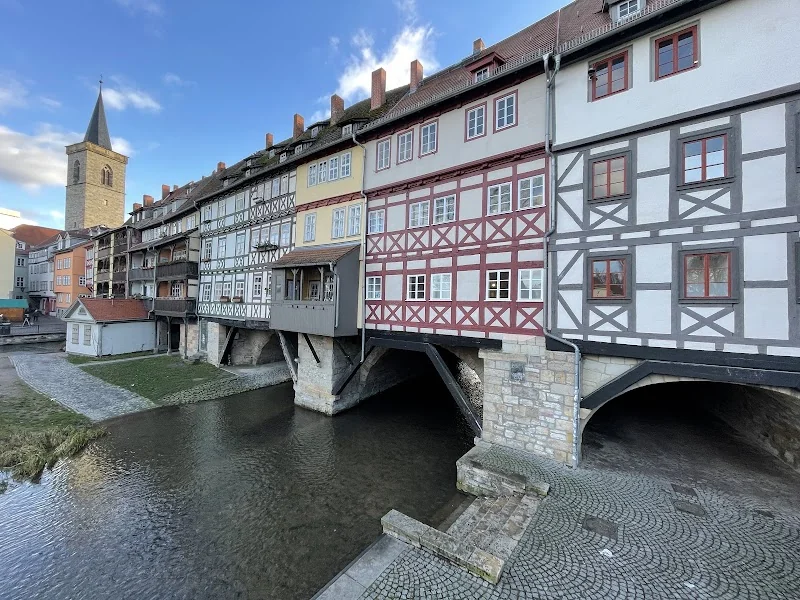
Krämerbrücke 7, Erfurt-Altstadt
Krämerbrücke 7, 99084 Erfurt, Germany
Medieval Mikveh | UNESCO World Heritage & Tours
The Medieval Mikveh in Erfurt is one of those places where history is not only told but can be experienced spatially. In the middle of the old town, not far from the Krämerbrücke, lies a medieval Jewish ritual bath, which today, together with the Old Synagogue and the Stone House, is part of the UNESCO World Heritage. For visitors, the Mikveh is therefore much more than an archaeological find: it is a key place to understand Jewish life, religious practice, urban density, and the handling of tradition in Erfurt. The ensemble is part of an urban culture of remembrance that shows in a confined space how deeply the medieval Jewish community was anchored in the daily life of the city and how much of this world could still be made visible despite expulsion, redevelopment, and later use. Today, the site connects authentic building substance with museum mediation, allowing the past to be comprehended not abstractly but on-site. Precisely because the Mikveh does not function like a classic museum, but as a historical space with a clear religious function, the visit feels so immediate. Those traveling to Erfurt will find here not a loud event venue but a quiet, impressive monument that fascinates with its location, history, and unique architectural form. ([unesco.de](https://www.unesco.de/staette/juedisch-mittelalterliches-erbe-in-erfurt/))
UNESCO World Heritage and Jewish History in Erfurt
The Medieval Mikveh stands in a historical context that is exceptionally well-documented for Erfurt. According to the German UNESCO Commission, the Jewish medieval heritage in Erfurt illustrates the life of the Jewish community and their coexistence with the Christian majority. This heritage includes the Old Synagogue, the Mikveh, and the Stone House, which are considered rare and exceptionally well-preserved examples of Central European Jewish buildings. This combination makes the site so significant: it is not just a single monument but part of a coherent urban history that spans from the late 11th century to the mid-14th century. UNESCO emphasizes that in Erfurt, the complete infrastructure of a medieval Jewish community could be uncovered, which is rare in this form. At the same time, the site reminds us of breaks, as Jewish life was shaped by pogroms, expulsion, and later redevelopment. The Mikveh itself was rediscovered in 2007 after having been forgotten for centuries. Today, it is recognized not only as a World Heritage site but also as a symbolic place for research, education, and remembrance. Those who know the historical background understand better why the Mikveh in the old town is not a casual sight but a central building block for understanding Jewish heritage in Central Europe. The official designation as a UNESCO cultural site also underscores that this is not just about local history but about a place of international significance where religious tradition, urban development, and material heritage come together in an impressive way. ([unesco.de](https://www.unesco.de/staette/juedisch-mittelalterliches-erbe-in-erfurt/))
Particularly noteworthy is how cohesive this history remains visible in Erfurt. UNESCO describes the ensemble as an adaptation to the specific spatial and social conditions of the city; that is, the buildings not only show religious practice but also the way a Jewish community integrated into urban daily life. The official explanations also make it clear that the Jewish medieval heritage of Erfurt cannot be viewed in isolation: the old town, trade routes, and residential and commercial spaces formed the framework in which Jewish and Christian residents lived side by side. This also shapes the perception of the Mikveh today. Those standing here do not look at a reconstructive outdoor object but at an authentic place embedded in the historical urban fabric. It is precisely this connection between World Heritage and urban space that makes the visit so powerful. The Mikveh tells not only of religious purification but also of presence, neighborhood, loss, and rediscovery. That the city of Erfurt and UNESCO jointly highlight this site as culturally significant shows how closely local history and European memory are intertwined. For SEO and search intentions around UNESCO World Heritage, Jewish heritage, and history, this connection is the core of the topic. ([unesco.de](https://www.unesco.de/staette/juedisch-mittelalterliches-erbe-in-erfurt/))
Architecture, Building Form, and Construction History of the Mikveh
The Medieval Mikveh is architecturally exciting because it does not copy a usual standard type but responds to the local situation in Erfurt. The city of Erfurt describes it as an early medieval Jewish ritual bath, whose main construction phase is dated to the mid-13th century, while an older construction phase is also verifiable. The construction method is unusual; there is currently no parallel for this form. This distinguishes the Erfurt Mikveh from more well-known shaft mikvehs in Cologne, Speyer, Worms, or Friedberg. While it belongs to this series of monumental community mikvehs, it simultaneously represents its own type. This is architecturally and cultural-historically important because the Mikveh is thus not just an example but a special case. The source situation is also interesting: the Mainz Hebrew scroll from 1248/49 mentions the Mikveh for the first time, and it can be traced back to around 1250 in the free rent registers for Severi. A plot of land on Krautgasse is mentioned as the location, immediately north of the Krämerbrücke, where the Cold Bath was located. Taken together, these written and archaeological clues show that the facility was already an integral part of the Jewish quarter in the High Middle Ages. The building itself measures about nine meters in length and just under three meters in width; the north wall has a niche, presumably for clothing that was left before the bath. The preserved step imprints on the north wall also reveal how access to the water basin was organized. Such details make the Mikveh a walkable history book because religious practice, architectural art, and everyday organization intertwine. ([juedisches-leben.erfurt.de](https://juedisches-leben.erfurt.de/jl/de/welterbe_werden/bewerbung/objekte/116860.html))
Equally impressive is the way the Mikveh received its water. The official information explains that the water supply was provided by groundwater, which was available in sufficient quantity in close proximity to the Gera. This allowed the regulations for ritual immersion to be adhered to even with seasonal fluctuations. The publication of the city of Erfurt adds that the water supply still functions today, although the water level is lower than in the Middle Ages, probably due to the later expansion of the flood ditch and the general decline of the groundwater level. That the facility was damaged, filled in, and then used as a cellar for a long time in the 14th and 15th centuries shows how a religious space can lose its function and still survive within the urban body. After the excavations, a protective structure was built to protect the remains from external influences while also allowing for museum presentation. Since September 2011, the Mikveh has been open to visitors. It is precisely this combination of archaeological substance, careful presentation, and clearly readable construction history that makes the Erfurt Mikveh so valuable. Those searching for terms like medieval Mikveh photos, medieval Mikveh Erfurt, or Mikveh building form will find here not just a beautiful motif but an exceptionally well-preserved historical system whose construction and function remain comprehensible to this day. ([juedisches-leben.erfurt.de](https://juedisches-leben.erfurt.de/mam/jl/we/jle_welterbe_informationsbausteine_unesco_version2_de_24-01.pdf))
Tours, Opening Hours, and Booking
The Medieval Mikveh is not a place for a free walk on your own, but a monument that is consciously conveyed through guided tours. According to official visitor information, the Mikveh can be visited as part of guided tours. Public tours take place on Thursdays and Fridays at 2:00 PM until about 2:45 PM, as well as on Saturdays and Sundays at 11:45 AM until about 12:30 PM. The meeting point is the Old Synagogue, which is practical because both places complement each other in content and space. The tours are free; donations are welcome. For groups, there is the option to book a private tour through the Old Synagogue. The official contact address is altesynagoge@erfurt.de, and a phone number is also provided. A group tour lasts about 45 minutes and costs 80 euros for a group of up to 25 people. This information is important for everyone planning their visit, as in this World Heritage site, not only the historical facts matter, but also the conditions of mediation. Those wanting to build a good SEO structure must answer exactly such questions: When is the Mikveh open? How long does a tour last? Where does the tour start? Do you need to reserve in advance? The answers are all available on the official pages, and they show that the visit is consciously designed as a guided historical experience. Particularly attractive is the fact that the offer takes place regularly and can be planned, making it suitable for short trips to Erfurt. ([juedisches-leben.erfurt.de](https://juedisches-leben.erfurt.de/jl/de/mittelalter/mikwe/besucherinfo/index.html))
Additionally, the Erfurt site also presents the Mikveh as part of special events and guided tours. For example, a tour with Dr. Karin Sczech was announced, focusing on the interior of the Mikveh and its unique architectural form. Such formats show that the mediation is not static but works with expertise, urban archaeology, and World Heritage communication. For visitors, this means: The tour is not only a condition for access but part of the experience. The ritual bath is not shown as a mere object but explained in the context of construction history, religious function, and rediscovery. Those who inform themselves will also discover that the Mikveh was originally long hidden and only came to light again through excavations. This is precisely why the guided visit is so meaningful; without explanation, many details of the protective structure, the stairs, the water basin, and the location in the urban space would be difficult to place. Therefore, those wishing to visit the Medieval Mikveh Erfurt should keep an eye on the tour times, arrive on time at the Old Synagogue, and prepare for a compact but content-rich tour. For search queries like Mikveh Erfurt opening hours, Mikveh Erfurt tour, or Mikveh Erfurt visitor information, the official visitor info provides exactly the practical answers needed before the visit. ([erfurt.de](https://www.erfurt.de/ef/de/erleben/veranstaltungen/vst/2025/jl_150755.html))
Photos, Interior, and Visitor Perspective
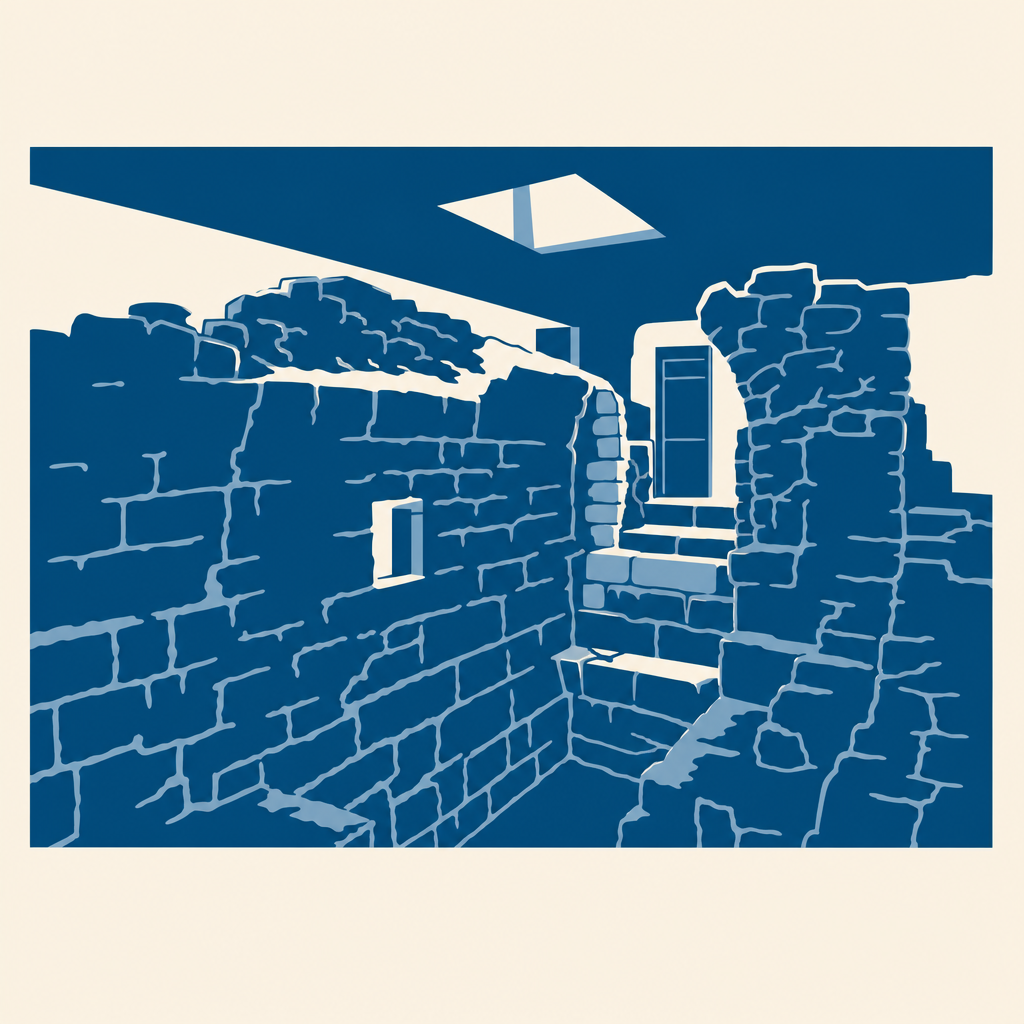
In many search queries, the image of the Mikveh is at the forefront, which is understandable: the facility appears in photos as simultaneously factual, archaeological, and atmospheric. Official pages from Erfurt show images, panoramas, and also virtual formats that provide a first impression. Particularly helpful is that the water basin in the protective structure is visible from above through a window. This allows for a clear idea of the actual ritual space even without a complete visit. The visual perception of the Mikveh thus consists of two levels: the protective structure as a modern shell and the preserved medieval structures inside. This combination makes the place so exciting for photos because not only a listed room is visible, but also the way archaeology is presented today. The official event page describes the Mikveh as a medieval Jewish ritual bath with a unique architectural form; this uniqueness can be visually captured well, even though the site is consciously protected and not openly accessible. Those searching for medieval Mikveh photos usually want to know what the monument actually looks like, and the answer is: It is not a large, spectacular showcase piece, but a quiet, concentrated place where stone, light, and protective architecture interact. It is precisely this restraint that creates the effect. The photos do not show over-staging but respect for an authentic historical find. ([erfurt.de](https://www.erfurt.de/ef/de/erleben/veranstaltungen/vst/2025/jl_150755.html))
Visitors experience on-site primarily the tension between visibility and protection. The ritual bath was provided with a protective structure after the excavations, which preserves the remains from external influences while also allowing for museum presentation. This idea shapes the entire tour: you do not just see a place; you also understand why it looks the way it does today. The view into the interior is therefore not a casual glance but a carefully framed access to a very old function. Additionally, the old town with its signposts, paths, and historical neighborhoods embeds the visit into a larger city tour. Both UNESCO and the city of Erfurt emphasize that Jewish traces remain present in the urban landscape and that the sites together form a historical overall picture. Therefore, those taking photos on-site do not just photograph a single monument but a whole narrative of rediscovery, research, and cultural mediation. This is particularly important for social media and discover texts, as it is essential to focus on the atmosphere: calm, historical, unexpected. The Mikveh is not an event location but a place of pause. This quality ensures that its images remain in the mind. ([juedisches-leben.erfurt.de](https://juedisches-leben.erfurt.de/jl/de/welterbe_werden/bewerbung/objekte/116860.html))
Location, Access, Parking, and Accessibility
The Mikveh is located in one of the most interesting historical zones of Erfurt. For a tour, the event location is given as Kreuzgasse, 99084 Erfurt, and the official visitor information refers to the city map of the Mikveh. Historical sources also mention the location on Krautgasse, immediately north of the Krämerbrücke. Thus, it is clear: the site is located in the heart of the old city and can be easily combined with a walk through the old town. Precisely because the Mikveh is located in the dense historical core, it is not a location with generous infrastructure like modern event venues. The visitor information explicitly states that there is no parking available. For guests, this means that it is best to plan the visit on foot, in combination with a city tour or via the approach to the Old Synagogue. This clarity is particularly important for search queries like Mikveh Erfurt parking or Mikveh Erfurt access, as it sets realistic expectations. Those arriving by car should not rely on parking spaces directly at the Mikveh but should plan for the old town's logic of paths and short distances. At the same time, the location is an advantage because it connects the visit with other sights and makes the historical context visible. The Mikveh is thus not isolated but embedded in a quarter where Jewish history, trade, and urban life meet. ([erfurt.de](https://www.erfurt.de/ef/de/erleben/veranstaltungen/vst/2025/jl_150755.html))
Also in terms of accessibility, the city of Erfurt sets concrete standards. The Mikveh has been certified according to the travel for all labeling system. The visitor information describes that the tour guides are trained for people with mobility impairments, visual impairments, hearing impairments, and cognitive disabilities. The entire route is step-free accessible for wheelchair users; additionally, seating is available if needed. For hearing-impaired guests, tours with FM systems are possible, and for blind or visually impaired visitors, tactile exhibits will be integrated. This shows that the mediation of the World Heritage is thought inclusively and does not rely solely on a classic museum visit. It is important that for some offers, prior registration is necessary, and the public tours are organized through the Erfurt Tourist Information. Practically, this means: those wishing to visit the Medieval Mikveh Erfurt should inform themselves in advance, select the date of the tour, and contact in good time for special needs. For an SEO text, these details are valuable as they answer specific questions and build trust. Especially at a historical site that is only accessible through guided tours, such information is crucial. The Mikveh is thus not only an outstanding monument but also a place where historical experience and good service come together. ([juedisches-leben.erfurt.de](https://juedisches-leben.erfurt.de/jl/de/mittelalter/mikwe/besucherinfo/index.html))
Sources:
- Visitor Information of the Mikveh - Jewish Life Erfurt
- Medieval Mikveh Erfurt - Jewish Life Erfurt
- Coexistence, Anti-Judaism, Pogrom, and Expulsion - Jewish Life Erfurt
- Jewish Medieval Heritage in Erfurt - German UNESCO Commission
- Tour: The Medieval Mikveh - Erfurt.de
- Tours in the Medieval Mikveh - Erfurt.de
Show moreShow less
Medieval Mikveh | UNESCO World Heritage & Tours
The Medieval Mikveh in Erfurt is one of those places where history is not only told but can be experienced spatially. In the middle of the old town, not far from the Krämerbrücke, lies a medieval Jewish ritual bath, which today, together with the Old Synagogue and the Stone House, is part of the UNESCO World Heritage. For visitors, the Mikveh is therefore much more than an archaeological find: it is a key place to understand Jewish life, religious practice, urban density, and the handling of tradition in Erfurt. The ensemble is part of an urban culture of remembrance that shows in a confined space how deeply the medieval Jewish community was anchored in the daily life of the city and how much of this world could still be made visible despite expulsion, redevelopment, and later use. Today, the site connects authentic building substance with museum mediation, allowing the past to be comprehended not abstractly but on-site. Precisely because the Mikveh does not function like a classic museum, but as a historical space with a clear religious function, the visit feels so immediate. Those traveling to Erfurt will find here not a loud event venue but a quiet, impressive monument that fascinates with its location, history, and unique architectural form. ([unesco.de](https://www.unesco.de/staette/juedisch-mittelalterliches-erbe-in-erfurt/))
UNESCO World Heritage and Jewish History in Erfurt
The Medieval Mikveh stands in a historical context that is exceptionally well-documented for Erfurt. According to the German UNESCO Commission, the Jewish medieval heritage in Erfurt illustrates the life of the Jewish community and their coexistence with the Christian majority. This heritage includes the Old Synagogue, the Mikveh, and the Stone House, which are considered rare and exceptionally well-preserved examples of Central European Jewish buildings. This combination makes the site so significant: it is not just a single monument but part of a coherent urban history that spans from the late 11th century to the mid-14th century. UNESCO emphasizes that in Erfurt, the complete infrastructure of a medieval Jewish community could be uncovered, which is rare in this form. At the same time, the site reminds us of breaks, as Jewish life was shaped by pogroms, expulsion, and later redevelopment. The Mikveh itself was rediscovered in 2007 after having been forgotten for centuries. Today, it is recognized not only as a World Heritage site but also as a symbolic place for research, education, and remembrance. Those who know the historical background understand better why the Mikveh in the old town is not a casual sight but a central building block for understanding Jewish heritage in Central Europe. The official designation as a UNESCO cultural site also underscores that this is not just about local history but about a place of international significance where religious tradition, urban development, and material heritage come together in an impressive way. ([unesco.de](https://www.unesco.de/staette/juedisch-mittelalterliches-erbe-in-erfurt/))
Particularly noteworthy is how cohesive this history remains visible in Erfurt. UNESCO describes the ensemble as an adaptation to the specific spatial and social conditions of the city; that is, the buildings not only show religious practice but also the way a Jewish community integrated into urban daily life. The official explanations also make it clear that the Jewish medieval heritage of Erfurt cannot be viewed in isolation: the old town, trade routes, and residential and commercial spaces formed the framework in which Jewish and Christian residents lived side by side. This also shapes the perception of the Mikveh today. Those standing here do not look at a reconstructive outdoor object but at an authentic place embedded in the historical urban fabric. It is precisely this connection between World Heritage and urban space that makes the visit so powerful. The Mikveh tells not only of religious purification but also of presence, neighborhood, loss, and rediscovery. That the city of Erfurt and UNESCO jointly highlight this site as culturally significant shows how closely local history and European memory are intertwined. For SEO and search intentions around UNESCO World Heritage, Jewish heritage, and history, this connection is the core of the topic. ([unesco.de](https://www.unesco.de/staette/juedisch-mittelalterliches-erbe-in-erfurt/))
Architecture, Building Form, and Construction History of the Mikveh
The Medieval Mikveh is architecturally exciting because it does not copy a usual standard type but responds to the local situation in Erfurt. The city of Erfurt describes it as an early medieval Jewish ritual bath, whose main construction phase is dated to the mid-13th century, while an older construction phase is also verifiable. The construction method is unusual; there is currently no parallel for this form. This distinguishes the Erfurt Mikveh from more well-known shaft mikvehs in Cologne, Speyer, Worms, or Friedberg. While it belongs to this series of monumental community mikvehs, it simultaneously represents its own type. This is architecturally and cultural-historically important because the Mikveh is thus not just an example but a special case. The source situation is also interesting: the Mainz Hebrew scroll from 1248/49 mentions the Mikveh for the first time, and it can be traced back to around 1250 in the free rent registers for Severi. A plot of land on Krautgasse is mentioned as the location, immediately north of the Krämerbrücke, where the Cold Bath was located. Taken together, these written and archaeological clues show that the facility was already an integral part of the Jewish quarter in the High Middle Ages. The building itself measures about nine meters in length and just under three meters in width; the north wall has a niche, presumably for clothing that was left before the bath. The preserved step imprints on the north wall also reveal how access to the water basin was organized. Such details make the Mikveh a walkable history book because religious practice, architectural art, and everyday organization intertwine. ([juedisches-leben.erfurt.de](https://juedisches-leben.erfurt.de/jl/de/welterbe_werden/bewerbung/objekte/116860.html))
Equally impressive is the way the Mikveh received its water. The official information explains that the water supply was provided by groundwater, which was available in sufficient quantity in close proximity to the Gera. This allowed the regulations for ritual immersion to be adhered to even with seasonal fluctuations. The publication of the city of Erfurt adds that the water supply still functions today, although the water level is lower than in the Middle Ages, probably due to the later expansion of the flood ditch and the general decline of the groundwater level. That the facility was damaged, filled in, and then used as a cellar for a long time in the 14th and 15th centuries shows how a religious space can lose its function and still survive within the urban body. After the excavations, a protective structure was built to protect the remains from external influences while also allowing for museum presentation. Since September 2011, the Mikveh has been open to visitors. It is precisely this combination of archaeological substance, careful presentation, and clearly readable construction history that makes the Erfurt Mikveh so valuable. Those searching for terms like medieval Mikveh photos, medieval Mikveh Erfurt, or Mikveh building form will find here not just a beautiful motif but an exceptionally well-preserved historical system whose construction and function remain comprehensible to this day. ([juedisches-leben.erfurt.de](https://juedisches-leben.erfurt.de/mam/jl/we/jle_welterbe_informationsbausteine_unesco_version2_de_24-01.pdf))
Tours, Opening Hours, and Booking
The Medieval Mikveh is not a place for a free walk on your own, but a monument that is consciously conveyed through guided tours. According to official visitor information, the Mikveh can be visited as part of guided tours. Public tours take place on Thursdays and Fridays at 2:00 PM until about 2:45 PM, as well as on Saturdays and Sundays at 11:45 AM until about 12:30 PM. The meeting point is the Old Synagogue, which is practical because both places complement each other in content and space. The tours are free; donations are welcome. For groups, there is the option to book a private tour through the Old Synagogue. The official contact address is altesynagoge@erfurt.de, and a phone number is also provided. A group tour lasts about 45 minutes and costs 80 euros for a group of up to 25 people. This information is important for everyone planning their visit, as in this World Heritage site, not only the historical facts matter, but also the conditions of mediation. Those wanting to build a good SEO structure must answer exactly such questions: When is the Mikveh open? How long does a tour last? Where does the tour start? Do you need to reserve in advance? The answers are all available on the official pages, and they show that the visit is consciously designed as a guided historical experience. Particularly attractive is the fact that the offer takes place regularly and can be planned, making it suitable for short trips to Erfurt. ([juedisches-leben.erfurt.de](https://juedisches-leben.erfurt.de/jl/de/mittelalter/mikwe/besucherinfo/index.html))
Additionally, the Erfurt site also presents the Mikveh as part of special events and guided tours. For example, a tour with Dr. Karin Sczech was announced, focusing on the interior of the Mikveh and its unique architectural form. Such formats show that the mediation is not static but works with expertise, urban archaeology, and World Heritage communication. For visitors, this means: The tour is not only a condition for access but part of the experience. The ritual bath is not shown as a mere object but explained in the context of construction history, religious function, and rediscovery. Those who inform themselves will also discover that the Mikveh was originally long hidden and only came to light again through excavations. This is precisely why the guided visit is so meaningful; without explanation, many details of the protective structure, the stairs, the water basin, and the location in the urban space would be difficult to place. Therefore, those wishing to visit the Medieval Mikveh Erfurt should keep an eye on the tour times, arrive on time at the Old Synagogue, and prepare for a compact but content-rich tour. For search queries like Mikveh Erfurt opening hours, Mikveh Erfurt tour, or Mikveh Erfurt visitor information, the official visitor info provides exactly the practical answers needed before the visit. ([erfurt.de](https://www.erfurt.de/ef/de/erleben/veranstaltungen/vst/2025/jl_150755.html))
Photos, Interior, and Visitor Perspective
In many search queries, the image of the Mikveh is at the forefront, which is understandable: the facility appears in photos as simultaneously factual, archaeological, and atmospheric. Official pages from Erfurt show images, panoramas, and also virtual formats that provide a first impression. Particularly helpful is that the water basin in the protective structure is visible from above through a window. This allows for a clear idea of the actual ritual space even without a complete visit. The visual perception of the Mikveh thus consists of two levels: the protective structure as a modern shell and the preserved medieval structures inside. This combination makes the place so exciting for photos because not only a listed room is visible, but also the way archaeology is presented today. The official event page describes the Mikveh as a medieval Jewish ritual bath with a unique architectural form; this uniqueness can be visually captured well, even though the site is consciously protected and not openly accessible. Those searching for medieval Mikveh photos usually want to know what the monument actually looks like, and the answer is: It is not a large, spectacular showcase piece, but a quiet, concentrated place where stone, light, and protective architecture interact. It is precisely this restraint that creates the effect. The photos do not show over-staging but respect for an authentic historical find. ([erfurt.de](https://www.erfurt.de/ef/de/erleben/veranstaltungen/vst/2025/jl_150755.html))
Visitors experience on-site primarily the tension between visibility and protection. The ritual bath was provided with a protective structure after the excavations, which preserves the remains from external influences while also allowing for museum presentation. This idea shapes the entire tour: you do not just see a place; you also understand why it looks the way it does today. The view into the interior is therefore not a casual glance but a carefully framed access to a very old function. Additionally, the old town with its signposts, paths, and historical neighborhoods embeds the visit into a larger city tour. Both UNESCO and the city of Erfurt emphasize that Jewish traces remain present in the urban landscape and that the sites together form a historical overall picture. Therefore, those taking photos on-site do not just photograph a single monument but a whole narrative of rediscovery, research, and cultural mediation. This is particularly important for social media and discover texts, as it is essential to focus on the atmosphere: calm, historical, unexpected. The Mikveh is not an event location but a place of pause. This quality ensures that its images remain in the mind. ([juedisches-leben.erfurt.de](https://juedisches-leben.erfurt.de/jl/de/welterbe_werden/bewerbung/objekte/116860.html))
Location, Access, Parking, and Accessibility
The Mikveh is located in one of the most interesting historical zones of Erfurt. For a tour, the event location is given as Kreuzgasse, 99084 Erfurt, and the official visitor information refers to the city map of the Mikveh. Historical sources also mention the location on Krautgasse, immediately north of the Krämerbrücke. Thus, it is clear: the site is located in the heart of the old city and can be easily combined with a walk through the old town. Precisely because the Mikveh is located in the dense historical core, it is not a location with generous infrastructure like modern event venues. The visitor information explicitly states that there is no parking available. For guests, this means that it is best to plan the visit on foot, in combination with a city tour or via the approach to the Old Synagogue. This clarity is particularly important for search queries like Mikveh Erfurt parking or Mikveh Erfurt access, as it sets realistic expectations. Those arriving by car should not rely on parking spaces directly at the Mikveh but should plan for the old town's logic of paths and short distances. At the same time, the location is an advantage because it connects the visit with other sights and makes the historical context visible. The Mikveh is thus not isolated but embedded in a quarter where Jewish history, trade, and urban life meet. ([erfurt.de](https://www.erfurt.de/ef/de/erleben/veranstaltungen/vst/2025/jl_150755.html))
Also in terms of accessibility, the city of Erfurt sets concrete standards. The Mikveh has been certified according to the travel for all labeling system. The visitor information describes that the tour guides are trained for people with mobility impairments, visual impairments, hearing impairments, and cognitive disabilities. The entire route is step-free accessible for wheelchair users; additionally, seating is available if needed. For hearing-impaired guests, tours with FM systems are possible, and for blind or visually impaired visitors, tactile exhibits will be integrated. This shows that the mediation of the World Heritage is thought inclusively and does not rely solely on a classic museum visit. It is important that for some offers, prior registration is necessary, and the public tours are organized through the Erfurt Tourist Information. Practically, this means: those wishing to visit the Medieval Mikveh Erfurt should inform themselves in advance, select the date of the tour, and contact in good time for special needs. For an SEO text, these details are valuable as they answer specific questions and build trust. Especially at a historical site that is only accessible through guided tours, such information is crucial. The Mikveh is thus not only an outstanding monument but also a place where historical experience and good service come together. ([juedisches-leben.erfurt.de](https://juedisches-leben.erfurt.de/jl/de/mittelalter/mikwe/besucherinfo/index.html))
Sources:
- Visitor Information of the Mikveh - Jewish Life Erfurt
- Medieval Mikveh Erfurt - Jewish Life Erfurt
- Coexistence, Anti-Judaism, Pogrom, and Expulsion - Jewish Life Erfurt
- Jewish Medieval Heritage in Erfurt - German UNESCO Commission
- Tour: The Medieval Mikveh - Erfurt.de
- Tours in the Medieval Mikveh - Erfurt.de
Medieval Mikveh | UNESCO World Heritage & Tours
The Medieval Mikveh in Erfurt is one of those places where history is not only told but can be experienced spatially. In the middle of the old town, not far from the Krämerbrücke, lies a medieval Jewish ritual bath, which today, together with the Old Synagogue and the Stone House, is part of the UNESCO World Heritage. For visitors, the Mikveh is therefore much more than an archaeological find: it is a key place to understand Jewish life, religious practice, urban density, and the handling of tradition in Erfurt. The ensemble is part of an urban culture of remembrance that shows in a confined space how deeply the medieval Jewish community was anchored in the daily life of the city and how much of this world could still be made visible despite expulsion, redevelopment, and later use. Today, the site connects authentic building substance with museum mediation, allowing the past to be comprehended not abstractly but on-site. Precisely because the Mikveh does not function like a classic museum, but as a historical space with a clear religious function, the visit feels so immediate. Those traveling to Erfurt will find here not a loud event venue but a quiet, impressive monument that fascinates with its location, history, and unique architectural form. ([unesco.de](https://www.unesco.de/staette/juedisch-mittelalterliches-erbe-in-erfurt/))
UNESCO World Heritage and Jewish History in Erfurt
The Medieval Mikveh stands in a historical context that is exceptionally well-documented for Erfurt. According to the German UNESCO Commission, the Jewish medieval heritage in Erfurt illustrates the life of the Jewish community and their coexistence with the Christian majority. This heritage includes the Old Synagogue, the Mikveh, and the Stone House, which are considered rare and exceptionally well-preserved examples of Central European Jewish buildings. This combination makes the site so significant: it is not just a single monument but part of a coherent urban history that spans from the late 11th century to the mid-14th century. UNESCO emphasizes that in Erfurt, the complete infrastructure of a medieval Jewish community could be uncovered, which is rare in this form. At the same time, the site reminds us of breaks, as Jewish life was shaped by pogroms, expulsion, and later redevelopment. The Mikveh itself was rediscovered in 2007 after having been forgotten for centuries. Today, it is recognized not only as a World Heritage site but also as a symbolic place for research, education, and remembrance. Those who know the historical background understand better why the Mikveh in the old town is not a casual sight but a central building block for understanding Jewish heritage in Central Europe. The official designation as a UNESCO cultural site also underscores that this is not just about local history but about a place of international significance where religious tradition, urban development, and material heritage come together in an impressive way. ([unesco.de](https://www.unesco.de/staette/juedisch-mittelalterliches-erbe-in-erfurt/))
Particularly noteworthy is how cohesive this history remains visible in Erfurt. UNESCO describes the ensemble as an adaptation to the specific spatial and social conditions of the city; that is, the buildings not only show religious practice but also the way a Jewish community integrated into urban daily life. The official explanations also make it clear that the Jewish medieval heritage of Erfurt cannot be viewed in isolation: the old town, trade routes, and residential and commercial spaces formed the framework in which Jewish and Christian residents lived side by side. This also shapes the perception of the Mikveh today. Those standing here do not look at a reconstructive outdoor object but at an authentic place embedded in the historical urban fabric. It is precisely this connection between World Heritage and urban space that makes the visit so powerful. The Mikveh tells not only of religious purification but also of presence, neighborhood, loss, and rediscovery. That the city of Erfurt and UNESCO jointly highlight this site as culturally significant shows how closely local history and European memory are intertwined. For SEO and search intentions around UNESCO World Heritage, Jewish heritage, and history, this connection is the core of the topic. ([unesco.de](https://www.unesco.de/staette/juedisch-mittelalterliches-erbe-in-erfurt/))
Architecture, Building Form, and Construction History of the Mikveh
The Medieval Mikveh is architecturally exciting because it does not copy a usual standard type but responds to the local situation in Erfurt. The city of Erfurt describes it as an early medieval Jewish ritual bath, whose main construction phase is dated to the mid-13th century, while an older construction phase is also verifiable. The construction method is unusual; there is currently no parallel for this form. This distinguishes the Erfurt Mikveh from more well-known shaft mikvehs in Cologne, Speyer, Worms, or Friedberg. While it belongs to this series of monumental community mikvehs, it simultaneously represents its own type. This is architecturally and cultural-historically important because the Mikveh is thus not just an example but a special case. The source situation is also interesting: the Mainz Hebrew scroll from 1248/49 mentions the Mikveh for the first time, and it can be traced back to around 1250 in the free rent registers for Severi. A plot of land on Krautgasse is mentioned as the location, immediately north of the Krämerbrücke, where the Cold Bath was located. Taken together, these written and archaeological clues show that the facility was already an integral part of the Jewish quarter in the High Middle Ages. The building itself measures about nine meters in length and just under three meters in width; the north wall has a niche, presumably for clothing that was left before the bath. The preserved step imprints on the north wall also reveal how access to the water basin was organized. Such details make the Mikveh a walkable history book because religious practice, architectural art, and everyday organization intertwine. ([juedisches-leben.erfurt.de](https://juedisches-leben.erfurt.de/jl/de/welterbe_werden/bewerbung/objekte/116860.html))
Equally impressive is the way the Mikveh received its water. The official information explains that the water supply was provided by groundwater, which was available in sufficient quantity in close proximity to the Gera. This allowed the regulations for ritual immersion to be adhered to even with seasonal fluctuations. The publication of the city of Erfurt adds that the water supply still functions today, although the water level is lower than in the Middle Ages, probably due to the later expansion of the flood ditch and the general decline of the groundwater level. That the facility was damaged, filled in, and then used as a cellar for a long time in the 14th and 15th centuries shows how a religious space can lose its function and still survive within the urban body. After the excavations, a protective structure was built to protect the remains from external influences while also allowing for museum presentation. Since September 2011, the Mikveh has been open to visitors. It is precisely this combination of archaeological substance, careful presentation, and clearly readable construction history that makes the Erfurt Mikveh so valuable. Those searching for terms like medieval Mikveh photos, medieval Mikveh Erfurt, or Mikveh building form will find here not just a beautiful motif but an exceptionally well-preserved historical system whose construction and function remain comprehensible to this day. ([juedisches-leben.erfurt.de](https://juedisches-leben.erfurt.de/mam/jl/we/jle_welterbe_informationsbausteine_unesco_version2_de_24-01.pdf))
Tours, Opening Hours, and Booking
The Medieval Mikveh is not a place for a free walk on your own, but a monument that is consciously conveyed through guided tours. According to official visitor information, the Mikveh can be visited as part of guided tours. Public tours take place on Thursdays and Fridays at 2:00 PM until about 2:45 PM, as well as on Saturdays and Sundays at 11:45 AM until about 12:30 PM. The meeting point is the Old Synagogue, which is practical because both places complement each other in content and space. The tours are free; donations are welcome. For groups, there is the option to book a private tour through the Old Synagogue. The official contact address is altesynagoge@erfurt.de, and a phone number is also provided. A group tour lasts about 45 minutes and costs 80 euros for a group of up to 25 people. This information is important for everyone planning their visit, as in this World Heritage site, not only the historical facts matter, but also the conditions of mediation. Those wanting to build a good SEO structure must answer exactly such questions: When is the Mikveh open? How long does a tour last? Where does the tour start? Do you need to reserve in advance? The answers are all available on the official pages, and they show that the visit is consciously designed as a guided historical experience. Particularly attractive is the fact that the offer takes place regularly and can be planned, making it suitable for short trips to Erfurt. ([juedisches-leben.erfurt.de](https://juedisches-leben.erfurt.de/jl/de/mittelalter/mikwe/besucherinfo/index.html))
Additionally, the Erfurt site also presents the Mikveh as part of special events and guided tours. For example, a tour with Dr. Karin Sczech was announced, focusing on the interior of the Mikveh and its unique architectural form. Such formats show that the mediation is not static but works with expertise, urban archaeology, and World Heritage communication. For visitors, this means: The tour is not only a condition for access but part of the experience. The ritual bath is not shown as a mere object but explained in the context of construction history, religious function, and rediscovery. Those who inform themselves will also discover that the Mikveh was originally long hidden and only came to light again through excavations. This is precisely why the guided visit is so meaningful; without explanation, many details of the protective structure, the stairs, the water basin, and the location in the urban space would be difficult to place. Therefore, those wishing to visit the Medieval Mikveh Erfurt should keep an eye on the tour times, arrive on time at the Old Synagogue, and prepare for a compact but content-rich tour. For search queries like Mikveh Erfurt opening hours, Mikveh Erfurt tour, or Mikveh Erfurt visitor information, the official visitor info provides exactly the practical answers needed before the visit. ([erfurt.de](https://www.erfurt.de/ef/de/erleben/veranstaltungen/vst/2025/jl_150755.html))
Photos, Interior, and Visitor Perspective
In many search queries, the image of the Mikveh is at the forefront, which is understandable: the facility appears in photos as simultaneously factual, archaeological, and atmospheric. Official pages from Erfurt show images, panoramas, and also virtual formats that provide a first impression. Particularly helpful is that the water basin in the protective structure is visible from above through a window. This allows for a clear idea of the actual ritual space even without a complete visit. The visual perception of the Mikveh thus consists of two levels: the protective structure as a modern shell and the preserved medieval structures inside. This combination makes the place so exciting for photos because not only a listed room is visible, but also the way archaeology is presented today. The official event page describes the Mikveh as a medieval Jewish ritual bath with a unique architectural form; this uniqueness can be visually captured well, even though the site is consciously protected and not openly accessible. Those searching for medieval Mikveh photos usually want to know what the monument actually looks like, and the answer is: It is not a large, spectacular showcase piece, but a quiet, concentrated place where stone, light, and protective architecture interact. It is precisely this restraint that creates the effect. The photos do not show over-staging but respect for an authentic historical find. ([erfurt.de](https://www.erfurt.de/ef/de/erleben/veranstaltungen/vst/2025/jl_150755.html))
Visitors experience on-site primarily the tension between visibility and protection. The ritual bath was provided with a protective structure after the excavations, which preserves the remains from external influences while also allowing for museum presentation. This idea shapes the entire tour: you do not just see a place; you also understand why it looks the way it does today. The view into the interior is therefore not a casual glance but a carefully framed access to a very old function. Additionally, the old town with its signposts, paths, and historical neighborhoods embeds the visit into a larger city tour. Both UNESCO and the city of Erfurt emphasize that Jewish traces remain present in the urban landscape and that the sites together form a historical overall picture. Therefore, those taking photos on-site do not just photograph a single monument but a whole narrative of rediscovery, research, and cultural mediation. This is particularly important for social media and discover texts, as it is essential to focus on the atmosphere: calm, historical, unexpected. The Mikveh is not an event location but a place of pause. This quality ensures that its images remain in the mind. ([juedisches-leben.erfurt.de](https://juedisches-leben.erfurt.de/jl/de/welterbe_werden/bewerbung/objekte/116860.html))
Location, Access, Parking, and Accessibility
The Mikveh is located in one of the most interesting historical zones of Erfurt. For a tour, the event location is given as Kreuzgasse, 99084 Erfurt, and the official visitor information refers to the city map of the Mikveh. Historical sources also mention the location on Krautgasse, immediately north of the Krämerbrücke. Thus, it is clear: the site is located in the heart of the old city and can be easily combined with a walk through the old town. Precisely because the Mikveh is located in the dense historical core, it is not a location with generous infrastructure like modern event venues. The visitor information explicitly states that there is no parking available. For guests, this means that it is best to plan the visit on foot, in combination with a city tour or via the approach to the Old Synagogue. This clarity is particularly important for search queries like Mikveh Erfurt parking or Mikveh Erfurt access, as it sets realistic expectations. Those arriving by car should not rely on parking spaces directly at the Mikveh but should plan for the old town's logic of paths and short distances. At the same time, the location is an advantage because it connects the visit with other sights and makes the historical context visible. The Mikveh is thus not isolated but embedded in a quarter where Jewish history, trade, and urban life meet. ([erfurt.de](https://www.erfurt.de/ef/de/erleben/veranstaltungen/vst/2025/jl_150755.html))
Also in terms of accessibility, the city of Erfurt sets concrete standards. The Mikveh has been certified according to the travel for all labeling system. The visitor information describes that the tour guides are trained for people with mobility impairments, visual impairments, hearing impairments, and cognitive disabilities. The entire route is step-free accessible for wheelchair users; additionally, seating is available if needed. For hearing-impaired guests, tours with FM systems are possible, and for blind or visually impaired visitors, tactile exhibits will be integrated. This shows that the mediation of the World Heritage is thought inclusively and does not rely solely on a classic museum visit. It is important that for some offers, prior registration is necessary, and the public tours are organized through the Erfurt Tourist Information. Practically, this means: those wishing to visit the Medieval Mikveh Erfurt should inform themselves in advance, select the date of the tour, and contact in good time for special needs. For an SEO text, these details are valuable as they answer specific questions and build trust. Especially at a historical site that is only accessible through guided tours, such information is crucial. The Mikveh is thus not only an outstanding monument but also a place where historical experience and good service come together. ([juedisches-leben.erfurt.de](https://juedisches-leben.erfurt.de/jl/de/mittelalter/mikwe/besucherinfo/index.html))
Sources:
- Visitor Information of the Mikveh - Jewish Life Erfurt
- Medieval Mikveh Erfurt - Jewish Life Erfurt
- Coexistence, Anti-Judaism, Pogrom, and Expulsion - Jewish Life Erfurt
- Jewish Medieval Heritage in Erfurt - German UNESCO Commission
- Tour: The Medieval Mikveh - Erfurt.de
- Tours in the Medieval Mikveh - Erfurt.de
Frequently Asked Questions
Reviews
Yevhenii Bondarenko
9. July 2022
Wow 🤩
Charline P (Truck)
4. April 2017
Cool! Interesting!
Thomas Ruckriegel
11. August 2025
Allegedly hard to find. I can't confirm that. Firstly, there's Google Maps, and secondly, its design makes it quite noticeable. Additional signs explain its construction. Unfortunately, the glass is already very scratched, and the lighting isn't very strong. This could be improved.
Miss Piggy
28. September 2025
The mikveh is an immersion bath and an important part of the Jewish community. It serves as a place of ritual purification. It was rediscovered and excavated in 2007 near the Merchants' Bridge, on the Gera River. We discovered it only by chance.
Marisa Martin
22. August 2023
A beautiful spot in one of Germany's most beautiful cities, locals take advantage of its waters to swim on hot summer days. It's one of the longest bridges in Europe (the Merchants' Bridge), with houses that have been converted into swimming areas.