
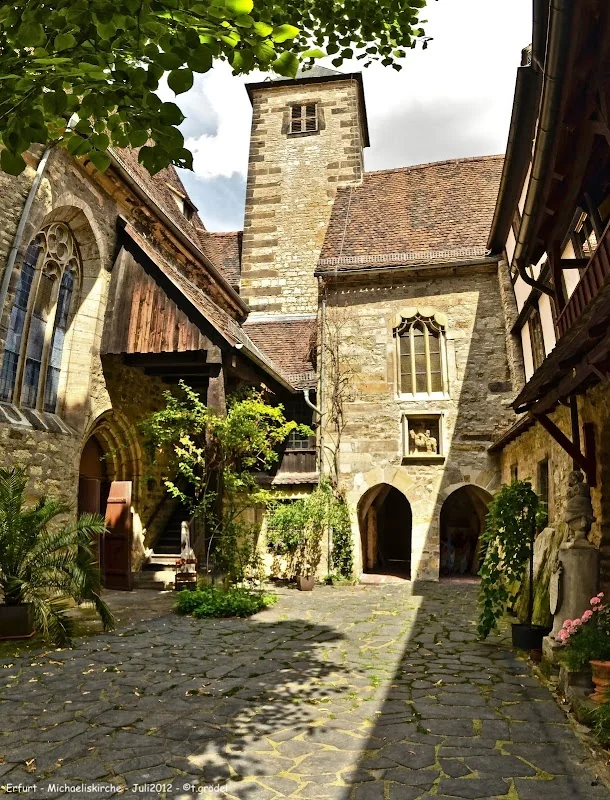
Erfurt
Michaelisstraße 11, 99084 Erfurt, Deutschland
Michaeliskirche Erfurt | Events & Luther
The Michaeliskirche in Erfurt is much more than a historic house of worship: It is a place where medieval architecture, Reformation history, spiritual life, and cultural events are closely intertwined. Visitors to the church on Michaelisstraße enter one of the oldest places of worship in the city and at the same time a space that is still used today for services, concerts, musical vespers, exhibitions, and organ music. Particularly impressive is its location in the former university district, directly opposite the Collegium maius, which makes the close connection of the church to the old University of Erfurt visible. This blend of history, atmosphere, and vibrant use continues to shape the character of the Michaeliskirche to this day. It is publicly accessible, admission is free, and it offers enough depth of content to appeal to both culture enthusiasts and travelers with a penchant for Reformation history. Anyone wanting to understand Erfurt cannot overlook this church, as it vividly connects the paths of city history, faith, and music. ([lange-naechte.erfurt.de](https://lange-naechte.erfurt.de/ln/de/kirchennacht/stationen/116458.html?utm_source=openai))
Events, Concerts, and Musical Program
For many visitors, the Michaeliskirche today is primarily a place of experience. The official tourism entry mentions concerts in the Michaeliskirchhof from early June to late August, musical vespers from early September to late May every Saturday at 5 PM, concerts in the church space, as well as regularly occurring exhibitions. Additionally, there are organ concerts on Wednesdays between 12:00 and 12:30 PM. This makes the church a cultural venue with a clear profile: It is not just about a single annual event, but about a continuous program that offers variety over many months. The current events section of the Michaeliskirche also shows that workshop events, special concerts, vespers, and music evenings coexist there. This is particularly important for searches related to Michaeliskirche events, as it reveals that behind it lies not just a building, but a vibrant event location. The church functions on multiple levels simultaneously: as a sacred space, as an acoustically appealing concert venue, and as a meeting point for people seeking music in a special ambiance. Those planning cultural experiences in Erfurt will find an offering here that pleasantly stands out from the usual event calendar of the city. The combination of a historic setting, small scale, and regular formats makes the Michaeliskirche a place that one does not just visit once, but to which one returns purposefully. ([erfurt-tourismus.de](https://www.erfurt-tourismus.de/sehens-wissenswertes/sehenswertes/weitere/michaeliskirche/?utm_source=openai))
Especially in the context of events, the atmosphere around the church is also crucial. The Michaeliskirchhof and the historic surroundings of Michaelisstraße give concerts and vespers a distinctly different character than a classical concert hall. In summer, when concerts take place in the churchyard, the place feels open, almost courtyard-like, and very close to the historical building substance. In the cooler months, the focus shifts to the church space, where the acoustics are particularly suitable for organ music, choral singing, or spiritual music. The official site points out that concerts in the church space are pleasantly popular, and the recurring dates confirm that the Michaeliskirche is not only used for tourism but also culturally. For SEO relevance, this combination is important: People search for programs, concerts, organ concerts, or musical vespers and mean a specific place that is regularly used. The Michaeliskirche meets this search interest with a mix of tradition and present. Those looking for a cultural experience that is not loud but impressive will find a very suitable place here. ([erfurt-tourismus.de](https://www.erfurt-tourismus.de/sehens-wissenswertes/sehenswertes/weitere/michaeliskirche/?utm_source=openai))
History, Luther, and University Church
The historical significance of the Michaeliskirche is exceptionally well documented. According to the official Erfurt entry, the church was built between 1278 and 1290; it was constructed on the foundations of an older predecessor building, of which the lower floors of the late Romanesque tower are still preserved today. Thus, it is one of the oldest churches in the city and symbolizes the long continuity of Christian and urban life in Erfurt. Its role as a university church is particularly important: With the founding of the University of Erfurt and the construction of the Collegium maius directly opposite the church, it became the university church in 1392. This directly links the Michaeliskirche to the educational history of the city and to the humanistic milieu of medieval Erfurt. The location in the former university district underscores this special function to this day. For the history of the Reformation, the place is also central, as Martin Luther regularly attended services at the Michaeliskirche during his studies in Erfurt from 1501 to 1505, and on October 21, 1522, he preached there himself. This connection to Luther makes the church a significant memorial site where Reformation history becomes very tangible rather than abstract. Thus, anyone walking through the Michaeliskirche stands in a space that connects university, church, and Reformation history. This multilayeredness explains why the church is so attractive for both city tours and visitors interested in cultural history. ([lange-naechte.erfurt.de](https://lange-naechte.erfurt.de/ln/de/kirchennacht/stationen/116458.html?utm_source=openai))
The references to Luther go beyond a mere commemorative mark. The Michaeliskirche is one of the stations that are repeatedly mentioned in Erfurt in connection with Luther's life path. The tourism entry explicitly points out that Luther preached in the Michaeliskirche, and the city and tourism representations emphasize the close proximity to the Collegium maius, the central building of the old university. This makes it understandable why the church appears in many historical Erfurt routes and thematic city tours. Those interested in the young Luther will find here an authentic place from his Erfurt years, where study, worship, and spiritual development came together. The role of the Michaeliskirche in late medieval urban life becomes clearer through this: it was not an isolated building but part of an urban educational and religious space. In SEO terms, users therefore search not only for Michaeliskirche history but also for Michaeliskirche Luther, university church, or Michaeliskirche old town Erfurt. Exactly these themes are still thought together in Erfurt today, and that is why the church has such strong thematic depth for visitors who are not only looking for a sight but a historical context. ([erfurt-tourismus.de](https://www.erfurt-tourismus.de/sehens-wissenswertes/sehenswertes/weitere/michaeliskirche/?utm_source=openai))
Access, Parking, and Opening Hours
Practically, the Michaeliskirche is also well embedded in the Erfurt old town. The official entry states the address Michaelisstraße 11 in 99084 Erfurt and points out that the church is about 350 meters from the tram. For visitors arriving by car, the nearby parking option mentioned is the parking garage Domplatz at Bechtheimer Straße 1. This is an important point for the old town, as the area around Michaelisstraße is one of the central and historically densely built parts of Erfurt. Those who are there benefit from short distances but should keep in mind the typical city center logic: In the historic center, public transport is often the most pleasant and stress-free choice. The fact that the Michaeliskirche is also publicly accessible and offers free admission makes a spontaneous visit particularly uncomplicated. The official information on mobility is also useful: bicycle boxes are available, photography is allowed, and sanitary facilities are not listed as available in the entry. These details are particularly relevant for travel planning and searches for Michaeliskirche access or Michaeliskirche parking, as they significantly ease the decision to visit. The current tourism entry also notes opening hours from Monday to Saturday between 11:00 AM and 3:30 PM. Those planning a visit on a specific day should check these times briefly again, but they are very helpful for initial orientation. Overall, it shows: The Michaeliskirche is not a hard-to-reach specialty destination but a well-accessible sight in the inner-city pedestrian network of Erfurt. ([erfurt.de](https://www.erfurt.de/ef/de/erleben/gemeinden/ev/147417.html?utm_source=openai))
For visitors, the combination of location and environment is also attractive. The church is located in a neighborhood that is closely connected to the medieval university district. This makes it easy to combine a visit with other sights, such as the Collegium maius, the historic city center, or other stations of the Erfurt old town. Particularly practical is that the entry not only mentions the address but also the immediate mobility framework: tram in short distance, parking garage nearby, free admission, and public accessibility. This creates planning security, especially when the visit takes place as part of a city stroll or cultural trip. Those interested in Michaeliskirche opening hours will find concrete information instead of vague formulations. And those traveling by bicycle can see the available bicycle boxes as a plus, as they make the visit more practical. In a historic old town like Erfurt, this practical usability is important: a historic church should not only be beautiful but also fit easily into a day's plan. The Michaeliskirche fulfills this very well, as it appears like a monument on one hand, while on the other hand, it is kept openly with its visitor information. ([erfurt-tourismus.de](https://www.erfurt-tourismus.de/sehens-wissenswertes/sehenswertes/weitere/michaeliskirche/?utm_source=openai))
Architecture, Bells, and Special Details
Architecturally, the Michaeliskirche is described in the tourism entry as Gothic, while the historical description refers to the late Romanesque origin of the tower and the later Gothic shaping of the church building. This mixture is precisely what makes it appealing: an older structural core remains visible, while the later construction phase shapes the current overall impression. For visitors, this means that the church does not appear as a completely uniform building but shows the layers of its history. Particularly striking is the tower, whose lower floors are preserved from the older predecessor building. In the vicinity of the church, the Laasphe Chapel is also mentioned as part of the medieval ensemble, which further increases the historical density of the place. The bells also deserve attention: the Michaeliskirche has three bells that are rung by hand, including the Katharina, the oldest bell in Erfurt. Such details are interesting not only for bell enthusiasts but also underscore the living practice of the place. A hand-rung bell is a sign that tradition is not only displayed in a museum-like manner but is actually maintained. This makes the Michaeliskirche a place where history becomes audible. Those who visit attentively will thus experience not only architecture but also acoustic and ritual continuity. In connection with the Gothic architectural form, the historical remains of the tower, and the proximity to the old university district, a very complete picture of a medieval sacred space emerges, which is still present in the urban memory. ([erfurt-tourismus.de](https://www.erfurt-tourismus.de/sehens-wissenswertes/sehenswertes/weitere/michaeliskirche/?utm_source=openai))
Another important aspect is the use of the interior and exterior space. The Michaeliskirche is not only described as a monument but also as a place where exhibitions, concerts, and spiritual formats take place. This means that the architecture is not just a backdrop but directly influences the use. The church space hosts cultural events, the churchyard becomes a stage in the summer months, and the location on Michaelisstraße anchors the ensemble in the historic cityscape. Those searching for Michaeliskirche exhibitions, Michaeliskirche organ concerts, or Michaeliskirche churchyard will encounter this connection of architecture and program. The official Erfurt representation of the church as part of the tourist highlights of Protestant Erfurt shows that the architectural appearance is embedded in a larger cultural narrative. The Michaeliskirche exemplifies Erfurt's strength as a city of short distances and long stories: an old building that does not appear complete but continues to live through its current use. This church is particularly attractive for visitors who love historical building substance and atmospheric places. ([kirchenkreis-erfurt.de](https://www.kirchenkreis-erfurt.de/kirchenkreis/tourismus-kultur/?utm_source=openai))
Michaelisstraße, Collegium maius, and Old Town Environment
The Michaeliskirche is hardly understandable without its surroundings. The place is located in the middle of the historic university district of Erfurt, opposite the Collegium maius, the main building of the old university. Several official representations emphasize this location and thus make visible how strongly church, education, and city history are intertwined here. For visitors, this creates a particularly dense urban space: narrow alleys, medieval buildings, historic courtyards, and a church building that is seamlessly embedded in this environment. Michaelisstraße itself is one of the most well-known streets in the old town and leads through an area that many perceive as the historic heart of Erfurt. That the Michaeliskirche stands in this neighborhood is no coincidence but an expression of its long role as a spiritual and university center. The Jewish city history of Erfurt also has its place in this environment, as historical sources locate the residential area of the Jewish community in the Middle Ages between the town hall, Krämerbrücke, and Michaeliskirche. This makes it clear that the place was an important stage not only for church history but for the entire city history. For an SEO-optimized description, this environment is particularly valuable because search queries often seek not only the church itself but also the old town, university district, Luther stations, or historical sights in the vicinity. The Michaeliskirche provides an ideal hub for this. Those standing here can discover further layers of Erfurt's history in just a few steps and quickly understand why the city is still perceived as a very compact, historically rich urban space. ([erfurt.de](https://www.erfurt.de/ef/de/erleben/besuch/luther/staetten/116856.html?utm_source=openai))
This embedding also makes the visit emotionally interesting. The Michaeliskirche is not an isolated single building but part of a vibrant cultural space where academic tradition, religious practice, and tourist use intersect. This explains why the church appears in tours, Luther routes, and cultural programs alike. The area around Michaelisstraße and the Collegium maius still conveys a sense of medieval density that has become rare in modern city centers. At the same time, the place remains open and accessible: free visits, regular concerts, changing exhibitions, and a clearly designated access via public transport or the parking garage Domplatz. This mixture of accessibility and historical depth makes the Michaeliskirche an attractive destination. For visitors getting to know Erfurt for the first time, the place is an excellent starting point for further discoveries. For returnees, it offers the charm of seeing new details with each visit: the tower, the churchyard, the surroundings, or the traces of university history. Thus, the Michaeliskirche becomes a key place that not only describes Erfurt but makes it tangible. ([erfurt-tourismus.de](https://www.erfurt-tourismus.de/sehens-wissenswertes/sehenswertes/weitere/michaeliskirche/?utm_source=openai))
Practical Tips for the Visit
Those wishing to visit the Michaeliskirche benefit from some clear practical information. The tourism entry mentions free admission and public accessibility, which facilitates spontaneous visits. Additionally, photography is allowed, and bicycle boxes are available. For many travelers, these are small but important details because they show that the church not only tolerates visitors but actively welcomes them. At the same time, the entry points out the absence of sanitary facilities, so this should be considered during longer stays in the old town. The church is particularly suitable for a combined visit with a city walk, service, music event, or historical tour. Thanks to its location on Michaelisstraße, other sights are quickly reachable, and the proximity to the tram makes even short visits uncomplicated. Those looking for current opening hours will find a specific framework in the tourism entry from Monday to Saturday between 11:00 AM and 3:30 PM. For event visits, one should additionally check the official event page, as new programs, special concerts, and vesper dates are regularly published there. This is especially important if the visit is to be linked to a specific concert or musical service. Overall, the Michaeliskirche is a very accessible destination that combines historical depth with good everyday usability. That is why it is equally interesting for tourists, culture enthusiasts, church visitors, and those seeking a quiet, atmospheric place. ([erfurt-tourismus.de](https://www.erfurt-tourismus.de/sehens-wissenswertes/sehenswertes/weitere/michaeliskirche/?utm_source=openai))
In summary, the Michaeliskirche in Erfurt is an exceptionally versatile sight. It is historically significant because it dates back to the late 13th century and became a university church in 1392. It is religiously and culturally important because Martin Luther regularly attended mass here during his Erfurt years and preached here himself in 1522. It is alive today because concerts, vespers, exhibitions, and organ music create a real rhythm of events. And it is practically well accessible because parking, public transport connections, and public accessibility are clearly stated. So if you are looking for a church that not only looks beautiful but has a lot to tell content-wise, the Michaeliskirche Erfurt is the right destination. For SEO purposes, the topics of events, Luther, history, access, parking, and university church are particularly relevant because they best reflect the real search interest of visitors. The Michaeliskirche thus stands for a rarely successful combination of historical depth, cultural use, and reliable visitor information. ([lange-naechte.erfurt.de](https://lange-naechte.erfurt.de/ln/de/kirchennacht/stationen/116458.html?utm_source=openai))
Sources:
Show moreShow less
Michaeliskirche Erfurt | Events & Luther
The Michaeliskirche in Erfurt is much more than a historic house of worship: It is a place where medieval architecture, Reformation history, spiritual life, and cultural events are closely intertwined. Visitors to the church on Michaelisstraße enter one of the oldest places of worship in the city and at the same time a space that is still used today for services, concerts, musical vespers, exhibitions, and organ music. Particularly impressive is its location in the former university district, directly opposite the Collegium maius, which makes the close connection of the church to the old University of Erfurt visible. This blend of history, atmosphere, and vibrant use continues to shape the character of the Michaeliskirche to this day. It is publicly accessible, admission is free, and it offers enough depth of content to appeal to both culture enthusiasts and travelers with a penchant for Reformation history. Anyone wanting to understand Erfurt cannot overlook this church, as it vividly connects the paths of city history, faith, and music. ([lange-naechte.erfurt.de](https://lange-naechte.erfurt.de/ln/de/kirchennacht/stationen/116458.html?utm_source=openai))
Events, Concerts, and Musical Program
For many visitors, the Michaeliskirche today is primarily a place of experience. The official tourism entry mentions concerts in the Michaeliskirchhof from early June to late August, musical vespers from early September to late May every Saturday at 5 PM, concerts in the church space, as well as regularly occurring exhibitions. Additionally, there are organ concerts on Wednesdays between 12:00 and 12:30 PM. This makes the church a cultural venue with a clear profile: It is not just about a single annual event, but about a continuous program that offers variety over many months. The current events section of the Michaeliskirche also shows that workshop events, special concerts, vespers, and music evenings coexist there. This is particularly important for searches related to Michaeliskirche events, as it reveals that behind it lies not just a building, but a vibrant event location. The church functions on multiple levels simultaneously: as a sacred space, as an acoustically appealing concert venue, and as a meeting point for people seeking music in a special ambiance. Those planning cultural experiences in Erfurt will find an offering here that pleasantly stands out from the usual event calendar of the city. The combination of a historic setting, small scale, and regular formats makes the Michaeliskirche a place that one does not just visit once, but to which one returns purposefully. ([erfurt-tourismus.de](https://www.erfurt-tourismus.de/sehens-wissenswertes/sehenswertes/weitere/michaeliskirche/?utm_source=openai))
Especially in the context of events, the atmosphere around the church is also crucial. The Michaeliskirchhof and the historic surroundings of Michaelisstraße give concerts and vespers a distinctly different character than a classical concert hall. In summer, when concerts take place in the churchyard, the place feels open, almost courtyard-like, and very close to the historical building substance. In the cooler months, the focus shifts to the church space, where the acoustics are particularly suitable for organ music, choral singing, or spiritual music. The official site points out that concerts in the church space are pleasantly popular, and the recurring dates confirm that the Michaeliskirche is not only used for tourism but also culturally. For SEO relevance, this combination is important: People search for programs, concerts, organ concerts, or musical vespers and mean a specific place that is regularly used. The Michaeliskirche meets this search interest with a mix of tradition and present. Those looking for a cultural experience that is not loud but impressive will find a very suitable place here. ([erfurt-tourismus.de](https://www.erfurt-tourismus.de/sehens-wissenswertes/sehenswertes/weitere/michaeliskirche/?utm_source=openai))
History, Luther, and University Church
The historical significance of the Michaeliskirche is exceptionally well documented. According to the official Erfurt entry, the church was built between 1278 and 1290; it was constructed on the foundations of an older predecessor building, of which the lower floors of the late Romanesque tower are still preserved today. Thus, it is one of the oldest churches in the city and symbolizes the long continuity of Christian and urban life in Erfurt. Its role as a university church is particularly important: With the founding of the University of Erfurt and the construction of the Collegium maius directly opposite the church, it became the university church in 1392. This directly links the Michaeliskirche to the educational history of the city and to the humanistic milieu of medieval Erfurt. The location in the former university district underscores this special function to this day. For the history of the Reformation, the place is also central, as Martin Luther regularly attended services at the Michaeliskirche during his studies in Erfurt from 1501 to 1505, and on October 21, 1522, he preached there himself. This connection to Luther makes the church a significant memorial site where Reformation history becomes very tangible rather than abstract. Thus, anyone walking through the Michaeliskirche stands in a space that connects university, church, and Reformation history. This multilayeredness explains why the church is so attractive for both city tours and visitors interested in cultural history. ([lange-naechte.erfurt.de](https://lange-naechte.erfurt.de/ln/de/kirchennacht/stationen/116458.html?utm_source=openai))
The references to Luther go beyond a mere commemorative mark. The Michaeliskirche is one of the stations that are repeatedly mentioned in Erfurt in connection with Luther's life path. The tourism entry explicitly points out that Luther preached in the Michaeliskirche, and the city and tourism representations emphasize the close proximity to the Collegium maius, the central building of the old university. This makes it understandable why the church appears in many historical Erfurt routes and thematic city tours. Those interested in the young Luther will find here an authentic place from his Erfurt years, where study, worship, and spiritual development came together. The role of the Michaeliskirche in late medieval urban life becomes clearer through this: it was not an isolated building but part of an urban educational and religious space. In SEO terms, users therefore search not only for Michaeliskirche history but also for Michaeliskirche Luther, university church, or Michaeliskirche old town Erfurt. Exactly these themes are still thought together in Erfurt today, and that is why the church has such strong thematic depth for visitors who are not only looking for a sight but a historical context. ([erfurt-tourismus.de](https://www.erfurt-tourismus.de/sehens-wissenswertes/sehenswertes/weitere/michaeliskirche/?utm_source=openai))
Access, Parking, and Opening Hours
Practically, the Michaeliskirche is also well embedded in the Erfurt old town. The official entry states the address Michaelisstraße 11 in 99084 Erfurt and points out that the church is about 350 meters from the tram. For visitors arriving by car, the nearby parking option mentioned is the parking garage Domplatz at Bechtheimer Straße 1. This is an important point for the old town, as the area around Michaelisstraße is one of the central and historically densely built parts of Erfurt. Those who are there benefit from short distances but should keep in mind the typical city center logic: In the historic center, public transport is often the most pleasant and stress-free choice. The fact that the Michaeliskirche is also publicly accessible and offers free admission makes a spontaneous visit particularly uncomplicated. The official information on mobility is also useful: bicycle boxes are available, photography is allowed, and sanitary facilities are not listed as available in the entry. These details are particularly relevant for travel planning and searches for Michaeliskirche access or Michaeliskirche parking, as they significantly ease the decision to visit. The current tourism entry also notes opening hours from Monday to Saturday between 11:00 AM and 3:30 PM. Those planning a visit on a specific day should check these times briefly again, but they are very helpful for initial orientation. Overall, it shows: The Michaeliskirche is not a hard-to-reach specialty destination but a well-accessible sight in the inner-city pedestrian network of Erfurt. ([erfurt.de](https://www.erfurt.de/ef/de/erleben/gemeinden/ev/147417.html?utm_source=openai))
For visitors, the combination of location and environment is also attractive. The church is located in a neighborhood that is closely connected to the medieval university district. This makes it easy to combine a visit with other sights, such as the Collegium maius, the historic city center, or other stations of the Erfurt old town. Particularly practical is that the entry not only mentions the address but also the immediate mobility framework: tram in short distance, parking garage nearby, free admission, and public accessibility. This creates planning security, especially when the visit takes place as part of a city stroll or cultural trip. Those interested in Michaeliskirche opening hours will find concrete information instead of vague formulations. And those traveling by bicycle can see the available bicycle boxes as a plus, as they make the visit more practical. In a historic old town like Erfurt, this practical usability is important: a historic church should not only be beautiful but also fit easily into a day's plan. The Michaeliskirche fulfills this very well, as it appears like a monument on one hand, while on the other hand, it is kept openly with its visitor information. ([erfurt-tourismus.de](https://www.erfurt-tourismus.de/sehens-wissenswertes/sehenswertes/weitere/michaeliskirche/?utm_source=openai))
Architecture, Bells, and Special Details
Architecturally, the Michaeliskirche is described in the tourism entry as Gothic, while the historical description refers to the late Romanesque origin of the tower and the later Gothic shaping of the church building. This mixture is precisely what makes it appealing: an older structural core remains visible, while the later construction phase shapes the current overall impression. For visitors, this means that the church does not appear as a completely uniform building but shows the layers of its history. Particularly striking is the tower, whose lower floors are preserved from the older predecessor building. In the vicinity of the church, the Laasphe Chapel is also mentioned as part of the medieval ensemble, which further increases the historical density of the place. The bells also deserve attention: the Michaeliskirche has three bells that are rung by hand, including the Katharina, the oldest bell in Erfurt. Such details are interesting not only for bell enthusiasts but also underscore the living practice of the place. A hand-rung bell is a sign that tradition is not only displayed in a museum-like manner but is actually maintained. This makes the Michaeliskirche a place where history becomes audible. Those who visit attentively will thus experience not only architecture but also acoustic and ritual continuity. In connection with the Gothic architectural form, the historical remains of the tower, and the proximity to the old university district, a very complete picture of a medieval sacred space emerges, which is still present in the urban memory. ([erfurt-tourismus.de](https://www.erfurt-tourismus.de/sehens-wissenswertes/sehenswertes/weitere/michaeliskirche/?utm_source=openai))
Another important aspect is the use of the interior and exterior space. The Michaeliskirche is not only described as a monument but also as a place where exhibitions, concerts, and spiritual formats take place. This means that the architecture is not just a backdrop but directly influences the use. The church space hosts cultural events, the churchyard becomes a stage in the summer months, and the location on Michaelisstraße anchors the ensemble in the historic cityscape. Those searching for Michaeliskirche exhibitions, Michaeliskirche organ concerts, or Michaeliskirche churchyard will encounter this connection of architecture and program. The official Erfurt representation of the church as part of the tourist highlights of Protestant Erfurt shows that the architectural appearance is embedded in a larger cultural narrative. The Michaeliskirche exemplifies Erfurt's strength as a city of short distances and long stories: an old building that does not appear complete but continues to live through its current use. This church is particularly attractive for visitors who love historical building substance and atmospheric places. ([kirchenkreis-erfurt.de](https://www.kirchenkreis-erfurt.de/kirchenkreis/tourismus-kultur/?utm_source=openai))
Michaelisstraße, Collegium maius, and Old Town Environment
The Michaeliskirche is hardly understandable without its surroundings. The place is located in the middle of the historic university district of Erfurt, opposite the Collegium maius, the main building of the old university. Several official representations emphasize this location and thus make visible how strongly church, education, and city history are intertwined here. For visitors, this creates a particularly dense urban space: narrow alleys, medieval buildings, historic courtyards, and a church building that is seamlessly embedded in this environment. Michaelisstraße itself is one of the most well-known streets in the old town and leads through an area that many perceive as the historic heart of Erfurt. That the Michaeliskirche stands in this neighborhood is no coincidence but an expression of its long role as a spiritual and university center. The Jewish city history of Erfurt also has its place in this environment, as historical sources locate the residential area of the Jewish community in the Middle Ages between the town hall, Krämerbrücke, and Michaeliskirche. This makes it clear that the place was an important stage not only for church history but for the entire city history. For an SEO-optimized description, this environment is particularly valuable because search queries often seek not only the church itself but also the old town, university district, Luther stations, or historical sights in the vicinity. The Michaeliskirche provides an ideal hub for this. Those standing here can discover further layers of Erfurt's history in just a few steps and quickly understand why the city is still perceived as a very compact, historically rich urban space. ([erfurt.de](https://www.erfurt.de/ef/de/erleben/besuch/luther/staetten/116856.html?utm_source=openai))
This embedding also makes the visit emotionally interesting. The Michaeliskirche is not an isolated single building but part of a vibrant cultural space where academic tradition, religious practice, and tourist use intersect. This explains why the church appears in tours, Luther routes, and cultural programs alike. The area around Michaelisstraße and the Collegium maius still conveys a sense of medieval density that has become rare in modern city centers. At the same time, the place remains open and accessible: free visits, regular concerts, changing exhibitions, and a clearly designated access via public transport or the parking garage Domplatz. This mixture of accessibility and historical depth makes the Michaeliskirche an attractive destination. For visitors getting to know Erfurt for the first time, the place is an excellent starting point for further discoveries. For returnees, it offers the charm of seeing new details with each visit: the tower, the churchyard, the surroundings, or the traces of university history. Thus, the Michaeliskirche becomes a key place that not only describes Erfurt but makes it tangible. ([erfurt-tourismus.de](https://www.erfurt-tourismus.de/sehens-wissenswertes/sehenswertes/weitere/michaeliskirche/?utm_source=openai))
Practical Tips for the Visit
Those wishing to visit the Michaeliskirche benefit from some clear practical information. The tourism entry mentions free admission and public accessibility, which facilitates spontaneous visits. Additionally, photography is allowed, and bicycle boxes are available. For many travelers, these are small but important details because they show that the church not only tolerates visitors but actively welcomes them. At the same time, the entry points out the absence of sanitary facilities, so this should be considered during longer stays in the old town. The church is particularly suitable for a combined visit with a city walk, service, music event, or historical tour. Thanks to its location on Michaelisstraße, other sights are quickly reachable, and the proximity to the tram makes even short visits uncomplicated. Those looking for current opening hours will find a specific framework in the tourism entry from Monday to Saturday between 11:00 AM and 3:30 PM. For event visits, one should additionally check the official event page, as new programs, special concerts, and vesper dates are regularly published there. This is especially important if the visit is to be linked to a specific concert or musical service. Overall, the Michaeliskirche is a very accessible destination that combines historical depth with good everyday usability. That is why it is equally interesting for tourists, culture enthusiasts, church visitors, and those seeking a quiet, atmospheric place. ([erfurt-tourismus.de](https://www.erfurt-tourismus.de/sehens-wissenswertes/sehenswertes/weitere/michaeliskirche/?utm_source=openai))
In summary, the Michaeliskirche in Erfurt is an exceptionally versatile sight. It is historically significant because it dates back to the late 13th century and became a university church in 1392. It is religiously and culturally important because Martin Luther regularly attended mass here during his Erfurt years and preached here himself in 1522. It is alive today because concerts, vespers, exhibitions, and organ music create a real rhythm of events. And it is practically well accessible because parking, public transport connections, and public accessibility are clearly stated. So if you are looking for a church that not only looks beautiful but has a lot to tell content-wise, the Michaeliskirche Erfurt is the right destination. For SEO purposes, the topics of events, Luther, history, access, parking, and university church are particularly relevant because they best reflect the real search interest of visitors. The Michaeliskirche thus stands for a rarely successful combination of historical depth, cultural use, and reliable visitor information. ([lange-naechte.erfurt.de](https://lange-naechte.erfurt.de/ln/de/kirchennacht/stationen/116458.html?utm_source=openai))
Sources:
Michaeliskirche Erfurt | Events & Luther
The Michaeliskirche in Erfurt is much more than a historic house of worship: It is a place where medieval architecture, Reformation history, spiritual life, and cultural events are closely intertwined. Visitors to the church on Michaelisstraße enter one of the oldest places of worship in the city and at the same time a space that is still used today for services, concerts, musical vespers, exhibitions, and organ music. Particularly impressive is its location in the former university district, directly opposite the Collegium maius, which makes the close connection of the church to the old University of Erfurt visible. This blend of history, atmosphere, and vibrant use continues to shape the character of the Michaeliskirche to this day. It is publicly accessible, admission is free, and it offers enough depth of content to appeal to both culture enthusiasts and travelers with a penchant for Reformation history. Anyone wanting to understand Erfurt cannot overlook this church, as it vividly connects the paths of city history, faith, and music. ([lange-naechte.erfurt.de](https://lange-naechte.erfurt.de/ln/de/kirchennacht/stationen/116458.html?utm_source=openai))
Events, Concerts, and Musical Program
For many visitors, the Michaeliskirche today is primarily a place of experience. The official tourism entry mentions concerts in the Michaeliskirchhof from early June to late August, musical vespers from early September to late May every Saturday at 5 PM, concerts in the church space, as well as regularly occurring exhibitions. Additionally, there are organ concerts on Wednesdays between 12:00 and 12:30 PM. This makes the church a cultural venue with a clear profile: It is not just about a single annual event, but about a continuous program that offers variety over many months. The current events section of the Michaeliskirche also shows that workshop events, special concerts, vespers, and music evenings coexist there. This is particularly important for searches related to Michaeliskirche events, as it reveals that behind it lies not just a building, but a vibrant event location. The church functions on multiple levels simultaneously: as a sacred space, as an acoustically appealing concert venue, and as a meeting point for people seeking music in a special ambiance. Those planning cultural experiences in Erfurt will find an offering here that pleasantly stands out from the usual event calendar of the city. The combination of a historic setting, small scale, and regular formats makes the Michaeliskirche a place that one does not just visit once, but to which one returns purposefully. ([erfurt-tourismus.de](https://www.erfurt-tourismus.de/sehens-wissenswertes/sehenswertes/weitere/michaeliskirche/?utm_source=openai))
Especially in the context of events, the atmosphere around the church is also crucial. The Michaeliskirchhof and the historic surroundings of Michaelisstraße give concerts and vespers a distinctly different character than a classical concert hall. In summer, when concerts take place in the churchyard, the place feels open, almost courtyard-like, and very close to the historical building substance. In the cooler months, the focus shifts to the church space, where the acoustics are particularly suitable for organ music, choral singing, or spiritual music. The official site points out that concerts in the church space are pleasantly popular, and the recurring dates confirm that the Michaeliskirche is not only used for tourism but also culturally. For SEO relevance, this combination is important: People search for programs, concerts, organ concerts, or musical vespers and mean a specific place that is regularly used. The Michaeliskirche meets this search interest with a mix of tradition and present. Those looking for a cultural experience that is not loud but impressive will find a very suitable place here. ([erfurt-tourismus.de](https://www.erfurt-tourismus.de/sehens-wissenswertes/sehenswertes/weitere/michaeliskirche/?utm_source=openai))
History, Luther, and University Church
The historical significance of the Michaeliskirche is exceptionally well documented. According to the official Erfurt entry, the church was built between 1278 and 1290; it was constructed on the foundations of an older predecessor building, of which the lower floors of the late Romanesque tower are still preserved today. Thus, it is one of the oldest churches in the city and symbolizes the long continuity of Christian and urban life in Erfurt. Its role as a university church is particularly important: With the founding of the University of Erfurt and the construction of the Collegium maius directly opposite the church, it became the university church in 1392. This directly links the Michaeliskirche to the educational history of the city and to the humanistic milieu of medieval Erfurt. The location in the former university district underscores this special function to this day. For the history of the Reformation, the place is also central, as Martin Luther regularly attended services at the Michaeliskirche during his studies in Erfurt from 1501 to 1505, and on October 21, 1522, he preached there himself. This connection to Luther makes the church a significant memorial site where Reformation history becomes very tangible rather than abstract. Thus, anyone walking through the Michaeliskirche stands in a space that connects university, church, and Reformation history. This multilayeredness explains why the church is so attractive for both city tours and visitors interested in cultural history. ([lange-naechte.erfurt.de](https://lange-naechte.erfurt.de/ln/de/kirchennacht/stationen/116458.html?utm_source=openai))
The references to Luther go beyond a mere commemorative mark. The Michaeliskirche is one of the stations that are repeatedly mentioned in Erfurt in connection with Luther's life path. The tourism entry explicitly points out that Luther preached in the Michaeliskirche, and the city and tourism representations emphasize the close proximity to the Collegium maius, the central building of the old university. This makes it understandable why the church appears in many historical Erfurt routes and thematic city tours. Those interested in the young Luther will find here an authentic place from his Erfurt years, where study, worship, and spiritual development came together. The role of the Michaeliskirche in late medieval urban life becomes clearer through this: it was not an isolated building but part of an urban educational and religious space. In SEO terms, users therefore search not only for Michaeliskirche history but also for Michaeliskirche Luther, university church, or Michaeliskirche old town Erfurt. Exactly these themes are still thought together in Erfurt today, and that is why the church has such strong thematic depth for visitors who are not only looking for a sight but a historical context. ([erfurt-tourismus.de](https://www.erfurt-tourismus.de/sehens-wissenswertes/sehenswertes/weitere/michaeliskirche/?utm_source=openai))
Access, Parking, and Opening Hours
Practically, the Michaeliskirche is also well embedded in the Erfurt old town. The official entry states the address Michaelisstraße 11 in 99084 Erfurt and points out that the church is about 350 meters from the tram. For visitors arriving by car, the nearby parking option mentioned is the parking garage Domplatz at Bechtheimer Straße 1. This is an important point for the old town, as the area around Michaelisstraße is one of the central and historically densely built parts of Erfurt. Those who are there benefit from short distances but should keep in mind the typical city center logic: In the historic center, public transport is often the most pleasant and stress-free choice. The fact that the Michaeliskirche is also publicly accessible and offers free admission makes a spontaneous visit particularly uncomplicated. The official information on mobility is also useful: bicycle boxes are available, photography is allowed, and sanitary facilities are not listed as available in the entry. These details are particularly relevant for travel planning and searches for Michaeliskirche access or Michaeliskirche parking, as they significantly ease the decision to visit. The current tourism entry also notes opening hours from Monday to Saturday between 11:00 AM and 3:30 PM. Those planning a visit on a specific day should check these times briefly again, but they are very helpful for initial orientation. Overall, it shows: The Michaeliskirche is not a hard-to-reach specialty destination but a well-accessible sight in the inner-city pedestrian network of Erfurt. ([erfurt.de](https://www.erfurt.de/ef/de/erleben/gemeinden/ev/147417.html?utm_source=openai))
For visitors, the combination of location and environment is also attractive. The church is located in a neighborhood that is closely connected to the medieval university district. This makes it easy to combine a visit with other sights, such as the Collegium maius, the historic city center, or other stations of the Erfurt old town. Particularly practical is that the entry not only mentions the address but also the immediate mobility framework: tram in short distance, parking garage nearby, free admission, and public accessibility. This creates planning security, especially when the visit takes place as part of a city stroll or cultural trip. Those interested in Michaeliskirche opening hours will find concrete information instead of vague formulations. And those traveling by bicycle can see the available bicycle boxes as a plus, as they make the visit more practical. In a historic old town like Erfurt, this practical usability is important: a historic church should not only be beautiful but also fit easily into a day's plan. The Michaeliskirche fulfills this very well, as it appears like a monument on one hand, while on the other hand, it is kept openly with its visitor information. ([erfurt-tourismus.de](https://www.erfurt-tourismus.de/sehens-wissenswertes/sehenswertes/weitere/michaeliskirche/?utm_source=openai))
Architecture, Bells, and Special Details
Architecturally, the Michaeliskirche is described in the tourism entry as Gothic, while the historical description refers to the late Romanesque origin of the tower and the later Gothic shaping of the church building. This mixture is precisely what makes it appealing: an older structural core remains visible, while the later construction phase shapes the current overall impression. For visitors, this means that the church does not appear as a completely uniform building but shows the layers of its history. Particularly striking is the tower, whose lower floors are preserved from the older predecessor building. In the vicinity of the church, the Laasphe Chapel is also mentioned as part of the medieval ensemble, which further increases the historical density of the place. The bells also deserve attention: the Michaeliskirche has three bells that are rung by hand, including the Katharina, the oldest bell in Erfurt. Such details are interesting not only for bell enthusiasts but also underscore the living practice of the place. A hand-rung bell is a sign that tradition is not only displayed in a museum-like manner but is actually maintained. This makes the Michaeliskirche a place where history becomes audible. Those who visit attentively will thus experience not only architecture but also acoustic and ritual continuity. In connection with the Gothic architectural form, the historical remains of the tower, and the proximity to the old university district, a very complete picture of a medieval sacred space emerges, which is still present in the urban memory. ([erfurt-tourismus.de](https://www.erfurt-tourismus.de/sehens-wissenswertes/sehenswertes/weitere/michaeliskirche/?utm_source=openai))
Another important aspect is the use of the interior and exterior space. The Michaeliskirche is not only described as a monument but also as a place where exhibitions, concerts, and spiritual formats take place. This means that the architecture is not just a backdrop but directly influences the use. The church space hosts cultural events, the churchyard becomes a stage in the summer months, and the location on Michaelisstraße anchors the ensemble in the historic cityscape. Those searching for Michaeliskirche exhibitions, Michaeliskirche organ concerts, or Michaeliskirche churchyard will encounter this connection of architecture and program. The official Erfurt representation of the church as part of the tourist highlights of Protestant Erfurt shows that the architectural appearance is embedded in a larger cultural narrative. The Michaeliskirche exemplifies Erfurt's strength as a city of short distances and long stories: an old building that does not appear complete but continues to live through its current use. This church is particularly attractive for visitors who love historical building substance and atmospheric places. ([kirchenkreis-erfurt.de](https://www.kirchenkreis-erfurt.de/kirchenkreis/tourismus-kultur/?utm_source=openai))
Michaelisstraße, Collegium maius, and Old Town Environment
The Michaeliskirche is hardly understandable without its surroundings. The place is located in the middle of the historic university district of Erfurt, opposite the Collegium maius, the main building of the old university. Several official representations emphasize this location and thus make visible how strongly church, education, and city history are intertwined here. For visitors, this creates a particularly dense urban space: narrow alleys, medieval buildings, historic courtyards, and a church building that is seamlessly embedded in this environment. Michaelisstraße itself is one of the most well-known streets in the old town and leads through an area that many perceive as the historic heart of Erfurt. That the Michaeliskirche stands in this neighborhood is no coincidence but an expression of its long role as a spiritual and university center. The Jewish city history of Erfurt also has its place in this environment, as historical sources locate the residential area of the Jewish community in the Middle Ages between the town hall, Krämerbrücke, and Michaeliskirche. This makes it clear that the place was an important stage not only for church history but for the entire city history. For an SEO-optimized description, this environment is particularly valuable because search queries often seek not only the church itself but also the old town, university district, Luther stations, or historical sights in the vicinity. The Michaeliskirche provides an ideal hub for this. Those standing here can discover further layers of Erfurt's history in just a few steps and quickly understand why the city is still perceived as a very compact, historically rich urban space. ([erfurt.de](https://www.erfurt.de/ef/de/erleben/besuch/luther/staetten/116856.html?utm_source=openai))
This embedding also makes the visit emotionally interesting. The Michaeliskirche is not an isolated single building but part of a vibrant cultural space where academic tradition, religious practice, and tourist use intersect. This explains why the church appears in tours, Luther routes, and cultural programs alike. The area around Michaelisstraße and the Collegium maius still conveys a sense of medieval density that has become rare in modern city centers. At the same time, the place remains open and accessible: free visits, regular concerts, changing exhibitions, and a clearly designated access via public transport or the parking garage Domplatz. This mixture of accessibility and historical depth makes the Michaeliskirche an attractive destination. For visitors getting to know Erfurt for the first time, the place is an excellent starting point for further discoveries. For returnees, it offers the charm of seeing new details with each visit: the tower, the churchyard, the surroundings, or the traces of university history. Thus, the Michaeliskirche becomes a key place that not only describes Erfurt but makes it tangible. ([erfurt-tourismus.de](https://www.erfurt-tourismus.de/sehens-wissenswertes/sehenswertes/weitere/michaeliskirche/?utm_source=openai))
Practical Tips for the Visit
Those wishing to visit the Michaeliskirche benefit from some clear practical information. The tourism entry mentions free admission and public accessibility, which facilitates spontaneous visits. Additionally, photography is allowed, and bicycle boxes are available. For many travelers, these are small but important details because they show that the church not only tolerates visitors but actively welcomes them. At the same time, the entry points out the absence of sanitary facilities, so this should be considered during longer stays in the old town. The church is particularly suitable for a combined visit with a city walk, service, music event, or historical tour. Thanks to its location on Michaelisstraße, other sights are quickly reachable, and the proximity to the tram makes even short visits uncomplicated. Those looking for current opening hours will find a specific framework in the tourism entry from Monday to Saturday between 11:00 AM and 3:30 PM. For event visits, one should additionally check the official event page, as new programs, special concerts, and vesper dates are regularly published there. This is especially important if the visit is to be linked to a specific concert or musical service. Overall, the Michaeliskirche is a very accessible destination that combines historical depth with good everyday usability. That is why it is equally interesting for tourists, culture enthusiasts, church visitors, and those seeking a quiet, atmospheric place. ([erfurt-tourismus.de](https://www.erfurt-tourismus.de/sehens-wissenswertes/sehenswertes/weitere/michaeliskirche/?utm_source=openai))
In summary, the Michaeliskirche in Erfurt is an exceptionally versatile sight. It is historically significant because it dates back to the late 13th century and became a university church in 1392. It is religiously and culturally important because Martin Luther regularly attended mass here during his Erfurt years and preached here himself in 1522. It is alive today because concerts, vespers, exhibitions, and organ music create a real rhythm of events. And it is practically well accessible because parking, public transport connections, and public accessibility are clearly stated. So if you are looking for a church that not only looks beautiful but has a lot to tell content-wise, the Michaeliskirche Erfurt is the right destination. For SEO purposes, the topics of events, Luther, history, access, parking, and university church are particularly relevant because they best reflect the real search interest of visitors. The Michaeliskirche thus stands for a rarely successful combination of historical depth, cultural use, and reliable visitor information. ([lange-naechte.erfurt.de](https://lange-naechte.erfurt.de/ln/de/kirchennacht/stationen/116458.html?utm_source=openai))
Sources:
Upcoming Events
No events found
Frequently Asked Questions
Reviews
Margaret Larkin
22. September 2025
When I went there, it wasn't open. Seemed like other tourists also expected it to be open. The exterior is interesting, and I'm impressed that it has been preserved for hundreds of years.
Hans-Peter Daum
25. June 2017
Universitätskirche
Michael Ortmann
28. April 2025
A very beautiful small church. In the past, the church held a high status, and many people visited it. Today, there are events and concerts here. It has a very beautiful Baroque style this ✝ church! It's worth taking a look inside 😇
Mik Soljanka
5. December 2025
A great church with a beautiful courtyard, altar, and an impressive organ – highly recommended!
Angel M
1. November 2023
Beautiful! You can't say more than that :) Outside very nice with greenery, interesting tombstones, and a chamber of silence. Inside very modern and a beautiful window!