
Erfurt
Fischmarkt 7, 99084 Erfurt, Deutschland
Kunsthalle Erfurt - House of the Red Ox | Tickets & Exhibition
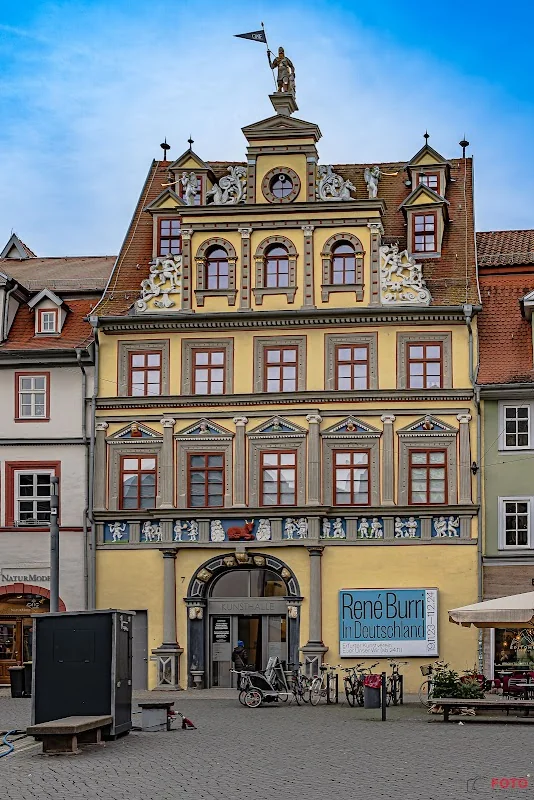
The Kunsthalle Erfurt in the House of the Red Ox is one of the most prominent cultural addresses in the city. Behind the historic Renaissance facade at Fischmarkt, the house presents changing exhibitions of modern and contemporary art over approximately 750 square meters. The profile ranges from painting and graphics to photography, video, and site-specific installations, allowing tradition and the present to meet in one place. For many visitors, this contrast is precisely the attraction: a listed building in the center of the old town, where new artistic perspectives continually unfold. ([erfurt.de](https://www.erfurt.de/ef/de/erleben/kunst/galerien/108302.html?utm_source=openai))
Those looking for tickets, photos, opening hours, directions, or parking will quickly find their way to the Kunsthalle, as it is well visible and easily accessible in the Erfurt old town. The house is part of the municipal museum landscape, sees itself as an open space for modern art, and appeals to a broad audience with its changing exhibitions. For this reason, it is an attractive destination for both art enthusiasts and spontaneous visits to the old town. ([erfurt.de](https://www.erfurt.de/ef/de/rathaus/bservice/leistungen/leistung-1519.htmc?utm_source=openai))
Tickets, Opening Hours, and Admission to the Kunsthalle Erfurt
For planning a visit, practical facts are particularly important. The Kunsthalle Erfurt is open from Tuesday to Sunday from 11 AM to 6 PM, and on Thursdays even until 10 PM. On public holidays, the hours are also from 11 AM to 6 PM. This makes the house suitable for both a classic day visit and a later cultural evening on Thursday, when one wishes to combine a stroll through the old town with a visit to an exhibition. This opening logic is very convenient for guests planning their Erfurt tour around Fischmarkt, Rathaus, and Krämerbrücke, as it offers many flexible time slots. ([erfurt.de](https://www.erfurt.de/ef/de/rathaus/sv/aemter/stelle-187.htmc?utm_source=openai))
For admission, the city of Erfurt charges 6.00 euros for adults and 4.00 euros for reduced tickets. Additionally, the first Tuesday of the month is free, making the Kunsthalle attractive for spontaneous visits and repeat visits. Those wishing for a more in-depth engagement with an exhibition can book special guided tours upon request; according to official information, tours lasting up to 60 minutes cost 40.00 euros plus admission, and tours lasting up to 90 minutes cost 60.00 euros plus admission. This is particularly interesting for groups, clubs, school classes, or company outings that want more context about the work, curation, and history of the house. ([erfurt.de](https://www.erfurt.de/ef/de/erleben/kunst/galerien/108302.html?utm_source=openai))
In terms of search behavior, it is evident that many people perceive the Kunsthalle not just as a classic museum location, but as a concrete excursion destination with clear visiting questions: How much does admission cost, when is the house open, and is a longer stay worthwhile? The Kunsthalle answers exactly this with a manageable pricing model, changing exhibitions, and a Thursday evening that presents the house in a special light. Therefore, those keeping an eye on tickets and opening hours can easily combine their visit with dining, city strolling, and other sights. ([erfurt.de](https://www.erfurt.de/ef/de/rathaus/sv/aemter/stelle-187.htmc?utm_source=openai))
Fischmarkt, Old Town, and Directions to the Kunsthalle Erfurt
The location is one of the greatest advantages of the house. The Kunsthalle is located at Fischmarkt 7 in the heart of the Erfurt old town, at one of the historically and urbanistically most important points in the city. Fischmarkt is considered the historical center of Erfurt and is surrounded by numerous old buildings. The official city description also emphasizes the location in the historic core and the immediate proximity to Rathaus and the atmosphere of the old town. Therefore, those visiting the Kunsthalle not only experience an exhibition but also automatically a part of Erfurt's urban memory. ([erfurt.de](https://www.erfurt.de/ef/de/service/mediathek/webcam/115742.html?utm_source=openai))
The Kunsthalle is very well connected for public transport. The city mentions tram lines 2, 3, and 6 with the stop Fischmarkt/Rathaus. On the visitor and accessibility page, it is additionally described that barrier-free tram stops are located directly at Fischmarkt, and the entrance is only about 50 meters away. This not only facilitates travel without a car but also makes the visit significantly more comfortable for guests with limited mobility. Those coming from other parts of the city can reach the house quickly and without complicated routes through the old town center. ([erfurt.de](https://www.erfurt.de/ef/de/rathaus/sv/aemter/stelle-187.htmc?utm_source=openai))
By car, the Erfurt city center is generally accessible via parking garages on the edge of the traffic-calmed zone. The city points out that approximately 3,700 parking spaces in parking garages are available in the city center, and a dynamic parking guidance system leads to free spaces. Additionally, there are park-and-ride facilities throughout the city area with about 1,400 free parking spaces on the outskirts, from which one can conveniently continue by tram. This is particularly sensible for a visit to the Kunsthalle, as Fischmarkt is part of the pedestrian-friendly old town, and the last stretch can ideally be completed on foot. ([erfurt.de](https://www.erfurt.de/ef/de/leben/verkehr/mobil/auto/parken/index.html?utm_source=openai))
The location in the pedestrian zone is therefore not a disadvantage but part of the experience. The city explicitly describes Erfurt as a city of short distances, where walking in the city center takes precedence. For visitors, this means: The Kunsthalle can be easily combined with other stops such as Rathaus, Domplatz, or Krämerbrücke without leaving the framework of a relaxed stroll through the old town. This mixture of art, architecture, and urban proximity makes the location so strong. ([erfurt.de](https://www.erfurt.de/ef/de/leben/planen/verkehr/begegnungszone/index.html?utm_source=openai))
House of the Red Ox: History, Renaissance Facade, and Renovation
The history of the house is at least as exciting as its current exhibition program. The building was mentioned as early as 1392, and in 1562, the wealthy Erfurt grain merchant and chief councilor Jacob Naffzer largely redesigned the building in the Renaissance style. This explains the representative facade, which still counts among the architectural gems of the city today. This historical background gives the Kunsthalle its special aura: one does not enter a neutral exhibition space but a place where city history and contemporary art directly intertwine. ([erfurt.de](https://www.erfurt.de/ef/de/service/aktuelles/pm/2017/126259.html?utm_source=openai))
The use as an art venue has also undergone a clear development. Between 1977 and 1979, the house was converted into an exhibition space after renovation work on the Renaissance facade; from this phase, the Gallery at Fischmarkt emerged. Since 2000, the institution has been named Kunsthalle Erfurt. According to municipal information, constantly changing exhibitions have been shown there since 1979. The development thus shows a continuous cultural enhancement: from a historic citizen's house, it has gradually become a specialized place for modern and contemporary art. ([kunstmuseen.erfurt.de](https://kunstmuseen.erfurt.de/km/de/service/aktuelles/meldungen/2017/ef_126259.html?utm_source=openai))
Important structural and functional modernization steps included the renewal of the roof covering in 2001, later improvements in fire protection, safety, climate, and lighting technology, as well as partial modernization starting in 2014. The goal was to make the house more accessible, user-friendly, and technically up-to-date. Among other things, the main entrance and foyer were redesigned, and a passenger elevator was created to ensure access to all levels of the exhibition area. Such measures are particularly important for a historic building because they respect the existing structure while making the museum visit contemporary. ([erfurt.de](https://www.erfurt.de/ef/de/service/aktuelles/pm/2014/120781.html?utm_source=openai))
A special room is the Renaissance Hall, which has been used for exhibitions and events in the past. This is a beautiful example of how the Kunsthalle works with its architecture rather than merely using it as a backdrop. Visitors experience not only art on the walls here but also a space with its own historical identity. This is precisely what distinguishes it from many modern white-cube galleries: In Erfurt, the history of the house is exhibited without overshadowing the art operation. ([erfurt.de](https://www.erfurt.de/ef/de/service/aktuelles/pm/2012/106348.html?utm_source=openai))
Exhibitions, Photography, and the Program of the Kunsthalle
The content strength of the Kunsthalle lies in its principle of change. The house does not show a permanent exhibition but relies on always new presentations of modern and contemporary art. According to the official description, the spectrum ranges from modernity to the immediate present and includes both national and international positions. This gives the place a high quality for repeat visits, as the impression from one exhibition visit can change to the next. Those who see a show today may experience a completely different artistic language, materials, and themes tomorrow. This is where the house derives its tension. ([erfurt.de](https://www.erfurt.de/ef/de/erleben/kunst/galerien/108302.html?utm_source=openai))
Photography is particularly important. Since the mid-1980s, it has gained significant importance in the profile of the Kunsthalle. This fits very well with search queries related to photos, exhibitions, and artistic imagery. The city explicitly states that alongside classical photographic positions, experimental and cross-border forms have also been shown. Thus, the Kunsthalle is not only a place for classical painting or sculpture but also for media-open art, where the image itself is examined, expanded, and sometimes even dissolved. For visitors, this means a wide range of forms of expression that can range from documentary to conceptual. ([erfurt.de](https://www.erfurt.de/ef/de/erleben/kunst/galerien/108302.html?utm_source=openai))
The programming of the Kunsthalle can be well recognized in several official press releases. For example, photographic work groups, overview exhibitions, experimental image concepts, and thematic presentations are mentioned. In various years, the content ranged from black-and-white photography to renowned photographic artists to installative or dialogical formats. This is a clear signal for visitors that the Kunsthalle is more a place of discovery than repetition. It does not only want to show well-known names but also create friction, ask questions, and open new perspectives on image, space, and society. ([erfurt.de](https://www.erfurt.de/ef/de/service/aktuelles/pm/2021/138529.html?utm_source=openai))
For SEO, this profile is important because it directly addresses the search intent behind terms like exhibition, program, or modern art. Those searching for the Kunsthalle Erfurt usually do not want an abstract cultural manifesto but a real assessment: What is shown there, how often do the exhibitions change, and why is a visit worthwhile? The honest answer is: because of the combination of a historic place, curatorial versatility, and a program that clearly focuses on the present and visual research. ([erfurt.de](https://www.erfurt.de/ef/de/erleben/kunst/galerien/108302.html?utm_source=openai))
Photos, Reviews, and the First Impression On-Site
Many users initially search for the Kunsthalle through photos because the facade at Fischmarkt creates immediate recognition. The official pages of the city show exterior views of the Kunsthalle, the view of the building, and its embedding in the historic urban space. Therefore, those who want to inform themselves in advance receive not only dry address data but also visual impressions that convey the effect of the house well. This is particularly helpful for decision-making when traveling with family, friends, or guests from other cities, wanting to know how the place feels beforehand. ([erfurt.de](https://www.erfurt.de/ef/de/erleben/kunst/galerien/108302.html?utm_source=openai))
The provided location data also mentions a rating of 4.4 stars based on 321 reviews. This is a solid signal for a municipal art address and fits a house that is sought after for its architecture, central location, and changing program. Those reading reviews usually expect practical tips on the overall impression, atmosphere, or how well the visit can be combined with a stroll through the old town. This is precisely where the Kunsthalle showcases its strengths: it is not just an exhibition space but part of a historically charged urban experience. ([erfurt.de](https://www.erfurt.de/ef/de/erleben/kunst/galerien/108302.html?utm_source=openai))
The first real impression is correspondingly strong. Fischmarkt is a central, historic square, and the Kunsthalle sits with its Renaissance facade right in the middle of this ensemble. This makes the building not appear isolated but embedded in an environment of Rathaus, old town alleys, and pedestrian zones. For visitors wanting to take photos, this is a plus: the architecture provides motifs that work both from close up and from a distance. At the same time, the place can be easily integrated into a day trip, as one can continue walking through the old town directly after the exhibition visit. ([erfurt.de](https://www.erfurt.de/ef/de/service/mediathek/webcam/115742.html?utm_source=openai))
When one understands the term reviews not only as evaluations but also as expectations, it becomes clear why the Kunsthalle appears so frequently online: it combines a strong image with a culturally reliable offering. The house is for many visitors the point at which Erfurt shows itself from its particularly dense, history-conscious, and contemporary side. This mixture explains why photos and experiences are so frequently searched for. ([erfurt.de](https://www.erfurt.de/ef/de/erleben/kunst/galerien/108302.html?utm_source=openai))
Accessibility, Service, and Practical Tips for the Visit
The Kunsthalle Erfurt places great importance on barrier-free and inclusive accessibility according to official representation. The access to the building is step-free, an elevator serves all floors, and a barrier-free toilet is available. Additionally, the tram stop is very close to the entrance, which makes orientation easier for all visitors. This combination is not a given for a historic building and shows that the house takes the requirements of modern museum visits seriously. Those traveling with strollers, wheelchairs, or limited mobility will find good conditions here. ([erfurt.de](https://www.erfurt.de/ef/de/erleben/kunst/galerien/108302.html?utm_source=openai))
The visitor service is also clearly structured. In addition to regular opening hours, there are special guided tours available upon request, which is particularly practical for groups and school classes. According to the official description, the Kunsthalle sees itself as a place of cultural participation and wants to provide a forum for aesthetic and social positions. This fits well with a house that not only shows art but also wants to stimulate discussions. In conjunction with the location at Fischmarkt, the short distances in the center, and the urban historical context, a visit thus becomes one that goes far beyond a quick photo stop. ([erfurt.de](https://www.erfurt.de/ef/de/rathaus/bservice/leistungen/leistung-1519.htmc?utm_source=openai))
In practice, it is advisable to combine the visit with the Erfurt old town. The city center is organized as a walkable space, and the Kunsthalle is located right in the middle of this system. Those arriving by train can get off at Fischmarkt or Rathaus; those coming by car can use parking garages in the city center or a park-and-ride offer on the outskirts and walk the last meters or continue by tram. This keeps the visit relaxed, even if one wants to see more than just the Kunsthalle. Especially on a Thursday with late opening, one can plan a long but pleasant cultural evening. ([erfurt.de](https://www.erfurt.de/ef/de/rathaus/sv/aemter/stelle-187.htmc?utm_source=openai))
In summary, the Kunsthalle Erfurt - House of the Red Ox is a very well-positioned place for modern art in a historic setting. It offers clear admission prices, reliable opening hours, a strong architectural identity, and a location that can be excellently combined with a visit to the old town. Those looking for a location that brings together culture, history, and practical visitor information will find here an address with real recognition value. ([erfurt.de](https://www.erfurt.de/ef/de/erleben/kunst/galerien/108302.html?utm_source=openai))
Sources:
Show moreShow less
Kunsthalle Erfurt - House of the Red Ox | Tickets & Exhibition
The Kunsthalle Erfurt in the House of the Red Ox is one of the most prominent cultural addresses in the city. Behind the historic Renaissance facade at Fischmarkt, the house presents changing exhibitions of modern and contemporary art over approximately 750 square meters. The profile ranges from painting and graphics to photography, video, and site-specific installations, allowing tradition and the present to meet in one place. For many visitors, this contrast is precisely the attraction: a listed building in the center of the old town, where new artistic perspectives continually unfold. ([erfurt.de](https://www.erfurt.de/ef/de/erleben/kunst/galerien/108302.html?utm_source=openai))
Those looking for tickets, photos, opening hours, directions, or parking will quickly find their way to the Kunsthalle, as it is well visible and easily accessible in the Erfurt old town. The house is part of the municipal museum landscape, sees itself as an open space for modern art, and appeals to a broad audience with its changing exhibitions. For this reason, it is an attractive destination for both art enthusiasts and spontaneous visits to the old town. ([erfurt.de](https://www.erfurt.de/ef/de/rathaus/bservice/leistungen/leistung-1519.htmc?utm_source=openai))
Tickets, Opening Hours, and Admission to the Kunsthalle Erfurt
For planning a visit, practical facts are particularly important. The Kunsthalle Erfurt is open from Tuesday to Sunday from 11 AM to 6 PM, and on Thursdays even until 10 PM. On public holidays, the hours are also from 11 AM to 6 PM. This makes the house suitable for both a classic day visit and a later cultural evening on Thursday, when one wishes to combine a stroll through the old town with a visit to an exhibition. This opening logic is very convenient for guests planning their Erfurt tour around Fischmarkt, Rathaus, and Krämerbrücke, as it offers many flexible time slots. ([erfurt.de](https://www.erfurt.de/ef/de/rathaus/sv/aemter/stelle-187.htmc?utm_source=openai))
For admission, the city of Erfurt charges 6.00 euros for adults and 4.00 euros for reduced tickets. Additionally, the first Tuesday of the month is free, making the Kunsthalle attractive for spontaneous visits and repeat visits. Those wishing for a more in-depth engagement with an exhibition can book special guided tours upon request; according to official information, tours lasting up to 60 minutes cost 40.00 euros plus admission, and tours lasting up to 90 minutes cost 60.00 euros plus admission. This is particularly interesting for groups, clubs, school classes, or company outings that want more context about the work, curation, and history of the house. ([erfurt.de](https://www.erfurt.de/ef/de/erleben/kunst/galerien/108302.html?utm_source=openai))
In terms of search behavior, it is evident that many people perceive the Kunsthalle not just as a classic museum location, but as a concrete excursion destination with clear visiting questions: How much does admission cost, when is the house open, and is a longer stay worthwhile? The Kunsthalle answers exactly this with a manageable pricing model, changing exhibitions, and a Thursday evening that presents the house in a special light. Therefore, those keeping an eye on tickets and opening hours can easily combine their visit with dining, city strolling, and other sights. ([erfurt.de](https://www.erfurt.de/ef/de/rathaus/sv/aemter/stelle-187.htmc?utm_source=openai))
Fischmarkt, Old Town, and Directions to the Kunsthalle Erfurt
The location is one of the greatest advantages of the house. The Kunsthalle is located at Fischmarkt 7 in the heart of the Erfurt old town, at one of the historically and urbanistically most important points in the city. Fischmarkt is considered the historical center of Erfurt and is surrounded by numerous old buildings. The official city description also emphasizes the location in the historic core and the immediate proximity to Rathaus and the atmosphere of the old town. Therefore, those visiting the Kunsthalle not only experience an exhibition but also automatically a part of Erfurt's urban memory. ([erfurt.de](https://www.erfurt.de/ef/de/service/mediathek/webcam/115742.html?utm_source=openai))
The Kunsthalle is very well connected for public transport. The city mentions tram lines 2, 3, and 6 with the stop Fischmarkt/Rathaus. On the visitor and accessibility page, it is additionally described that barrier-free tram stops are located directly at Fischmarkt, and the entrance is only about 50 meters away. This not only facilitates travel without a car but also makes the visit significantly more comfortable for guests with limited mobility. Those coming from other parts of the city can reach the house quickly and without complicated routes through the old town center. ([erfurt.de](https://www.erfurt.de/ef/de/rathaus/sv/aemter/stelle-187.htmc?utm_source=openai))
By car, the Erfurt city center is generally accessible via parking garages on the edge of the traffic-calmed zone. The city points out that approximately 3,700 parking spaces in parking garages are available in the city center, and a dynamic parking guidance system leads to free spaces. Additionally, there are park-and-ride facilities throughout the city area with about 1,400 free parking spaces on the outskirts, from which one can conveniently continue by tram. This is particularly sensible for a visit to the Kunsthalle, as Fischmarkt is part of the pedestrian-friendly old town, and the last stretch can ideally be completed on foot. ([erfurt.de](https://www.erfurt.de/ef/de/leben/verkehr/mobil/auto/parken/index.html?utm_source=openai))
The location in the pedestrian zone is therefore not a disadvantage but part of the experience. The city explicitly describes Erfurt as a city of short distances, where walking in the city center takes precedence. For visitors, this means: The Kunsthalle can be easily combined with other stops such as Rathaus, Domplatz, or Krämerbrücke without leaving the framework of a relaxed stroll through the old town. This mixture of art, architecture, and urban proximity makes the location so strong. ([erfurt.de](https://www.erfurt.de/ef/de/leben/planen/verkehr/begegnungszone/index.html?utm_source=openai))
House of the Red Ox: History, Renaissance Facade, and Renovation
The history of the house is at least as exciting as its current exhibition program. The building was mentioned as early as 1392, and in 1562, the wealthy Erfurt grain merchant and chief councilor Jacob Naffzer largely redesigned the building in the Renaissance style. This explains the representative facade, which still counts among the architectural gems of the city today. This historical background gives the Kunsthalle its special aura: one does not enter a neutral exhibition space but a place where city history and contemporary art directly intertwine. ([erfurt.de](https://www.erfurt.de/ef/de/service/aktuelles/pm/2017/126259.html?utm_source=openai))
The use as an art venue has also undergone a clear development. Between 1977 and 1979, the house was converted into an exhibition space after renovation work on the Renaissance facade; from this phase, the Gallery at Fischmarkt emerged. Since 2000, the institution has been named Kunsthalle Erfurt. According to municipal information, constantly changing exhibitions have been shown there since 1979. The development thus shows a continuous cultural enhancement: from a historic citizen's house, it has gradually become a specialized place for modern and contemporary art. ([kunstmuseen.erfurt.de](https://kunstmuseen.erfurt.de/km/de/service/aktuelles/meldungen/2017/ef_126259.html?utm_source=openai))
Important structural and functional modernization steps included the renewal of the roof covering in 2001, later improvements in fire protection, safety, climate, and lighting technology, as well as partial modernization starting in 2014. The goal was to make the house more accessible, user-friendly, and technically up-to-date. Among other things, the main entrance and foyer were redesigned, and a passenger elevator was created to ensure access to all levels of the exhibition area. Such measures are particularly important for a historic building because they respect the existing structure while making the museum visit contemporary. ([erfurt.de](https://www.erfurt.de/ef/de/service/aktuelles/pm/2014/120781.html?utm_source=openai))
A special room is the Renaissance Hall, which has been used for exhibitions and events in the past. This is a beautiful example of how the Kunsthalle works with its architecture rather than merely using it as a backdrop. Visitors experience not only art on the walls here but also a space with its own historical identity. This is precisely what distinguishes it from many modern white-cube galleries: In Erfurt, the history of the house is exhibited without overshadowing the art operation. ([erfurt.de](https://www.erfurt.de/ef/de/service/aktuelles/pm/2012/106348.html?utm_source=openai))
Exhibitions, Photography, and the Program of the Kunsthalle
The content strength of the Kunsthalle lies in its principle of change. The house does not show a permanent exhibition but relies on always new presentations of modern and contemporary art. According to the official description, the spectrum ranges from modernity to the immediate present and includes both national and international positions. This gives the place a high quality for repeat visits, as the impression from one exhibition visit can change to the next. Those who see a show today may experience a completely different artistic language, materials, and themes tomorrow. This is where the house derives its tension. ([erfurt.de](https://www.erfurt.de/ef/de/erleben/kunst/galerien/108302.html?utm_source=openai))
Photography is particularly important. Since the mid-1980s, it has gained significant importance in the profile of the Kunsthalle. This fits very well with search queries related to photos, exhibitions, and artistic imagery. The city explicitly states that alongside classical photographic positions, experimental and cross-border forms have also been shown. Thus, the Kunsthalle is not only a place for classical painting or sculpture but also for media-open art, where the image itself is examined, expanded, and sometimes even dissolved. For visitors, this means a wide range of forms of expression that can range from documentary to conceptual. ([erfurt.de](https://www.erfurt.de/ef/de/erleben/kunst/galerien/108302.html?utm_source=openai))
The programming of the Kunsthalle can be well recognized in several official press releases. For example, photographic work groups, overview exhibitions, experimental image concepts, and thematic presentations are mentioned. In various years, the content ranged from black-and-white photography to renowned photographic artists to installative or dialogical formats. This is a clear signal for visitors that the Kunsthalle is more a place of discovery than repetition. It does not only want to show well-known names but also create friction, ask questions, and open new perspectives on image, space, and society. ([erfurt.de](https://www.erfurt.de/ef/de/service/aktuelles/pm/2021/138529.html?utm_source=openai))
For SEO, this profile is important because it directly addresses the search intent behind terms like exhibition, program, or modern art. Those searching for the Kunsthalle Erfurt usually do not want an abstract cultural manifesto but a real assessment: What is shown there, how often do the exhibitions change, and why is a visit worthwhile? The honest answer is: because of the combination of a historic place, curatorial versatility, and a program that clearly focuses on the present and visual research. ([erfurt.de](https://www.erfurt.de/ef/de/erleben/kunst/galerien/108302.html?utm_source=openai))
Photos, Reviews, and the First Impression On-Site
Many users initially search for the Kunsthalle through photos because the facade at Fischmarkt creates immediate recognition. The official pages of the city show exterior views of the Kunsthalle, the view of the building, and its embedding in the historic urban space. Therefore, those who want to inform themselves in advance receive not only dry address data but also visual impressions that convey the effect of the house well. This is particularly helpful for decision-making when traveling with family, friends, or guests from other cities, wanting to know how the place feels beforehand. ([erfurt.de](https://www.erfurt.de/ef/de/erleben/kunst/galerien/108302.html?utm_source=openai))
The provided location data also mentions a rating of 4.4 stars based on 321 reviews. This is a solid signal for a municipal art address and fits a house that is sought after for its architecture, central location, and changing program. Those reading reviews usually expect practical tips on the overall impression, atmosphere, or how well the visit can be combined with a stroll through the old town. This is precisely where the Kunsthalle showcases its strengths: it is not just an exhibition space but part of a historically charged urban experience. ([erfurt.de](https://www.erfurt.de/ef/de/erleben/kunst/galerien/108302.html?utm_source=openai))
The first real impression is correspondingly strong. Fischmarkt is a central, historic square, and the Kunsthalle sits with its Renaissance facade right in the middle of this ensemble. This makes the building not appear isolated but embedded in an environment of Rathaus, old town alleys, and pedestrian zones. For visitors wanting to take photos, this is a plus: the architecture provides motifs that work both from close up and from a distance. At the same time, the place can be easily integrated into a day trip, as one can continue walking through the old town directly after the exhibition visit. ([erfurt.de](https://www.erfurt.de/ef/de/service/mediathek/webcam/115742.html?utm_source=openai))
When one understands the term reviews not only as evaluations but also as expectations, it becomes clear why the Kunsthalle appears so frequently online: it combines a strong image with a culturally reliable offering. The house is for many visitors the point at which Erfurt shows itself from its particularly dense, history-conscious, and contemporary side. This mixture explains why photos and experiences are so frequently searched for. ([erfurt.de](https://www.erfurt.de/ef/de/erleben/kunst/galerien/108302.html?utm_source=openai))
Accessibility, Service, and Practical Tips for the Visit
The Kunsthalle Erfurt places great importance on barrier-free and inclusive accessibility according to official representation. The access to the building is step-free, an elevator serves all floors, and a barrier-free toilet is available. Additionally, the tram stop is very close to the entrance, which makes orientation easier for all visitors. This combination is not a given for a historic building and shows that the house takes the requirements of modern museum visits seriously. Those traveling with strollers, wheelchairs, or limited mobility will find good conditions here. ([erfurt.de](https://www.erfurt.de/ef/de/erleben/kunst/galerien/108302.html?utm_source=openai))
The visitor service is also clearly structured. In addition to regular opening hours, there are special guided tours available upon request, which is particularly practical for groups and school classes. According to the official description, the Kunsthalle sees itself as a place of cultural participation and wants to provide a forum for aesthetic and social positions. This fits well with a house that not only shows art but also wants to stimulate discussions. In conjunction with the location at Fischmarkt, the short distances in the center, and the urban historical context, a visit thus becomes one that goes far beyond a quick photo stop. ([erfurt.de](https://www.erfurt.de/ef/de/rathaus/bservice/leistungen/leistung-1519.htmc?utm_source=openai))
In practice, it is advisable to combine the visit with the Erfurt old town. The city center is organized as a walkable space, and the Kunsthalle is located right in the middle of this system. Those arriving by train can get off at Fischmarkt or Rathaus; those coming by car can use parking garages in the city center or a park-and-ride offer on the outskirts and walk the last meters or continue by tram. This keeps the visit relaxed, even if one wants to see more than just the Kunsthalle. Especially on a Thursday with late opening, one can plan a long but pleasant cultural evening. ([erfurt.de](https://www.erfurt.de/ef/de/rathaus/sv/aemter/stelle-187.htmc?utm_source=openai))
In summary, the Kunsthalle Erfurt - House of the Red Ox is a very well-positioned place for modern art in a historic setting. It offers clear admission prices, reliable opening hours, a strong architectural identity, and a location that can be excellently combined with a visit to the old town. Those looking for a location that brings together culture, history, and practical visitor information will find here an address with real recognition value. ([erfurt.de](https://www.erfurt.de/ef/de/erleben/kunst/galerien/108302.html?utm_source=openai))
Sources:
Kunsthalle Erfurt - House of the Red Ox | Tickets & Exhibition
The Kunsthalle Erfurt in the House of the Red Ox is one of the most prominent cultural addresses in the city. Behind the historic Renaissance facade at Fischmarkt, the house presents changing exhibitions of modern and contemporary art over approximately 750 square meters. The profile ranges from painting and graphics to photography, video, and site-specific installations, allowing tradition and the present to meet in one place. For many visitors, this contrast is precisely the attraction: a listed building in the center of the old town, where new artistic perspectives continually unfold. ([erfurt.de](https://www.erfurt.de/ef/de/erleben/kunst/galerien/108302.html?utm_source=openai))
Those looking for tickets, photos, opening hours, directions, or parking will quickly find their way to the Kunsthalle, as it is well visible and easily accessible in the Erfurt old town. The house is part of the municipal museum landscape, sees itself as an open space for modern art, and appeals to a broad audience with its changing exhibitions. For this reason, it is an attractive destination for both art enthusiasts and spontaneous visits to the old town. ([erfurt.de](https://www.erfurt.de/ef/de/rathaus/bservice/leistungen/leistung-1519.htmc?utm_source=openai))
Tickets, Opening Hours, and Admission to the Kunsthalle Erfurt
For planning a visit, practical facts are particularly important. The Kunsthalle Erfurt is open from Tuesday to Sunday from 11 AM to 6 PM, and on Thursdays even until 10 PM. On public holidays, the hours are also from 11 AM to 6 PM. This makes the house suitable for both a classic day visit and a later cultural evening on Thursday, when one wishes to combine a stroll through the old town with a visit to an exhibition. This opening logic is very convenient for guests planning their Erfurt tour around Fischmarkt, Rathaus, and Krämerbrücke, as it offers many flexible time slots. ([erfurt.de](https://www.erfurt.de/ef/de/rathaus/sv/aemter/stelle-187.htmc?utm_source=openai))
For admission, the city of Erfurt charges 6.00 euros for adults and 4.00 euros for reduced tickets. Additionally, the first Tuesday of the month is free, making the Kunsthalle attractive for spontaneous visits and repeat visits. Those wishing for a more in-depth engagement with an exhibition can book special guided tours upon request; according to official information, tours lasting up to 60 minutes cost 40.00 euros plus admission, and tours lasting up to 90 minutes cost 60.00 euros plus admission. This is particularly interesting for groups, clubs, school classes, or company outings that want more context about the work, curation, and history of the house. ([erfurt.de](https://www.erfurt.de/ef/de/erleben/kunst/galerien/108302.html?utm_source=openai))
In terms of search behavior, it is evident that many people perceive the Kunsthalle not just as a classic museum location, but as a concrete excursion destination with clear visiting questions: How much does admission cost, when is the house open, and is a longer stay worthwhile? The Kunsthalle answers exactly this with a manageable pricing model, changing exhibitions, and a Thursday evening that presents the house in a special light. Therefore, those keeping an eye on tickets and opening hours can easily combine their visit with dining, city strolling, and other sights. ([erfurt.de](https://www.erfurt.de/ef/de/rathaus/sv/aemter/stelle-187.htmc?utm_source=openai))
Fischmarkt, Old Town, and Directions to the Kunsthalle Erfurt
The location is one of the greatest advantages of the house. The Kunsthalle is located at Fischmarkt 7 in the heart of the Erfurt old town, at one of the historically and urbanistically most important points in the city. Fischmarkt is considered the historical center of Erfurt and is surrounded by numerous old buildings. The official city description also emphasizes the location in the historic core and the immediate proximity to Rathaus and the atmosphere of the old town. Therefore, those visiting the Kunsthalle not only experience an exhibition but also automatically a part of Erfurt's urban memory. ([erfurt.de](https://www.erfurt.de/ef/de/service/mediathek/webcam/115742.html?utm_source=openai))
The Kunsthalle is very well connected for public transport. The city mentions tram lines 2, 3, and 6 with the stop Fischmarkt/Rathaus. On the visitor and accessibility page, it is additionally described that barrier-free tram stops are located directly at Fischmarkt, and the entrance is only about 50 meters away. This not only facilitates travel without a car but also makes the visit significantly more comfortable for guests with limited mobility. Those coming from other parts of the city can reach the house quickly and without complicated routes through the old town center. ([erfurt.de](https://www.erfurt.de/ef/de/rathaus/sv/aemter/stelle-187.htmc?utm_source=openai))
By car, the Erfurt city center is generally accessible via parking garages on the edge of the traffic-calmed zone. The city points out that approximately 3,700 parking spaces in parking garages are available in the city center, and a dynamic parking guidance system leads to free spaces. Additionally, there are park-and-ride facilities throughout the city area with about 1,400 free parking spaces on the outskirts, from which one can conveniently continue by tram. This is particularly sensible for a visit to the Kunsthalle, as Fischmarkt is part of the pedestrian-friendly old town, and the last stretch can ideally be completed on foot. ([erfurt.de](https://www.erfurt.de/ef/de/leben/verkehr/mobil/auto/parken/index.html?utm_source=openai))
The location in the pedestrian zone is therefore not a disadvantage but part of the experience. The city explicitly describes Erfurt as a city of short distances, where walking in the city center takes precedence. For visitors, this means: The Kunsthalle can be easily combined with other stops such as Rathaus, Domplatz, or Krämerbrücke without leaving the framework of a relaxed stroll through the old town. This mixture of art, architecture, and urban proximity makes the location so strong. ([erfurt.de](https://www.erfurt.de/ef/de/leben/planen/verkehr/begegnungszone/index.html?utm_source=openai))
House of the Red Ox: History, Renaissance Facade, and Renovation
The history of the house is at least as exciting as its current exhibition program. The building was mentioned as early as 1392, and in 1562, the wealthy Erfurt grain merchant and chief councilor Jacob Naffzer largely redesigned the building in the Renaissance style. This explains the representative facade, which still counts among the architectural gems of the city today. This historical background gives the Kunsthalle its special aura: one does not enter a neutral exhibition space but a place where city history and contemporary art directly intertwine. ([erfurt.de](https://www.erfurt.de/ef/de/service/aktuelles/pm/2017/126259.html?utm_source=openai))
The use as an art venue has also undergone a clear development. Between 1977 and 1979, the house was converted into an exhibition space after renovation work on the Renaissance facade; from this phase, the Gallery at Fischmarkt emerged. Since 2000, the institution has been named Kunsthalle Erfurt. According to municipal information, constantly changing exhibitions have been shown there since 1979. The development thus shows a continuous cultural enhancement: from a historic citizen's house, it has gradually become a specialized place for modern and contemporary art. ([kunstmuseen.erfurt.de](https://kunstmuseen.erfurt.de/km/de/service/aktuelles/meldungen/2017/ef_126259.html?utm_source=openai))
Important structural and functional modernization steps included the renewal of the roof covering in 2001, later improvements in fire protection, safety, climate, and lighting technology, as well as partial modernization starting in 2014. The goal was to make the house more accessible, user-friendly, and technically up-to-date. Among other things, the main entrance and foyer were redesigned, and a passenger elevator was created to ensure access to all levels of the exhibition area. Such measures are particularly important for a historic building because they respect the existing structure while making the museum visit contemporary. ([erfurt.de](https://www.erfurt.de/ef/de/service/aktuelles/pm/2014/120781.html?utm_source=openai))
A special room is the Renaissance Hall, which has been used for exhibitions and events in the past. This is a beautiful example of how the Kunsthalle works with its architecture rather than merely using it as a backdrop. Visitors experience not only art on the walls here but also a space with its own historical identity. This is precisely what distinguishes it from many modern white-cube galleries: In Erfurt, the history of the house is exhibited without overshadowing the art operation. ([erfurt.de](https://www.erfurt.de/ef/de/service/aktuelles/pm/2012/106348.html?utm_source=openai))
Exhibitions, Photography, and the Program of the Kunsthalle
The content strength of the Kunsthalle lies in its principle of change. The house does not show a permanent exhibition but relies on always new presentations of modern and contemporary art. According to the official description, the spectrum ranges from modernity to the immediate present and includes both national and international positions. This gives the place a high quality for repeat visits, as the impression from one exhibition visit can change to the next. Those who see a show today may experience a completely different artistic language, materials, and themes tomorrow. This is where the house derives its tension. ([erfurt.de](https://www.erfurt.de/ef/de/erleben/kunst/galerien/108302.html?utm_source=openai))
Photography is particularly important. Since the mid-1980s, it has gained significant importance in the profile of the Kunsthalle. This fits very well with search queries related to photos, exhibitions, and artistic imagery. The city explicitly states that alongside classical photographic positions, experimental and cross-border forms have also been shown. Thus, the Kunsthalle is not only a place for classical painting or sculpture but also for media-open art, where the image itself is examined, expanded, and sometimes even dissolved. For visitors, this means a wide range of forms of expression that can range from documentary to conceptual. ([erfurt.de](https://www.erfurt.de/ef/de/erleben/kunst/galerien/108302.html?utm_source=openai))
The programming of the Kunsthalle can be well recognized in several official press releases. For example, photographic work groups, overview exhibitions, experimental image concepts, and thematic presentations are mentioned. In various years, the content ranged from black-and-white photography to renowned photographic artists to installative or dialogical formats. This is a clear signal for visitors that the Kunsthalle is more a place of discovery than repetition. It does not only want to show well-known names but also create friction, ask questions, and open new perspectives on image, space, and society. ([erfurt.de](https://www.erfurt.de/ef/de/service/aktuelles/pm/2021/138529.html?utm_source=openai))
For SEO, this profile is important because it directly addresses the search intent behind terms like exhibition, program, or modern art. Those searching for the Kunsthalle Erfurt usually do not want an abstract cultural manifesto but a real assessment: What is shown there, how often do the exhibitions change, and why is a visit worthwhile? The honest answer is: because of the combination of a historic place, curatorial versatility, and a program that clearly focuses on the present and visual research. ([erfurt.de](https://www.erfurt.de/ef/de/erleben/kunst/galerien/108302.html?utm_source=openai))
Photos, Reviews, and the First Impression On-Site
Many users initially search for the Kunsthalle through photos because the facade at Fischmarkt creates immediate recognition. The official pages of the city show exterior views of the Kunsthalle, the view of the building, and its embedding in the historic urban space. Therefore, those who want to inform themselves in advance receive not only dry address data but also visual impressions that convey the effect of the house well. This is particularly helpful for decision-making when traveling with family, friends, or guests from other cities, wanting to know how the place feels beforehand. ([erfurt.de](https://www.erfurt.de/ef/de/erleben/kunst/galerien/108302.html?utm_source=openai))
The provided location data also mentions a rating of 4.4 stars based on 321 reviews. This is a solid signal for a municipal art address and fits a house that is sought after for its architecture, central location, and changing program. Those reading reviews usually expect practical tips on the overall impression, atmosphere, or how well the visit can be combined with a stroll through the old town. This is precisely where the Kunsthalle showcases its strengths: it is not just an exhibition space but part of a historically charged urban experience. ([erfurt.de](https://www.erfurt.de/ef/de/erleben/kunst/galerien/108302.html?utm_source=openai))
The first real impression is correspondingly strong. Fischmarkt is a central, historic square, and the Kunsthalle sits with its Renaissance facade right in the middle of this ensemble. This makes the building not appear isolated but embedded in an environment of Rathaus, old town alleys, and pedestrian zones. For visitors wanting to take photos, this is a plus: the architecture provides motifs that work both from close up and from a distance. At the same time, the place can be easily integrated into a day trip, as one can continue walking through the old town directly after the exhibition visit. ([erfurt.de](https://www.erfurt.de/ef/de/service/mediathek/webcam/115742.html?utm_source=openai))
When one understands the term reviews not only as evaluations but also as expectations, it becomes clear why the Kunsthalle appears so frequently online: it combines a strong image with a culturally reliable offering. The house is for many visitors the point at which Erfurt shows itself from its particularly dense, history-conscious, and contemporary side. This mixture explains why photos and experiences are so frequently searched for. ([erfurt.de](https://www.erfurt.de/ef/de/erleben/kunst/galerien/108302.html?utm_source=openai))
Accessibility, Service, and Practical Tips for the Visit
The Kunsthalle Erfurt places great importance on barrier-free and inclusive accessibility according to official representation. The access to the building is step-free, an elevator serves all floors, and a barrier-free toilet is available. Additionally, the tram stop is very close to the entrance, which makes orientation easier for all visitors. This combination is not a given for a historic building and shows that the house takes the requirements of modern museum visits seriously. Those traveling with strollers, wheelchairs, or limited mobility will find good conditions here. ([erfurt.de](https://www.erfurt.de/ef/de/erleben/kunst/galerien/108302.html?utm_source=openai))
The visitor service is also clearly structured. In addition to regular opening hours, there are special guided tours available upon request, which is particularly practical for groups and school classes. According to the official description, the Kunsthalle sees itself as a place of cultural participation and wants to provide a forum for aesthetic and social positions. This fits well with a house that not only shows art but also wants to stimulate discussions. In conjunction with the location at Fischmarkt, the short distances in the center, and the urban historical context, a visit thus becomes one that goes far beyond a quick photo stop. ([erfurt.de](https://www.erfurt.de/ef/de/rathaus/bservice/leistungen/leistung-1519.htmc?utm_source=openai))
In practice, it is advisable to combine the visit with the Erfurt old town. The city center is organized as a walkable space, and the Kunsthalle is located right in the middle of this system. Those arriving by train can get off at Fischmarkt or Rathaus; those coming by car can use parking garages in the city center or a park-and-ride offer on the outskirts and walk the last meters or continue by tram. This keeps the visit relaxed, even if one wants to see more than just the Kunsthalle. Especially on a Thursday with late opening, one can plan a long but pleasant cultural evening. ([erfurt.de](https://www.erfurt.de/ef/de/rathaus/sv/aemter/stelle-187.htmc?utm_source=openai))
In summary, the Kunsthalle Erfurt - House of the Red Ox is a very well-positioned place for modern art in a historic setting. It offers clear admission prices, reliable opening hours, a strong architectural identity, and a location that can be excellently combined with a visit to the old town. Those looking for a location that brings together culture, history, and practical visitor information will find here an address with real recognition value. ([erfurt.de](https://www.erfurt.de/ef/de/erleben/kunst/galerien/108302.html?utm_source=openai))
Sources:
Upcoming Events

Guided Tours for Colours & Values at Kunsthalle Erfurt
Colors, attitude, and strong positions: The guided tour through Colours & Values at Kunsthalle Erfurt opens the perspective for contemporary painting. #ArtErfurt

Guided Tours "StipVisite. Exhibition of State Scholarship Holders for Fine Arts 2025"
StipVisite at the Kunsthalle Erfurt: Nature, memory, and contemporary art in dialogue. Guided tour on 28.06.2026 at 12:30 PM. #ArtExperience

Poetry in Dialogue – StipVisite: Exhibition of State Scholarship Holders for Visual Arts 2025
Poetry, art, and the present meet at Kunsthalle Erfurt. Poetry in Dialogue for StipVisite on June 30, 2026, at 6:30 PM. #Poetry
Frequently Asked Questions
Reviews
Nina Hartmann
2. January 2026
A phenomenal place! The blend of modern and classical art in a building with such history is impressive. Each room offers something different and unusual, and the staff are extremely friendly and ready to explain every detail.
Axel Büse
11. July 2025
Modern museum with interesting exhibitions of local and international artists.
Erica Frolova
21. January 2023
Amazing exhibitions Must see
Eva Simner
11. May 2019
Aside from the exposition, the gallery itself is very nice too. As someone with a fear of heights, climbing up glass stairs isn't the most comfortable thing. I was surprised to hear that they have normal ones too! They are around for anyone interested.
Echo Huang
28. June 2024
Seriously? 6 euro ticket just let me see this ordinary work, which is even under student level. Can finish less than 10 mins. Worst art exhibition I've ever seen.