
Erfurt
Krämerbrücke, 99084 Erfurt-Altstadt, Deutschland
Krämerbrücke | Krämerbrückenfest 2026 & Route
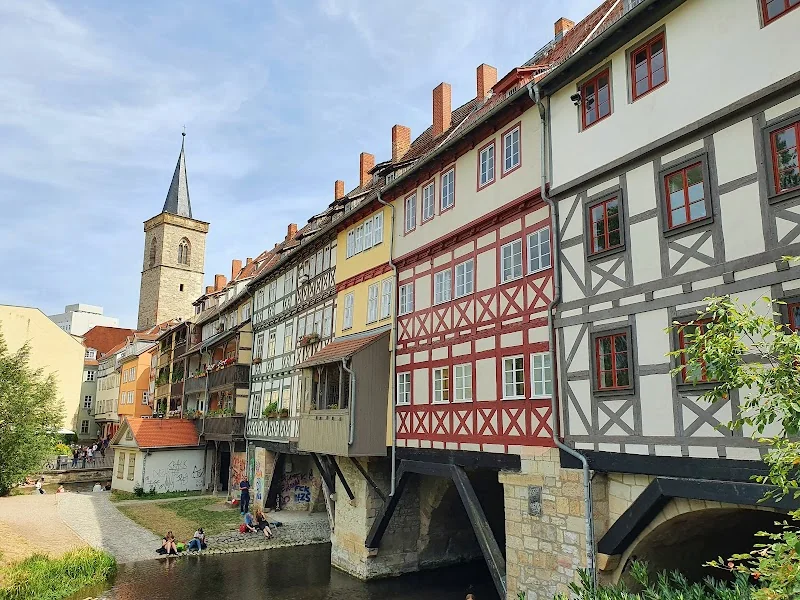
The Krämerbrücke is one of the most famous landmarks of Erfurt and a place where history, everyday life, and visitor experiences connect in a very special way. Upon entering the old town, one quickly realizes that this bridge is not an ordinary structure, but a living monument with houses, shops, galleries, and gastronomic addresses. It is located in the historical center, near the town hall and fish market, making it ideal for city strolls as well as quick stops. Its special effect arises from the mix of medieval construction history, dense development, good accessibility, and an atmosphere that feels relaxed during the day and almost romantic in the evening. At the same time, the Krämerbrücke is much more than a photo motif: it is a place where people live, work, shop, enjoy, and celebrate. This is exactly why it fits so well with the frequently sought topics around route, parking, pictures, cafés, chocolate, ice cream, and of course the Krämerbrückenfest, which has repeatedly brought the bridge into the spotlight of the city for decades. ([erfurt-tourismus.de](https://www.erfurt-tourismus.de/sehenswertes/kraemerbruecke/))
Krämerbrücke Erfurt: History, Structure, and Special Features
Historically, the Krämerbrücke is one of the most extraordinary structures in Germany. The first mention dates back to 1117, and later the wooden bridge was rebuilt as a stone bridge in 1325. Spanning a length of 79 meters, six barrel vaults cover the broad stream of the Gera, and it is precisely this compact yet monumental construction that gives the structure its charm. The Erfurt tourism website describes the Krämerbrücke as the most interesting secular building in the city and emphasizes that it was originally 120 meters long and built with 62 narrow houses, which were later combined into 32 houses. Thus, it is not only a monument but a structurally unique ensemble that has changed, renewed, and yet preserved its character over centuries. The official texts also highlight that of the two former bridgehead churches, the eastern Ägidienkirche is still preserved today, offering an impressive view with its tower. This combination of bridge, living space, craftsmanship, and church explains why the Krämerbrücke is still understood as a symbol of Erfurt's identity. It is not only a historical relic but a living place that demonstrates how medieval urban structure can continue to have an impact in the present. ([erfurt.de](https://www.erfurt.de/ef/de/erleben/sehenswertes/bruecken/108111.html))
Moreover, the Krämerbrücke has always been perceived as a very special urban space. The official city website emphasizes that it is located in the center of the old town, near the town hall, and is considered a living monument. Today, visitors will find galleries and shops on the bridge selling Thuringian blue print fabrics, hand-painted ceramics, Lauscha glass, jewelry, wood carvings, and Unstrut wines. This selection is no coincidence but part of the cultural profile of the bridge: arts and crafts and regional products continue to shape its character today. The history of the bridge houses and the centuries-long use as a living and sales place are also crucial, as they make the Krämerbrücke something that is not only observed but traversed and experienced. Those who stand here move through a space that has bundled economic, social, and cultural functions in Erfurt for centuries. It is precisely this mix of function and memory that ensures that the Krämerbrücke does not feel museum-like but remains vibrant. It is a monument, a shopping place, a residential address, and a tourist highlight all at once. ([erfurt.de](https://www.erfurt.de/ef/de/wirtschaft/partner/stiftungen/kraemerbruecke/bruecke/121188.html))
Krämerbrückenfest 2026: Program, Artists, and Atmosphere
A central reason for searching around the Krämerbrücke is the Krämerbrückenfest, which takes place every year on the third weekend of June and is announced for June 19 to 21, 2026. The official tourism presentation speaks of the 49th Krämerbrückenfest and promises a colorful festival of art, culture, and entertainment in the heart of Erfurt's old town. The famous Krämerbrücke is at the center, with music, juggling, and culinary delights surrounding the bridge, all free and experienced outdoors. Particularly important for planning is that the festival is not limited to the bridge itself but is spread across several locations in the city center. According to the official press release from the anniversary year 2025, eight locations as well as numerous courtyards and meadows will be used, including Domplatz, Theatervorplatz, and Petersberg. This makes the festival extensive, varied, and very open to different target groups. Therefore, those looking for the program, artists, and atmosphere will find not only a fixed stage but a city festival that weaves through the old town like a net. This mix of tradition and mobility is one reason why the Krämerbrückenfest has become Thuringia's largest old town festival. ([erfurt-tourismus.de](https://www.erfurt-tourismus.de/veranstaltungen/hoehepunkte/kraemerbrueckenfest))
The thematic dramaturgy of the festival is also noteworthy. The history of the Krämerbrückenfest shows that Erfurt has relied on a strong connection between folk festival, culture, and urban space since 1975. The official history page describes that the festival was launched in June 1975 and was the festival of the Erfurt Mitte district until 1989. From the beginning, there was a farce with Till Eulenspiegel, which has remained as an opening ritual and is still associated with the festival today. Even in the early years, artists, dancers, magicians, acrobats, and food and drink were mentioned as fixed components, and the expansion of the festival grounds over time shows how dynamically the program has developed. For 2025, a special art installation on the bridge was also announced: Pons in visibilis, a work by Robert Leuschner that makes the load-bearing structure of the building visible. Such artistic interventions illustrate that the Krämerbrückenfest is not just a folk festival but also a cultural-political statement for the visibility of urban history and the present. Therefore, those looking for the Krämerbrückenfest 2026 program or artists should keep an eye on the official pages, as the respective formats, stages, and participants will be added and updated there. ([erfurt.de](https://www.erfurt.de/ef/de/erleben/veranstaltungen/feste/kraemerbrueckenfest/141505.html))
Route to the Krämerbrücke: Access, Parking, and Public Transport
The search for Krämerbrücke Erfurt route or Krämerbrücke Erfurt parking is completely understandable, as the bridge is centrally located but in the middle of a historical old town with limited car traffic. The official access recommendation from the city is clear: those coming by car should use the parking garage at Domplatz if possible. Additionally, the parking garage at Hirschlachufer and Q-Park Anger 1 are mentioned as nearby options. From there, it is only a few minutes on foot towards the fish market and further to the Krämerbrücke. The description of the access from the north, south, west, and east repeatedly points to Domplatz as a sensible reference point. This is practical for visitors, as the old town can be experienced well as a pedestrian zone and the paths are not complicated. Therefore, those visiting the bridge should not try to drive directly in front of the structure but understand the walk through the city center as part of the experience. Walking through the market street, past the town hall and fish market, vividly conveys the historical context and almost automatically sets the right mood for the visit. ([erfurt.de](https://www.erfurt.de/ef/de/wirtschaft/partner/stiftungen/kraemerbruecke/bruecke/121188.html))
The Krämerbrücke is also very well connected by public transport. The official site mentions tram lines 3, 4, and 6 from Erfurt main station to the Fischmarkt stop. From there, you walk left around the town hall towards Benediktsplatz and are directly in front of the Krämerbrücke. The tourism site also mentions a distance of about 250 meters to public transport. Those who rely on accessibility should know that the path from Benediktsplatz to the bridge has a short steep incline and is only recommended for manual wheelchairs with assistance; afterwards, there is cobblestone in the area of the Gera. At the same time, the tourism site states that photography is allowed, bike racks are available, and there are no sanitary facilities directly on the bridge. This information is particularly valuable as it makes the visit realistically planable. The Krämerbrücke is therefore very central, but it is also a historical urban space with typical old town cobblestones and narrow transitions. Knowing this allows for better planning of access, route, and duration of stay, making the experience of the bridge more relaxed. ([erfurt.de](https://www.erfurt.de/ef/de/wirtschaft/partner/stiftungen/kraemerbruecke/bruecke/121188.html))
Krämerbrückencafé, Chocolate, and Ice Cream: Enjoyment on the Bridge
The Krämerbrücke is not only a place for history and photos but also a very strong place of enjoyment. The official tourism site describes galleries and shops where Thuringian blue print fabrics, hand-painted ceramics, Lauscha glass, jewelry, wood carvings, and Unstrut wines are offered. This shows that the bridge continues to be a place of artisanal and regional trade. Those specifically looking for Krämerbrückencafé, chocolate, or ice cream will also find official entries in the vicinity of the bridge. The Krämerbrückencafé at Kreuzgasse 1 advertises breakfast all day, fresh ingredients, seasonality, and regularly changing menus. Goldhelm on the Krämerbrücke is described as offering handmade chocolate, pralines, truffles, spreads, and natural ice cream. In the workshop and shop version, there is also a special view of the bridge, while Krämerbrücke 12 is mentioned as a shop address. Additionally, at the foot of the Krämerbrücke is the FAUSTUS restaurant, café, and bar, which offers seasonal and regional specialties and invites guests to linger on its terrace. This variety makes the area around the bridge particularly attractive for anyone looking for a café with flair, a sweet break, or Thuringian specialties. ([erfurt-tourismus.de](https://www.erfurt-tourismus.de/sehenswertes/kraemerbruecke/))
Especially the combination of architecture and enjoyment is an important part of the search interest, as many visitors associate the Krämerbrücke with culinary impressions. This is not just a feeling but is also reflected in the official information: the bridge is lined with galleries, shops, and gastronomic offerings, and the surroundings are so compact that one can seamlessly transition from strolling to a coffee break or a chocolate shop. For search terms like Krämerbrücke ice cream or Krämerbrücke chocolate, Goldhelm is particularly relevant because it explicitly mentions natural ice cream and handmade chocolate. For the breakfast and café area, the Krämerbrückencafé is a suitable point of contact, and for guests looking for longer breaks or an evening stop, FAUSTUS complements the offering with a restaurant and bar. All of this shows: the Krämerbrücke is not just a structure but an urban space of enjoyment, where Erfurt shows its hospitable side. Therefore, those visiting the bridge can experience culture, craftsmanship, and culinary delights within a very small radius, making the place attractive for day visitors as well as for evening strolls. ([erfurt-tourismus.de](https://www.erfurt-tourismus.de/stadtbummel/kraemerbruecke/goldhelm-laden/?utm_source=openai))
Images, Photos, and 360° Tour of the Krämerbrücke
Those searching for Krämerbrücke Erfurt images or Krämerbrücke photos have very good reasons, as the bridge is one of the most photogenic places in the city. Its house fronts, cobblestones, proximity to the Gera, and the view of the old town create motifs that change significantly depending on the time of day and weather. The official tourism site therefore offers not only descriptions but also a 360° tour and short films introducing four people who work or have found their place on the bridge. These include puppeteer Martin Gobsch, painter Beate Kister, chocolatier Alex Kühn from Goldhelm, and Bettina Vick with Thuringian specialties. These portraits show that the Krämerbrücke does not function as a backdrop but as a real living and working space. Therefore, those photographing the bridge are not only capturing an architectural shot but always a piece of a very active part of the city. The fact that photography is allowed makes it even easier. Thus, the Krämerbrücke becomes equally interesting for social media, travel blogs, and private travel albums. ([erfurt-tourismus.de](https://www.erfurt-tourismus.de/sehenswertes/kraemerbruecke/))
For longer stays, it is also worth looking at the central location of the bridge in the old town. The official city site describes it as a living monument in the center of the old town and near the town hall; the tourism site also points out the good public transport connections, nearby parking garages, and free accessibility. Therefore, those looking for a hotel benefit from the very compact structure of the city center, as many destinations around Domplatz, Fischmarkt, Anger, and the old town can be easily connected on foot. This is particularly practical for guests who want to experience Erfurt not just briefly but truly. At the same time, one should know that there are no sanitary facilities on the bridge itself and that the historical cobblestones require a bit of attention depending on the route. In combination with the success recorded in 2017 of Erfurt's old town and the Krämerbrücke among Germany's most popular travel destinations, it becomes clear why this place is in such high demand: it combines history, urban atmosphere, and tourist infrastructure in a small space. Therefore, the Krämerbrücke is equally attractive for images, short stays, and longer city trips. ([erfurt.de](https://www.erfurt.de/ef/de/wirtschaft/partner/stiftungen/kraemerbruecke/bruecke/121188.html))
Sources:
- Krämerbrücke - Erfurt Tourism
- Foundation Krämerbrücke: Location and Access to the Krämerbrücke | Erfurt.de
- The 49th Krämerbrückenfest from June 19 to 21, 2026 - Erfurt Tourism
- Krämerbrückenfest: History | Erfurt.de
- Goldhelm Chocolate Manufacture – Store Krämerbrücke - Erfurt Tourism
- Krämerbrückencafé - Erfurt Tourism
Show moreShow less
Krämerbrücke | Krämerbrückenfest 2026 & Route
The Krämerbrücke is one of the most famous landmarks of Erfurt and a place where history, everyday life, and visitor experiences connect in a very special way. Upon entering the old town, one quickly realizes that this bridge is not an ordinary structure, but a living monument with houses, shops, galleries, and gastronomic addresses. It is located in the historical center, near the town hall and fish market, making it ideal for city strolls as well as quick stops. Its special effect arises from the mix of medieval construction history, dense development, good accessibility, and an atmosphere that feels relaxed during the day and almost romantic in the evening. At the same time, the Krämerbrücke is much more than a photo motif: it is a place where people live, work, shop, enjoy, and celebrate. This is exactly why it fits so well with the frequently sought topics around route, parking, pictures, cafés, chocolate, ice cream, and of course the Krämerbrückenfest, which has repeatedly brought the bridge into the spotlight of the city for decades. ([erfurt-tourismus.de](https://www.erfurt-tourismus.de/sehenswertes/kraemerbruecke/))
Krämerbrücke Erfurt: History, Structure, and Special Features
Historically, the Krämerbrücke is one of the most extraordinary structures in Germany. The first mention dates back to 1117, and later the wooden bridge was rebuilt as a stone bridge in 1325. Spanning a length of 79 meters, six barrel vaults cover the broad stream of the Gera, and it is precisely this compact yet monumental construction that gives the structure its charm. The Erfurt tourism website describes the Krämerbrücke as the most interesting secular building in the city and emphasizes that it was originally 120 meters long and built with 62 narrow houses, which were later combined into 32 houses. Thus, it is not only a monument but a structurally unique ensemble that has changed, renewed, and yet preserved its character over centuries. The official texts also highlight that of the two former bridgehead churches, the eastern Ägidienkirche is still preserved today, offering an impressive view with its tower. This combination of bridge, living space, craftsmanship, and church explains why the Krämerbrücke is still understood as a symbol of Erfurt's identity. It is not only a historical relic but a living place that demonstrates how medieval urban structure can continue to have an impact in the present. ([erfurt.de](https://www.erfurt.de/ef/de/erleben/sehenswertes/bruecken/108111.html))
Moreover, the Krämerbrücke has always been perceived as a very special urban space. The official city website emphasizes that it is located in the center of the old town, near the town hall, and is considered a living monument. Today, visitors will find galleries and shops on the bridge selling Thuringian blue print fabrics, hand-painted ceramics, Lauscha glass, jewelry, wood carvings, and Unstrut wines. This selection is no coincidence but part of the cultural profile of the bridge: arts and crafts and regional products continue to shape its character today. The history of the bridge houses and the centuries-long use as a living and sales place are also crucial, as they make the Krämerbrücke something that is not only observed but traversed and experienced. Those who stand here move through a space that has bundled economic, social, and cultural functions in Erfurt for centuries. It is precisely this mix of function and memory that ensures that the Krämerbrücke does not feel museum-like but remains vibrant. It is a monument, a shopping place, a residential address, and a tourist highlight all at once. ([erfurt.de](https://www.erfurt.de/ef/de/wirtschaft/partner/stiftungen/kraemerbruecke/bruecke/121188.html))
Krämerbrückenfest 2026: Program, Artists, and Atmosphere
A central reason for searching around the Krämerbrücke is the Krämerbrückenfest, which takes place every year on the third weekend of June and is announced for June 19 to 21, 2026. The official tourism presentation speaks of the 49th Krämerbrückenfest and promises a colorful festival of art, culture, and entertainment in the heart of Erfurt's old town. The famous Krämerbrücke is at the center, with music, juggling, and culinary delights surrounding the bridge, all free and experienced outdoors. Particularly important for planning is that the festival is not limited to the bridge itself but is spread across several locations in the city center. According to the official press release from the anniversary year 2025, eight locations as well as numerous courtyards and meadows will be used, including Domplatz, Theatervorplatz, and Petersberg. This makes the festival extensive, varied, and very open to different target groups. Therefore, those looking for the program, artists, and atmosphere will find not only a fixed stage but a city festival that weaves through the old town like a net. This mix of tradition and mobility is one reason why the Krämerbrückenfest has become Thuringia's largest old town festival. ([erfurt-tourismus.de](https://www.erfurt-tourismus.de/veranstaltungen/hoehepunkte/kraemerbrueckenfest))
The thematic dramaturgy of the festival is also noteworthy. The history of the Krämerbrückenfest shows that Erfurt has relied on a strong connection between folk festival, culture, and urban space since 1975. The official history page describes that the festival was launched in June 1975 and was the festival of the Erfurt Mitte district until 1989. From the beginning, there was a farce with Till Eulenspiegel, which has remained as an opening ritual and is still associated with the festival today. Even in the early years, artists, dancers, magicians, acrobats, and food and drink were mentioned as fixed components, and the expansion of the festival grounds over time shows how dynamically the program has developed. For 2025, a special art installation on the bridge was also announced: Pons in visibilis, a work by Robert Leuschner that makes the load-bearing structure of the building visible. Such artistic interventions illustrate that the Krämerbrückenfest is not just a folk festival but also a cultural-political statement for the visibility of urban history and the present. Therefore, those looking for the Krämerbrückenfest 2026 program or artists should keep an eye on the official pages, as the respective formats, stages, and participants will be added and updated there. ([erfurt.de](https://www.erfurt.de/ef/de/erleben/veranstaltungen/feste/kraemerbrueckenfest/141505.html))
Route to the Krämerbrücke: Access, Parking, and Public Transport
The search for Krämerbrücke Erfurt route or Krämerbrücke Erfurt parking is completely understandable, as the bridge is centrally located but in the middle of a historical old town with limited car traffic. The official access recommendation from the city is clear: those coming by car should use the parking garage at Domplatz if possible. Additionally, the parking garage at Hirschlachufer and Q-Park Anger 1 are mentioned as nearby options. From there, it is only a few minutes on foot towards the fish market and further to the Krämerbrücke. The description of the access from the north, south, west, and east repeatedly points to Domplatz as a sensible reference point. This is practical for visitors, as the old town can be experienced well as a pedestrian zone and the paths are not complicated. Therefore, those visiting the bridge should not try to drive directly in front of the structure but understand the walk through the city center as part of the experience. Walking through the market street, past the town hall and fish market, vividly conveys the historical context and almost automatically sets the right mood for the visit. ([erfurt.de](https://www.erfurt.de/ef/de/wirtschaft/partner/stiftungen/kraemerbruecke/bruecke/121188.html))
The Krämerbrücke is also very well connected by public transport. The official site mentions tram lines 3, 4, and 6 from Erfurt main station to the Fischmarkt stop. From there, you walk left around the town hall towards Benediktsplatz and are directly in front of the Krämerbrücke. The tourism site also mentions a distance of about 250 meters to public transport. Those who rely on accessibility should know that the path from Benediktsplatz to the bridge has a short steep incline and is only recommended for manual wheelchairs with assistance; afterwards, there is cobblestone in the area of the Gera. At the same time, the tourism site states that photography is allowed, bike racks are available, and there are no sanitary facilities directly on the bridge. This information is particularly valuable as it makes the visit realistically planable. The Krämerbrücke is therefore very central, but it is also a historical urban space with typical old town cobblestones and narrow transitions. Knowing this allows for better planning of access, route, and duration of stay, making the experience of the bridge more relaxed. ([erfurt.de](https://www.erfurt.de/ef/de/wirtschaft/partner/stiftungen/kraemerbruecke/bruecke/121188.html))
Krämerbrückencafé, Chocolate, and Ice Cream: Enjoyment on the Bridge
The Krämerbrücke is not only a place for history and photos but also a very strong place of enjoyment. The official tourism site describes galleries and shops where Thuringian blue print fabrics, hand-painted ceramics, Lauscha glass, jewelry, wood carvings, and Unstrut wines are offered. This shows that the bridge continues to be a place of artisanal and regional trade. Those specifically looking for Krämerbrückencafé, chocolate, or ice cream will also find official entries in the vicinity of the bridge. The Krämerbrückencafé at Kreuzgasse 1 advertises breakfast all day, fresh ingredients, seasonality, and regularly changing menus. Goldhelm on the Krämerbrücke is described as offering handmade chocolate, pralines, truffles, spreads, and natural ice cream. In the workshop and shop version, there is also a special view of the bridge, while Krämerbrücke 12 is mentioned as a shop address. Additionally, at the foot of the Krämerbrücke is the FAUSTUS restaurant, café, and bar, which offers seasonal and regional specialties and invites guests to linger on its terrace. This variety makes the area around the bridge particularly attractive for anyone looking for a café with flair, a sweet break, or Thuringian specialties. ([erfurt-tourismus.de](https://www.erfurt-tourismus.de/sehenswertes/kraemerbruecke/))
Especially the combination of architecture and enjoyment is an important part of the search interest, as many visitors associate the Krämerbrücke with culinary impressions. This is not just a feeling but is also reflected in the official information: the bridge is lined with galleries, shops, and gastronomic offerings, and the surroundings are so compact that one can seamlessly transition from strolling to a coffee break or a chocolate shop. For search terms like Krämerbrücke ice cream or Krämerbrücke chocolate, Goldhelm is particularly relevant because it explicitly mentions natural ice cream and handmade chocolate. For the breakfast and café area, the Krämerbrückencafé is a suitable point of contact, and for guests looking for longer breaks or an evening stop, FAUSTUS complements the offering with a restaurant and bar. All of this shows: the Krämerbrücke is not just a structure but an urban space of enjoyment, where Erfurt shows its hospitable side. Therefore, those visiting the bridge can experience culture, craftsmanship, and culinary delights within a very small radius, making the place attractive for day visitors as well as for evening strolls. ([erfurt-tourismus.de](https://www.erfurt-tourismus.de/stadtbummel/kraemerbruecke/goldhelm-laden/?utm_source=openai))
Images, Photos, and 360° Tour of the Krämerbrücke
Those searching for Krämerbrücke Erfurt images or Krämerbrücke photos have very good reasons, as the bridge is one of the most photogenic places in the city. Its house fronts, cobblestones, proximity to the Gera, and the view of the old town create motifs that change significantly depending on the time of day and weather. The official tourism site therefore offers not only descriptions but also a 360° tour and short films introducing four people who work or have found their place on the bridge. These include puppeteer Martin Gobsch, painter Beate Kister, chocolatier Alex Kühn from Goldhelm, and Bettina Vick with Thuringian specialties. These portraits show that the Krämerbrücke does not function as a backdrop but as a real living and working space. Therefore, those photographing the bridge are not only capturing an architectural shot but always a piece of a very active part of the city. The fact that photography is allowed makes it even easier. Thus, the Krämerbrücke becomes equally interesting for social media, travel blogs, and private travel albums. ([erfurt-tourismus.de](https://www.erfurt-tourismus.de/sehenswertes/kraemerbruecke/))
For longer stays, it is also worth looking at the central location of the bridge in the old town. The official city site describes it as a living monument in the center of the old town and near the town hall; the tourism site also points out the good public transport connections, nearby parking garages, and free accessibility. Therefore, those looking for a hotel benefit from the very compact structure of the city center, as many destinations around Domplatz, Fischmarkt, Anger, and the old town can be easily connected on foot. This is particularly practical for guests who want to experience Erfurt not just briefly but truly. At the same time, one should know that there are no sanitary facilities on the bridge itself and that the historical cobblestones require a bit of attention depending on the route. In combination with the success recorded in 2017 of Erfurt's old town and the Krämerbrücke among Germany's most popular travel destinations, it becomes clear why this place is in such high demand: it combines history, urban atmosphere, and tourist infrastructure in a small space. Therefore, the Krämerbrücke is equally attractive for images, short stays, and longer city trips. ([erfurt.de](https://www.erfurt.de/ef/de/wirtschaft/partner/stiftungen/kraemerbruecke/bruecke/121188.html))
Sources:
- Krämerbrücke - Erfurt Tourism
- Foundation Krämerbrücke: Location and Access to the Krämerbrücke | Erfurt.de
- The 49th Krämerbrückenfest from June 19 to 21, 2026 - Erfurt Tourism
- Krämerbrückenfest: History | Erfurt.de
- Goldhelm Chocolate Manufacture – Store Krämerbrücke - Erfurt Tourism
- Krämerbrückencafé - Erfurt Tourism
Krämerbrücke | Krämerbrückenfest 2026 & Route
The Krämerbrücke is one of the most famous landmarks of Erfurt and a place where history, everyday life, and visitor experiences connect in a very special way. Upon entering the old town, one quickly realizes that this bridge is not an ordinary structure, but a living monument with houses, shops, galleries, and gastronomic addresses. It is located in the historical center, near the town hall and fish market, making it ideal for city strolls as well as quick stops. Its special effect arises from the mix of medieval construction history, dense development, good accessibility, and an atmosphere that feels relaxed during the day and almost romantic in the evening. At the same time, the Krämerbrücke is much more than a photo motif: it is a place where people live, work, shop, enjoy, and celebrate. This is exactly why it fits so well with the frequently sought topics around route, parking, pictures, cafés, chocolate, ice cream, and of course the Krämerbrückenfest, which has repeatedly brought the bridge into the spotlight of the city for decades. ([erfurt-tourismus.de](https://www.erfurt-tourismus.de/sehenswertes/kraemerbruecke/))
Krämerbrücke Erfurt: History, Structure, and Special Features
Historically, the Krämerbrücke is one of the most extraordinary structures in Germany. The first mention dates back to 1117, and later the wooden bridge was rebuilt as a stone bridge in 1325. Spanning a length of 79 meters, six barrel vaults cover the broad stream of the Gera, and it is precisely this compact yet monumental construction that gives the structure its charm. The Erfurt tourism website describes the Krämerbrücke as the most interesting secular building in the city and emphasizes that it was originally 120 meters long and built with 62 narrow houses, which were later combined into 32 houses. Thus, it is not only a monument but a structurally unique ensemble that has changed, renewed, and yet preserved its character over centuries. The official texts also highlight that of the two former bridgehead churches, the eastern Ägidienkirche is still preserved today, offering an impressive view with its tower. This combination of bridge, living space, craftsmanship, and church explains why the Krämerbrücke is still understood as a symbol of Erfurt's identity. It is not only a historical relic but a living place that demonstrates how medieval urban structure can continue to have an impact in the present. ([erfurt.de](https://www.erfurt.de/ef/de/erleben/sehenswertes/bruecken/108111.html))
Moreover, the Krämerbrücke has always been perceived as a very special urban space. The official city website emphasizes that it is located in the center of the old town, near the town hall, and is considered a living monument. Today, visitors will find galleries and shops on the bridge selling Thuringian blue print fabrics, hand-painted ceramics, Lauscha glass, jewelry, wood carvings, and Unstrut wines. This selection is no coincidence but part of the cultural profile of the bridge: arts and crafts and regional products continue to shape its character today. The history of the bridge houses and the centuries-long use as a living and sales place are also crucial, as they make the Krämerbrücke something that is not only observed but traversed and experienced. Those who stand here move through a space that has bundled economic, social, and cultural functions in Erfurt for centuries. It is precisely this mix of function and memory that ensures that the Krämerbrücke does not feel museum-like but remains vibrant. It is a monument, a shopping place, a residential address, and a tourist highlight all at once. ([erfurt.de](https://www.erfurt.de/ef/de/wirtschaft/partner/stiftungen/kraemerbruecke/bruecke/121188.html))
Krämerbrückenfest 2026: Program, Artists, and Atmosphere
A central reason for searching around the Krämerbrücke is the Krämerbrückenfest, which takes place every year on the third weekend of June and is announced for June 19 to 21, 2026. The official tourism presentation speaks of the 49th Krämerbrückenfest and promises a colorful festival of art, culture, and entertainment in the heart of Erfurt's old town. The famous Krämerbrücke is at the center, with music, juggling, and culinary delights surrounding the bridge, all free and experienced outdoors. Particularly important for planning is that the festival is not limited to the bridge itself but is spread across several locations in the city center. According to the official press release from the anniversary year 2025, eight locations as well as numerous courtyards and meadows will be used, including Domplatz, Theatervorplatz, and Petersberg. This makes the festival extensive, varied, and very open to different target groups. Therefore, those looking for the program, artists, and atmosphere will find not only a fixed stage but a city festival that weaves through the old town like a net. This mix of tradition and mobility is one reason why the Krämerbrückenfest has become Thuringia's largest old town festival. ([erfurt-tourismus.de](https://www.erfurt-tourismus.de/veranstaltungen/hoehepunkte/kraemerbrueckenfest))
The thematic dramaturgy of the festival is also noteworthy. The history of the Krämerbrückenfest shows that Erfurt has relied on a strong connection between folk festival, culture, and urban space since 1975. The official history page describes that the festival was launched in June 1975 and was the festival of the Erfurt Mitte district until 1989. From the beginning, there was a farce with Till Eulenspiegel, which has remained as an opening ritual and is still associated with the festival today. Even in the early years, artists, dancers, magicians, acrobats, and food and drink were mentioned as fixed components, and the expansion of the festival grounds over time shows how dynamically the program has developed. For 2025, a special art installation on the bridge was also announced: Pons in visibilis, a work by Robert Leuschner that makes the load-bearing structure of the building visible. Such artistic interventions illustrate that the Krämerbrückenfest is not just a folk festival but also a cultural-political statement for the visibility of urban history and the present. Therefore, those looking for the Krämerbrückenfest 2026 program or artists should keep an eye on the official pages, as the respective formats, stages, and participants will be added and updated there. ([erfurt.de](https://www.erfurt.de/ef/de/erleben/veranstaltungen/feste/kraemerbrueckenfest/141505.html))
Route to the Krämerbrücke: Access, Parking, and Public Transport
The search for Krämerbrücke Erfurt route or Krämerbrücke Erfurt parking is completely understandable, as the bridge is centrally located but in the middle of a historical old town with limited car traffic. The official access recommendation from the city is clear: those coming by car should use the parking garage at Domplatz if possible. Additionally, the parking garage at Hirschlachufer and Q-Park Anger 1 are mentioned as nearby options. From there, it is only a few minutes on foot towards the fish market and further to the Krämerbrücke. The description of the access from the north, south, west, and east repeatedly points to Domplatz as a sensible reference point. This is practical for visitors, as the old town can be experienced well as a pedestrian zone and the paths are not complicated. Therefore, those visiting the bridge should not try to drive directly in front of the structure but understand the walk through the city center as part of the experience. Walking through the market street, past the town hall and fish market, vividly conveys the historical context and almost automatically sets the right mood for the visit. ([erfurt.de](https://www.erfurt.de/ef/de/wirtschaft/partner/stiftungen/kraemerbruecke/bruecke/121188.html))
The Krämerbrücke is also very well connected by public transport. The official site mentions tram lines 3, 4, and 6 from Erfurt main station to the Fischmarkt stop. From there, you walk left around the town hall towards Benediktsplatz and are directly in front of the Krämerbrücke. The tourism site also mentions a distance of about 250 meters to public transport. Those who rely on accessibility should know that the path from Benediktsplatz to the bridge has a short steep incline and is only recommended for manual wheelchairs with assistance; afterwards, there is cobblestone in the area of the Gera. At the same time, the tourism site states that photography is allowed, bike racks are available, and there are no sanitary facilities directly on the bridge. This information is particularly valuable as it makes the visit realistically planable. The Krämerbrücke is therefore very central, but it is also a historical urban space with typical old town cobblestones and narrow transitions. Knowing this allows for better planning of access, route, and duration of stay, making the experience of the bridge more relaxed. ([erfurt.de](https://www.erfurt.de/ef/de/wirtschaft/partner/stiftungen/kraemerbruecke/bruecke/121188.html))
Krämerbrückencafé, Chocolate, and Ice Cream: Enjoyment on the Bridge
The Krämerbrücke is not only a place for history and photos but also a very strong place of enjoyment. The official tourism site describes galleries and shops where Thuringian blue print fabrics, hand-painted ceramics, Lauscha glass, jewelry, wood carvings, and Unstrut wines are offered. This shows that the bridge continues to be a place of artisanal and regional trade. Those specifically looking for Krämerbrückencafé, chocolate, or ice cream will also find official entries in the vicinity of the bridge. The Krämerbrückencafé at Kreuzgasse 1 advertises breakfast all day, fresh ingredients, seasonality, and regularly changing menus. Goldhelm on the Krämerbrücke is described as offering handmade chocolate, pralines, truffles, spreads, and natural ice cream. In the workshop and shop version, there is also a special view of the bridge, while Krämerbrücke 12 is mentioned as a shop address. Additionally, at the foot of the Krämerbrücke is the FAUSTUS restaurant, café, and bar, which offers seasonal and regional specialties and invites guests to linger on its terrace. This variety makes the area around the bridge particularly attractive for anyone looking for a café with flair, a sweet break, or Thuringian specialties. ([erfurt-tourismus.de](https://www.erfurt-tourismus.de/sehenswertes/kraemerbruecke/))
Especially the combination of architecture and enjoyment is an important part of the search interest, as many visitors associate the Krämerbrücke with culinary impressions. This is not just a feeling but is also reflected in the official information: the bridge is lined with galleries, shops, and gastronomic offerings, and the surroundings are so compact that one can seamlessly transition from strolling to a coffee break or a chocolate shop. For search terms like Krämerbrücke ice cream or Krämerbrücke chocolate, Goldhelm is particularly relevant because it explicitly mentions natural ice cream and handmade chocolate. For the breakfast and café area, the Krämerbrückencafé is a suitable point of contact, and for guests looking for longer breaks or an evening stop, FAUSTUS complements the offering with a restaurant and bar. All of this shows: the Krämerbrücke is not just a structure but an urban space of enjoyment, where Erfurt shows its hospitable side. Therefore, those visiting the bridge can experience culture, craftsmanship, and culinary delights within a very small radius, making the place attractive for day visitors as well as for evening strolls. ([erfurt-tourismus.de](https://www.erfurt-tourismus.de/stadtbummel/kraemerbruecke/goldhelm-laden/?utm_source=openai))
Images, Photos, and 360° Tour of the Krämerbrücke
Those searching for Krämerbrücke Erfurt images or Krämerbrücke photos have very good reasons, as the bridge is one of the most photogenic places in the city. Its house fronts, cobblestones, proximity to the Gera, and the view of the old town create motifs that change significantly depending on the time of day and weather. The official tourism site therefore offers not only descriptions but also a 360° tour and short films introducing four people who work or have found their place on the bridge. These include puppeteer Martin Gobsch, painter Beate Kister, chocolatier Alex Kühn from Goldhelm, and Bettina Vick with Thuringian specialties. These portraits show that the Krämerbrücke does not function as a backdrop but as a real living and working space. Therefore, those photographing the bridge are not only capturing an architectural shot but always a piece of a very active part of the city. The fact that photography is allowed makes it even easier. Thus, the Krämerbrücke becomes equally interesting for social media, travel blogs, and private travel albums. ([erfurt-tourismus.de](https://www.erfurt-tourismus.de/sehenswertes/kraemerbruecke/))
For longer stays, it is also worth looking at the central location of the bridge in the old town. The official city site describes it as a living monument in the center of the old town and near the town hall; the tourism site also points out the good public transport connections, nearby parking garages, and free accessibility. Therefore, those looking for a hotel benefit from the very compact structure of the city center, as many destinations around Domplatz, Fischmarkt, Anger, and the old town can be easily connected on foot. This is particularly practical for guests who want to experience Erfurt not just briefly but truly. At the same time, one should know that there are no sanitary facilities on the bridge itself and that the historical cobblestones require a bit of attention depending on the route. In combination with the success recorded in 2017 of Erfurt's old town and the Krämerbrücke among Germany's most popular travel destinations, it becomes clear why this place is in such high demand: it combines history, urban atmosphere, and tourist infrastructure in a small space. Therefore, the Krämerbrücke is equally attractive for images, short stays, and longer city trips. ([erfurt.de](https://www.erfurt.de/ef/de/wirtschaft/partner/stiftungen/kraemerbruecke/bruecke/121188.html))
Sources:
- Krämerbrücke - Erfurt Tourism
- Foundation Krämerbrücke: Location and Access to the Krämerbrücke | Erfurt.de
- The 49th Krämerbrückenfest from June 19 to 21, 2026 - Erfurt Tourism
- Krämerbrückenfest: History | Erfurt.de
- Goldhelm Chocolate Manufacture – Store Krämerbrücke - Erfurt Tourism
- Krämerbrückencafé - Erfurt Tourism
Upcoming Events
No events found
Frequently Asked Questions
Reviews
No reviews found