
Erfurt
Anger 80, 99084 Erfurt, Deutschland
Kaufmannskirche Erfurt | Events & Opening Hours
The Kaufmannskirche at Anger is one of the most prominent churches in Erfurt and is much more than a historical place of worship. It is located at one of the most well-known spots in the city center, closing off the Anger as an urban dominant to the northeast and connecting medieval city history with vibrant present. Those who visit the Kaufmannskirche today experience not only a sacred space but a place where worship, tours, music, art, and remembrance are closely intertwined. The church is considered one of the oldest parish churches in the city, a site of Luther, and a site of Bach, and it is perceived by many as a reliably open church, a quiet space, a cultural attraction, and a spiritual center. Between the altar area, pulpit, historical architectural form, and current community life, a multifaceted picture emerges that is particularly appealing for visitors interested in history, architecture, music, and urban development. The following sections summarize the most important facts and frame them in such a way that one can understand the Kaufmannskirche not just as a sight but as a living place. ([kaufmannsgemeinde-erfurt.de](https://kaufmannsgemeinde-erfurt.de/kaufmannskirche/))
Events, Services, and Music at the Kaufmannskirche
The Kaufmannskirche is today a place where spiritual life and cultural events meaningfully complement each other. On the website of the Evangelical Kaufmann Community, it is shown that not only classical services take place here, but also a very wide range of musical and community formats are maintained. These include church choir, cantata services focusing on music by Gottfried Heinrich Stölzel, the Evangelical Children's Choir Erfurt, musically designed services with solo instruments or project brass groups, concerts by external ensembles, and other music events organized by the merchants' society. The community also describes 20 minutes of organ music every Monday as a fixed part of the program. Thus, the Kaufmannskirche is not just a concert hall but a place where music and proclamation stand in a tradition that has developed over centuries. The concert area is explicitly distinguished from liturgical music on the community page, while the events are transparently announced in the calendar. For visitors, this means: Those looking for Kaufmannskirche Erfurt events, Kaufmannskirche Erfurt concerts, or Kaufmannskirche Erfurt services will find a place with a regular program, musical diversity, and an open, community-related structure. Erfurt Tourism also refers to current dates such as tours, GospelRock, and organ impulses, showing that the church does not appear museum-like but is actively used. Therefore, anyone interested in a visit should not only search for a single event but keep an eye on the entire event calendar. ([kaufmannsgemeinde-erfurt.de](https://kaufmannsgemeinde-erfurt.de/veranstaltungen/musik/))
Opening Hours Today and Public Tours
For many visitors, the question of opening hours is crucial when they want to experience the Kaufmannskirche Erfurt today or on a specific day. The Evangelical Kaufmann Community describes the church as a “reliably open church” and states that for the visiting season from March 21 to November 10, it regularly opens on Mondays, Wednesdays to Fridays, and Saturdays from 11 AM to 2 PM. This information is particularly important because the church is not accessible around the clock and its visiting times are consciously tied to a season. Additionally, the community offers free public tours from May to October on the first Thursday of each month, meeting at 2 PM at the Luther Monument south of the church. The tours are conducted by art-historically and theologically experienced volunteer members of the community, who explain significant artworks alongside the building history. Furthermore, Erfurt Tourism provides information about regular public tours from April to November as well as the possibility to book registered paid tours. For visitors, this is practical: Those who want to not just briefly enter the church but truly understand it should plan for a tour. Other useful information also makes the visit easier: According to Erfurt Tourism, the church is publicly accessible, entry is free, photography is allowed, bike racks are available, and a sanitary facility is reportedly not present. This results in a clear picture: The Kaufmannskirche is an open but consciously structured place where one should check visiting times, season, and tour dates in advance. ([kaufmannsgemeinde-erfurt.de](https://kaufmannsgemeinde-erfurt.de/kaufmannskirche/))
Directions, Maps, and Parking at Anger
The Kaufmannskirche is very conveniently located in the middle of Erfurt's center, making it attractive for both spontaneous visits and planned cultural events. The community describes the church as located directly at Anger, a place that is reachable by all tram lines. According to the community page, it is only about 200 meters from the Anger stop along the main post office building towards the east, and right after the Luther Monument, one reaches the church. Erfurt Tourism additionally mentions a distance of 160 meters to the tram, thus summarizing the good public transport connection compactly. For those searching for Kaufmannskirche Erfurt maps or Kaufmannskirche Erfurt parking, this information is particularly helpful as it shows that the church is accessible without a long walk and does not rely on a separate parking area. Those arriving by car will find several parking garages in the vicinity, including the Hotel Am Kaisersaal parking garage on Futterstraße, the Reglermauer parking garage, and the Q-Park Anger 1 parking garage. Thus, it is clear: One does not have to hope for a parking space directly at the church in the city center but can focus on the well-known parking garages in the nearby area. For visitors, this also means more freedom in planning the day, as one can easily combine sightseeing, shopping, and events. The location at Anger is also urbanistically exciting, as the church forms a prominent orientation point between the shopping street, historical houses, and the Luther Monument. Therefore, those who not only know the address but consciously plan the route benefit from a very clear city center location with a short distance to public transport and several parking options in the immediate vicinity. ([kaufmannsgemeinde-erfurt.de](https://kaufmannsgemeinde-erfurt.de/informationen/so-finden-sie-uns/))
History, Luther, and Bach in Erfurt
The history of the Kaufmannskirche dates back to the early beginnings of urban development, making it a key location for the historical understanding of Erfurt. According to official accounts, its origin can likely be traced back to the 11th century; the church is first mentioned in a document in 1248. The current building is the result of a long development process, as after the city fire of 1291, the church was rebuilt as a three-nave Gothic basilica and consecrated in 1368. The community page and Erfurt Tourism emphasize that the Kaufmannskirche was closely connected to the historical trading place at Anger, where merchants and long-distance traders settled. This origin explains why the church is still perceived as a special city church today. Its role in the history of the Reformation is particularly significant: On October 22, 1522, Martin Luther preached here, and the Kaufmannskirche is therefore considered an authentic Luther site. In front of the church stands the Erfurt Luther Monument, which visibly marks the place in the urban space. Equally important is the connection to the Bach family. In the Kaufmannskirche, Johann Sebastian Bach's parents were married in 1668, and the Bach family was closely associated with the Kaufmann Community in Erfurt. Erfurt Tourism lists more than 100 entries for baptisms, weddings, and burials in the church records of the Bach family. Thus, the church is interesting not only for Reformation history but also for music history and family history of European significance. Additional historical stations include the time as a Swedish garrison church from 1636 to 1650, the baroque dome of the north tower from 1684, the organ prospect from 1686, and the major restorations of the 19th century as well as the 20th and 21st centuries. Therefore, those searching for Kaufmannskirche Erfurt Bach find not only a name but a concretely documented connection between place, family, city, and music tradition. ([kaufmannsgemeinde-erfurt.de](https://kaufmannsgemeinde-erfurt.de/kaufmannskirche/geschichte/))
Altar, Pulpit, and the Organ Tradition
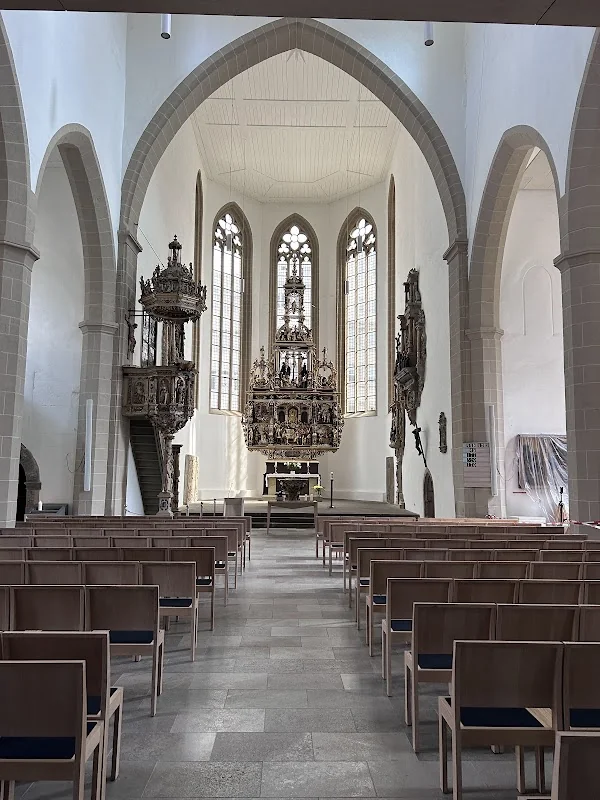
Particularly impressive is the post-Reformation furnishings of the Kaufmannskirche, which continues to shape the inner character of the space today. The community page highlights that especially the pulpit and altar served to visually convey the biblical foundations of Lutheran doctrine to the worship visitor. This shows the theological and artistic uniqueness of the church: It is not just a historical space but a consciously designed teaching and proclamation environment. The time between 1598 and 1625 played an important role in the history of the altar area when the pulpit, baptismal font, and high altar were created. The baptismal font from 1608 was restored from 2008 to 2009 and rededicated in 2009 with a festive service. The altar area itself was also renovated from 2013 to 2014, and the altar was restored. These works demonstrate how intensively the community maintains the historical fabric. The organ tradition of the Kaufmannskirche is equally remarkable. From 1686 to 1688, Christoph Junge and Hanns Albrecht built a new organ, with the prospect crafted by Hans Silberschlag; in 1845, Johann Michael Hesse repaired the instrument and expanded it with some registers. In 1911, an organ built by Wilhelm Rühlmann with 42 voices on three manuals and pedal was consecrated, and in 1957, the company Schuster und Sohn erected another instrument, which essentially remained intact until 2020. According to the community page, this organ is no longer playable today and has been dismantled, but the baroque prospect remains as a testament to the long tradition. Together with the regular musical formats, Monday music, and concert series, an exciting overall picture emerges: The Kaufmannskirche is not just any performance venue but a space where liturgy, art, craftsmanship, and music history are directly connected. Therefore, those searching for Kaufmannskirche Erfurt altar or Kaufmannskirche Erfurt organ will find not just individual objects here but a developed cultural narrative. ([kaufmannsgemeinde-erfurt.de](https://kaufmannsgemeinde-erfurt.de/kaufmannskirche/))
Photos, Architecture, and the Special Atmosphere
Architecturally, the Kaufmannskirche is also an extraordinary place, well-suited for photos and for an initial impression in the city center. Erfurt Tourism describes it as the only city church in Erfurt with two towers and mentions the Romanesque predecessor building, which was first mentioned in 1248. After the fire of 1291, the church was built as a three-nave Gothic basilica with a high Gothic choir and two Romanesque tower sections; this building has essentially been preserved to this day. The community page adds that the current building is a three-nave Gothic basilica without a transept, whose further altar area is separated by a large triumphal arch. Particularly interesting is the recent interior design: After extensive renovations, the north and south galleries were removed, allowing the majestic effect of the arcades and the space to come to the fore again. According to Erfurt Tourism, photography is allowed, and this allows the special atmosphere to be well captured. Upon entering the church, one experiences a mix of historical depth and modern clarity: historical artworks meet a newly designed, functionally used church that is simultaneously a place of worship, event venue, and memorial. Visible signs in the urban space also include the Luther Monument in front of the church and the cross stone on the outer wall, which commemorates Luther's sermon. This makes the church appear not isolated but embedded in a vibrant urban environment at Anger. For many visitors, this contrast is particularly appealing: outside the bustling shopping and business street, inside silence, history, and a consciously designed sacred order. Therefore, those searching for Kaufmannskirche photos will quickly realize that the church offers not only individual beautiful views but a very dense spatial experience of architecture, light, art, and urban context. This makes it a destination suitable for both short visits and intensive cultural-historical explorations. ([kaufmannsgemeinde-erfurt.de](https://kaufmannsgemeinde-erfurt.de/kaufmannskirche/bauwerk/))
Sources:
Mehr anzeigenWeniger anzeigen
Kaufmannskirche Erfurt | Events & Opening Hours
The Kaufmannskirche at Anger is one of the most prominent churches in Erfurt and is much more than a historical place of worship. It is located at one of the most well-known spots in the city center, closing off the Anger as an urban dominant to the northeast and connecting medieval city history with vibrant present. Those who visit the Kaufmannskirche today experience not only a sacred space but a place where worship, tours, music, art, and remembrance are closely intertwined. The church is considered one of the oldest parish churches in the city, a site of Luther, and a site of Bach, and it is perceived by many as a reliably open church, a quiet space, a cultural attraction, and a spiritual center. Between the altar area, pulpit, historical architectural form, and current community life, a multifaceted picture emerges that is particularly appealing for visitors interested in history, architecture, music, and urban development. The following sections summarize the most important facts and frame them in such a way that one can understand the Kaufmannskirche not just as a sight but as a living place. ([kaufmannsgemeinde-erfurt.de](https://kaufmannsgemeinde-erfurt.de/kaufmannskirche/))
Events, Services, and Music at the Kaufmannskirche
The Kaufmannskirche is today a place where spiritual life and cultural events meaningfully complement each other. On the website of the Evangelical Kaufmann Community, it is shown that not only classical services take place here, but also a very wide range of musical and community formats are maintained. These include church choir, cantata services focusing on music by Gottfried Heinrich Stölzel, the Evangelical Children's Choir Erfurt, musically designed services with solo instruments or project brass groups, concerts by external ensembles, and other music events organized by the merchants' society. The community also describes 20 minutes of organ music every Monday as a fixed part of the program. Thus, the Kaufmannskirche is not just a concert hall but a place where music and proclamation stand in a tradition that has developed over centuries. The concert area is explicitly distinguished from liturgical music on the community page, while the events are transparently announced in the calendar. For visitors, this means: Those looking for Kaufmannskirche Erfurt events, Kaufmannskirche Erfurt concerts, or Kaufmannskirche Erfurt services will find a place with a regular program, musical diversity, and an open, community-related structure. Erfurt Tourism also refers to current dates such as tours, GospelRock, and organ impulses, showing that the church does not appear museum-like but is actively used. Therefore, anyone interested in a visit should not only search for a single event but keep an eye on the entire event calendar. ([kaufmannsgemeinde-erfurt.de](https://kaufmannsgemeinde-erfurt.de/veranstaltungen/musik/))
Opening Hours Today and Public Tours
For many visitors, the question of opening hours is crucial when they want to experience the Kaufmannskirche Erfurt today or on a specific day. The Evangelical Kaufmann Community describes the church as a “reliably open church” and states that for the visiting season from March 21 to November 10, it regularly opens on Mondays, Wednesdays to Fridays, and Saturdays from 11 AM to 2 PM. This information is particularly important because the church is not accessible around the clock and its visiting times are consciously tied to a season. Additionally, the community offers free public tours from May to October on the first Thursday of each month, meeting at 2 PM at the Luther Monument south of the church. The tours are conducted by art-historically and theologically experienced volunteer members of the community, who explain significant artworks alongside the building history. Furthermore, Erfurt Tourism provides information about regular public tours from April to November as well as the possibility to book registered paid tours. For visitors, this is practical: Those who want to not just briefly enter the church but truly understand it should plan for a tour. Other useful information also makes the visit easier: According to Erfurt Tourism, the church is publicly accessible, entry is free, photography is allowed, bike racks are available, and a sanitary facility is reportedly not present. This results in a clear picture: The Kaufmannskirche is an open but consciously structured place where one should check visiting times, season, and tour dates in advance. ([kaufmannsgemeinde-erfurt.de](https://kaufmannsgemeinde-erfurt.de/kaufmannskirche/))
Directions, Maps, and Parking at Anger
The Kaufmannskirche is very conveniently located in the middle of Erfurt's center, making it attractive for both spontaneous visits and planned cultural events. The community describes the church as located directly at Anger, a place that is reachable by all tram lines. According to the community page, it is only about 200 meters from the Anger stop along the main post office building towards the east, and right after the Luther Monument, one reaches the church. Erfurt Tourism additionally mentions a distance of 160 meters to the tram, thus summarizing the good public transport connection compactly. For those searching for Kaufmannskirche Erfurt maps or Kaufmannskirche Erfurt parking, this information is particularly helpful as it shows that the church is accessible without a long walk and does not rely on a separate parking area. Those arriving by car will find several parking garages in the vicinity, including the Hotel Am Kaisersaal parking garage on Futterstraße, the Reglermauer parking garage, and the Q-Park Anger 1 parking garage. Thus, it is clear: One does not have to hope for a parking space directly at the church in the city center but can focus on the well-known parking garages in the nearby area. For visitors, this also means more freedom in planning the day, as one can easily combine sightseeing, shopping, and events. The location at Anger is also urbanistically exciting, as the church forms a prominent orientation point between the shopping street, historical houses, and the Luther Monument. Therefore, those who not only know the address but consciously plan the route benefit from a very clear city center location with a short distance to public transport and several parking options in the immediate vicinity. ([kaufmannsgemeinde-erfurt.de](https://kaufmannsgemeinde-erfurt.de/informationen/so-finden-sie-uns/))
History, Luther, and Bach in Erfurt
The history of the Kaufmannskirche dates back to the early beginnings of urban development, making it a key location for the historical understanding of Erfurt. According to official accounts, its origin can likely be traced back to the 11th century; the church is first mentioned in a document in 1248. The current building is the result of a long development process, as after the city fire of 1291, the church was rebuilt as a three-nave Gothic basilica and consecrated in 1368. The community page and Erfurt Tourism emphasize that the Kaufmannskirche was closely connected to the historical trading place at Anger, where merchants and long-distance traders settled. This origin explains why the church is still perceived as a special city church today. Its role in the history of the Reformation is particularly significant: On October 22, 1522, Martin Luther preached here, and the Kaufmannskirche is therefore considered an authentic Luther site. In front of the church stands the Erfurt Luther Monument, which visibly marks the place in the urban space. Equally important is the connection to the Bach family. In the Kaufmannskirche, Johann Sebastian Bach's parents were married in 1668, and the Bach family was closely associated with the Kaufmann Community in Erfurt. Erfurt Tourism lists more than 100 entries for baptisms, weddings, and burials in the church records of the Bach family. Thus, the church is interesting not only for Reformation history but also for music history and family history of European significance. Additional historical stations include the time as a Swedish garrison church from 1636 to 1650, the baroque dome of the north tower from 1684, the organ prospect from 1686, and the major restorations of the 19th century as well as the 20th and 21st centuries. Therefore, those searching for Kaufmannskirche Erfurt Bach find not only a name but a concretely documented connection between place, family, city, and music tradition. ([kaufmannsgemeinde-erfurt.de](https://kaufmannsgemeinde-erfurt.de/kaufmannskirche/geschichte/))
Altar, Pulpit, and the Organ Tradition
Particularly impressive is the post-Reformation furnishings of the Kaufmannskirche, which continues to shape the inner character of the space today. The community page highlights that especially the pulpit and altar served to visually convey the biblical foundations of Lutheran doctrine to the worship visitor. This shows the theological and artistic uniqueness of the church: It is not just a historical space but a consciously designed teaching and proclamation environment. The time between 1598 and 1625 played an important role in the history of the altar area when the pulpit, baptismal font, and high altar were created. The baptismal font from 1608 was restored from 2008 to 2009 and rededicated in 2009 with a festive service. The altar area itself was also renovated from 2013 to 2014, and the altar was restored. These works demonstrate how intensively the community maintains the historical fabric. The organ tradition of the Kaufmannskirche is equally remarkable. From 1686 to 1688, Christoph Junge and Hanns Albrecht built a new organ, with the prospect crafted by Hans Silberschlag; in 1845, Johann Michael Hesse repaired the instrument and expanded it with some registers. In 1911, an organ built by Wilhelm Rühlmann with 42 voices on three manuals and pedal was consecrated, and in 1957, the company Schuster und Sohn erected another instrument, which essentially remained intact until 2020. According to the community page, this organ is no longer playable today and has been dismantled, but the baroque prospect remains as a testament to the long tradition. Together with the regular musical formats, Monday music, and concert series, an exciting overall picture emerges: The Kaufmannskirche is not just any performance venue but a space where liturgy, art, craftsmanship, and music history are directly connected. Therefore, those searching for Kaufmannskirche Erfurt altar or Kaufmannskirche Erfurt organ will find not just individual objects here but a developed cultural narrative. ([kaufmannsgemeinde-erfurt.de](https://kaufmannsgemeinde-erfurt.de/kaufmannskirche/))
Photos, Architecture, and the Special Atmosphere
Architecturally, the Kaufmannskirche is also an extraordinary place, well-suited for photos and for an initial impression in the city center. Erfurt Tourism describes it as the only city church in Erfurt with two towers and mentions the Romanesque predecessor building, which was first mentioned in 1248. After the fire of 1291, the church was built as a three-nave Gothic basilica with a high Gothic choir and two Romanesque tower sections; this building has essentially been preserved to this day. The community page adds that the current building is a three-nave Gothic basilica without a transept, whose further altar area is separated by a large triumphal arch. Particularly interesting is the recent interior design: After extensive renovations, the north and south galleries were removed, allowing the majestic effect of the arcades and the space to come to the fore again. According to Erfurt Tourism, photography is allowed, and this allows the special atmosphere to be well captured. Upon entering the church, one experiences a mix of historical depth and modern clarity: historical artworks meet a newly designed, functionally used church that is simultaneously a place of worship, event venue, and memorial. Visible signs in the urban space also include the Luther Monument in front of the church and the cross stone on the outer wall, which commemorates Luther's sermon. This makes the church appear not isolated but embedded in a vibrant urban environment at Anger. For many visitors, this contrast is particularly appealing: outside the bustling shopping and business street, inside silence, history, and a consciously designed sacred order. Therefore, those searching for Kaufmannskirche photos will quickly realize that the church offers not only individual beautiful views but a very dense spatial experience of architecture, light, art, and urban context. This makes it a destination suitable for both short visits and intensive cultural-historical explorations. ([kaufmannsgemeinde-erfurt.de](https://kaufmannsgemeinde-erfurt.de/kaufmannskirche/bauwerk/))
Sources:
Kaufmannskirche Erfurt | Events & Opening Hours
The Kaufmannskirche at Anger is one of the most prominent churches in Erfurt and is much more than a historical place of worship. It is located at one of the most well-known spots in the city center, closing off the Anger as an urban dominant to the northeast and connecting medieval city history with vibrant present. Those who visit the Kaufmannskirche today experience not only a sacred space but a place where worship, tours, music, art, and remembrance are closely intertwined. The church is considered one of the oldest parish churches in the city, a site of Luther, and a site of Bach, and it is perceived by many as a reliably open church, a quiet space, a cultural attraction, and a spiritual center. Between the altar area, pulpit, historical architectural form, and current community life, a multifaceted picture emerges that is particularly appealing for visitors interested in history, architecture, music, and urban development. The following sections summarize the most important facts and frame them in such a way that one can understand the Kaufmannskirche not just as a sight but as a living place. ([kaufmannsgemeinde-erfurt.de](https://kaufmannsgemeinde-erfurt.de/kaufmannskirche/))
Events, Services, and Music at the Kaufmannskirche
The Kaufmannskirche is today a place where spiritual life and cultural events meaningfully complement each other. On the website of the Evangelical Kaufmann Community, it is shown that not only classical services take place here, but also a very wide range of musical and community formats are maintained. These include church choir, cantata services focusing on music by Gottfried Heinrich Stölzel, the Evangelical Children's Choir Erfurt, musically designed services with solo instruments or project brass groups, concerts by external ensembles, and other music events organized by the merchants' society. The community also describes 20 minutes of organ music every Monday as a fixed part of the program. Thus, the Kaufmannskirche is not just a concert hall but a place where music and proclamation stand in a tradition that has developed over centuries. The concert area is explicitly distinguished from liturgical music on the community page, while the events are transparently announced in the calendar. For visitors, this means: Those looking for Kaufmannskirche Erfurt events, Kaufmannskirche Erfurt concerts, or Kaufmannskirche Erfurt services will find a place with a regular program, musical diversity, and an open, community-related structure. Erfurt Tourism also refers to current dates such as tours, GospelRock, and organ impulses, showing that the church does not appear museum-like but is actively used. Therefore, anyone interested in a visit should not only search for a single event but keep an eye on the entire event calendar. ([kaufmannsgemeinde-erfurt.de](https://kaufmannsgemeinde-erfurt.de/veranstaltungen/musik/))
Opening Hours Today and Public Tours
For many visitors, the question of opening hours is crucial when they want to experience the Kaufmannskirche Erfurt today or on a specific day. The Evangelical Kaufmann Community describes the church as a “reliably open church” and states that for the visiting season from March 21 to November 10, it regularly opens on Mondays, Wednesdays to Fridays, and Saturdays from 11 AM to 2 PM. This information is particularly important because the church is not accessible around the clock and its visiting times are consciously tied to a season. Additionally, the community offers free public tours from May to October on the first Thursday of each month, meeting at 2 PM at the Luther Monument south of the church. The tours are conducted by art-historically and theologically experienced volunteer members of the community, who explain significant artworks alongside the building history. Furthermore, Erfurt Tourism provides information about regular public tours from April to November as well as the possibility to book registered paid tours. For visitors, this is practical: Those who want to not just briefly enter the church but truly understand it should plan for a tour. Other useful information also makes the visit easier: According to Erfurt Tourism, the church is publicly accessible, entry is free, photography is allowed, bike racks are available, and a sanitary facility is reportedly not present. This results in a clear picture: The Kaufmannskirche is an open but consciously structured place where one should check visiting times, season, and tour dates in advance. ([kaufmannsgemeinde-erfurt.de](https://kaufmannsgemeinde-erfurt.de/kaufmannskirche/))
Directions, Maps, and Parking at Anger
The Kaufmannskirche is very conveniently located in the middle of Erfurt's center, making it attractive for both spontaneous visits and planned cultural events. The community describes the church as located directly at Anger, a place that is reachable by all tram lines. According to the community page, it is only about 200 meters from the Anger stop along the main post office building towards the east, and right after the Luther Monument, one reaches the church. Erfurt Tourism additionally mentions a distance of 160 meters to the tram, thus summarizing the good public transport connection compactly. For those searching for Kaufmannskirche Erfurt maps or Kaufmannskirche Erfurt parking, this information is particularly helpful as it shows that the church is accessible without a long walk and does not rely on a separate parking area. Those arriving by car will find several parking garages in the vicinity, including the Hotel Am Kaisersaal parking garage on Futterstraße, the Reglermauer parking garage, and the Q-Park Anger 1 parking garage. Thus, it is clear: One does not have to hope for a parking space directly at the church in the city center but can focus on the well-known parking garages in the nearby area. For visitors, this also means more freedom in planning the day, as one can easily combine sightseeing, shopping, and events. The location at Anger is also urbanistically exciting, as the church forms a prominent orientation point between the shopping street, historical houses, and the Luther Monument. Therefore, those who not only know the address but consciously plan the route benefit from a very clear city center location with a short distance to public transport and several parking options in the immediate vicinity. ([kaufmannsgemeinde-erfurt.de](https://kaufmannsgemeinde-erfurt.de/informationen/so-finden-sie-uns/))
History, Luther, and Bach in Erfurt
The history of the Kaufmannskirche dates back to the early beginnings of urban development, making it a key location for the historical understanding of Erfurt. According to official accounts, its origin can likely be traced back to the 11th century; the church is first mentioned in a document in 1248. The current building is the result of a long development process, as after the city fire of 1291, the church was rebuilt as a three-nave Gothic basilica and consecrated in 1368. The community page and Erfurt Tourism emphasize that the Kaufmannskirche was closely connected to the historical trading place at Anger, where merchants and long-distance traders settled. This origin explains why the church is still perceived as a special city church today. Its role in the history of the Reformation is particularly significant: On October 22, 1522, Martin Luther preached here, and the Kaufmannskirche is therefore considered an authentic Luther site. In front of the church stands the Erfurt Luther Monument, which visibly marks the place in the urban space. Equally important is the connection to the Bach family. In the Kaufmannskirche, Johann Sebastian Bach's parents were married in 1668, and the Bach family was closely associated with the Kaufmann Community in Erfurt. Erfurt Tourism lists more than 100 entries for baptisms, weddings, and burials in the church records of the Bach family. Thus, the church is interesting not only for Reformation history but also for music history and family history of European significance. Additional historical stations include the time as a Swedish garrison church from 1636 to 1650, the baroque dome of the north tower from 1684, the organ prospect from 1686, and the major restorations of the 19th century as well as the 20th and 21st centuries. Therefore, those searching for Kaufmannskirche Erfurt Bach find not only a name but a concretely documented connection between place, family, city, and music tradition. ([kaufmannsgemeinde-erfurt.de](https://kaufmannsgemeinde-erfurt.de/kaufmannskirche/geschichte/))
Altar, Pulpit, and the Organ Tradition
Particularly impressive is the post-Reformation furnishings of the Kaufmannskirche, which continues to shape the inner character of the space today. The community page highlights that especially the pulpit and altar served to visually convey the biblical foundations of Lutheran doctrine to the worship visitor. This shows the theological and artistic uniqueness of the church: It is not just a historical space but a consciously designed teaching and proclamation environment. The time between 1598 and 1625 played an important role in the history of the altar area when the pulpit, baptismal font, and high altar were created. The baptismal font from 1608 was restored from 2008 to 2009 and rededicated in 2009 with a festive service. The altar area itself was also renovated from 2013 to 2014, and the altar was restored. These works demonstrate how intensively the community maintains the historical fabric. The organ tradition of the Kaufmannskirche is equally remarkable. From 1686 to 1688, Christoph Junge and Hanns Albrecht built a new organ, with the prospect crafted by Hans Silberschlag; in 1845, Johann Michael Hesse repaired the instrument and expanded it with some registers. In 1911, an organ built by Wilhelm Rühlmann with 42 voices on three manuals and pedal was consecrated, and in 1957, the company Schuster und Sohn erected another instrument, which essentially remained intact until 2020. According to the community page, this organ is no longer playable today and has been dismantled, but the baroque prospect remains as a testament to the long tradition. Together with the regular musical formats, Monday music, and concert series, an exciting overall picture emerges: The Kaufmannskirche is not just any performance venue but a space where liturgy, art, craftsmanship, and music history are directly connected. Therefore, those searching for Kaufmannskirche Erfurt altar or Kaufmannskirche Erfurt organ will find not just individual objects here but a developed cultural narrative. ([kaufmannsgemeinde-erfurt.de](https://kaufmannsgemeinde-erfurt.de/kaufmannskirche/))
Photos, Architecture, and the Special Atmosphere
Architecturally, the Kaufmannskirche is also an extraordinary place, well-suited for photos and for an initial impression in the city center. Erfurt Tourism describes it as the only city church in Erfurt with two towers and mentions the Romanesque predecessor building, which was first mentioned in 1248. After the fire of 1291, the church was built as a three-nave Gothic basilica with a high Gothic choir and two Romanesque tower sections; this building has essentially been preserved to this day. The community page adds that the current building is a three-nave Gothic basilica without a transept, whose further altar area is separated by a large triumphal arch. Particularly interesting is the recent interior design: After extensive renovations, the north and south galleries were removed, allowing the majestic effect of the arcades and the space to come to the fore again. According to Erfurt Tourism, photography is allowed, and this allows the special atmosphere to be well captured. Upon entering the church, one experiences a mix of historical depth and modern clarity: historical artworks meet a newly designed, functionally used church that is simultaneously a place of worship, event venue, and memorial. Visible signs in the urban space also include the Luther Monument in front of the church and the cross stone on the outer wall, which commemorates Luther's sermon. This makes the church appear not isolated but embedded in a vibrant urban environment at Anger. For many visitors, this contrast is particularly appealing: outside the bustling shopping and business street, inside silence, history, and a consciously designed sacred order. Therefore, those searching for Kaufmannskirche photos will quickly realize that the church offers not only individual beautiful views but a very dense spatial experience of architecture, light, art, and urban context. This makes it a destination suitable for both short visits and intensive cultural-historical explorations. ([kaufmannsgemeinde-erfurt.de](https://kaufmannsgemeinde-erfurt.de/kaufmannskirche/bauwerk/))
Sources:
Upcoming Events
No events found
Frequently Asked Questions
Reviews
Joost Francien Verbaan
6. January 2026
One of the many impressive churches in Erfurt. They are scattered throughout the city as if they were chapels, but each one is huge on its own. This one has particularly beautiful towers.
Shadenight123
27. April 2019
Wonderful
Steffen Joost
17. January 2026
Very nicely renovated church, after 30 years in Erfurt, I was there for a concert for the first time. As is usual in churches at this time of year, it was a bit cold.
Clemens Matscha
14. January 2025
St. Gregor Church, also known as the "Merchant Church" after its founders in the Middle Ages, is centrally located in the city center. Recently completely renovated, it shines again in new splendor and invites to services. It should definitely be part of the visit program when you visit Erfurt.
Julchen F.
22. January 2026
It was my 4th Candle Light concert and simply beautiful. The music and atmosphere touch the soul and make you forget everything for a moment. Especially in the church, it was a feast for the eyes.