
Erfurt
Barfüßerstraße 20, 99084 Erfurt-Altstadt, Deutschland
Barfüßerkirche Erfurt | Events & Opening Hours
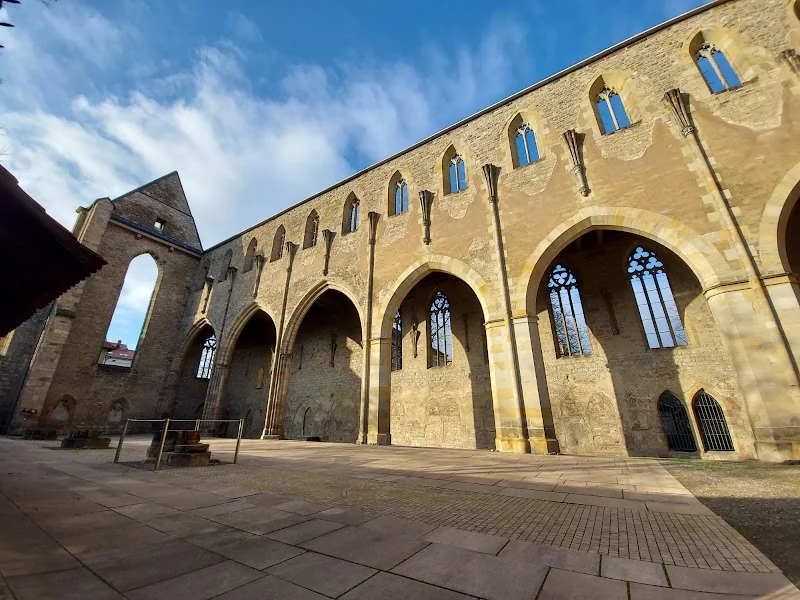
The Barfüßerkirche is one of the most impressive historical sites in Erfurt, uniquely combining church ruins, a museum, and an event venue. Today, anyone passing by Barfüßerstraße 20 not only sees the traces of a once-powerful Franciscan church but also a cultural monument that has shaped the cityscape for centuries. The church was built as part of the Franciscan monastery, was damaged multiple times, altered repeatedly, and finally severely destroyed by an air raid in 1944. Nevertheless, it has remained a central place in Erfurt's history to this day. Particularly notable is the rebuilt High Choir, where significant art treasures are preserved and which will reopen to visitors in 2026 after a long closure. This blend of ruin, memory, art, and vibrant culture makes the Barfüßerkirche one of the most exciting destinations for anyone seeking history, events, and unique photo opportunities in Erfurt. ([barfuesserkirche.de](https://barfuesserkirche.de/))
Opening Hours 2026, Admission and Access
For current visits, the opening hours are particularly important, as the Barfüßerkirche is not a classic year-round museum with continuous standard operations, but is opened seasonally and on special occasions. According to the official announcement from the Erfurt Art Museums, the High Choir will be accessible from May 30 to September 13, 2026, every Tuesday to Sunday from 1 PM to 6 PM; admission is free. This makes the visit especially appealing to people who want to incorporate their old town stroll, a museum afternoon, or a cultural appointment into the warm season. The address is Barfüßerstraße 20 in 99084 Erfurt. The site is part of the Erfurt Art Museums and is closely connected to the Angermuseum, which also explains why valuable artworks and museum presentations can be found in the choir. The location is also interesting for photos: The tourism site explicitly states that photography is allowed. Those with limited mobility should know that access to the museum involves a step, followed by another step inside, while the ruin itself is accessible at ground level. This creates a realistic picture of the visit: culturally high-caliber, but in a historical building situation with special architectural conditions. ([kunstmuseen.erfurt.de](https://kunstmuseen.erfurt.de/km/de/angermuseum/haus/barfuesserkirche/index.html))
Content-wise, the High Choir is particularly worth a look because the city of Erfurt showcases an important part of its art historical heritage there. The press release regarding the reopening emphasizes that the oldest stained glass windows in the city, magnificent altars, bells, and modern art can be seen here. This is precisely what attracts visitors who do not just want to view a ruin but are looking for a place where narratives from the Middle Ages, Reformation, and monument preservation converge. The fact that the choir will reopen regularly in 2026 after 15 years of closure is more than just a footnote: it shows how strongly the Barfüßerkirche remains in the focus of urban cultural preservation to this day. For practical orientation, it is also helpful that the Barfüßerkirche is not located off the beaten path, but right in the old town close to well-known routes and transport connections. For this reason, it is suitable for spontaneous visits as well as for deliberately planned city explorations. ([kunstmuseen.erfurt.de](https://kunstmuseen.erfurt.de/km/de/service/aktuelles/presse/index.html))
Barfüßerkirche Erfurt: Events, Summer Theater, and Program
If you are looking for events, programs, or summer theater, the Barfüßerkirche is exactly the right place to experience culture not just in an exhibition but in the atmospheric space itself. The initiative group Barfüßerkirche explicitly describes the place as a vibrant cultural space where concerts, exhibitions, and lectures take place. Especially in summer, the ruin becomes a backdrop for the summer theater, making it a magnet for guests from the city and beyond. This use is no coincidence but ties into the special effect of the place: the open walls, the historic choir, and the visible traces of history create a stage that is distinctly different from modern event halls. For many people, this is exactly why Barfüßerkirche, summer theater, and events in Erfurt are so often searched together. Therefore, anyone looking for a program in 2026, upcoming events, or special cultural appointments should keep an eye on the official site of the art museums and the pages of the initiative group, as special openings, concerts, and program highlights are compiled there. Particularly interesting is that the event venue hosts both museum educational and musical formats, thus appealing to multiple target groups. ([barfuesserkirche.de](https://barfuesserkirche.de/))
A good example of this mix is the International Museum Day in May 2026: The Erfurt Art Museums announced a preview in the High Choir with a welcome, concert, and conclusion. At the same time, it was announced that the High Choir will reopen regularly for visitor traffic from May 30, 2026, after 15 years of closure. Such dates show that the Barfüßerkirche is not just a static monument but a place with recurring events that breathe new life into the historical space. The official press and event pages also repeatedly mention concerts in the High Choir, and the city reminded in 2024 that the ruin serves as the backdrop for summer theater performances year after year. Therefore, anyone searching for photos, event programs, or the next cultural-historical appointments will not find just any event location here, but a monument with a special atmosphere. This is a crucial difference for search interests around Barfüßerkirche Erfurt theater, summer theater, and events. ([kunstmuseen.erfurt.de](https://kunstmuseen.erfurt.de/km/de/service/aktuelles/meldungen/2026/ef_154188.html))
History of the Barfüßerkirche: Franciscans, Luther, and Ruins
The history of the Barfüßerkirche begins early and reaches deep into the history of the city and church of Erfurt. The Franciscans arrived in Erfurt as early as 1224; the construction developed over many decades and was completed in several phases. On the initiative group's page, the church is described as a masterpiece of architecture, completed around 1250, burned down in 1291, and rebuilt until about 1430. The art museums add that the choir was consecrated in 1316 and that further construction continued on the nave until the 15th century. Thus, the church became not only a place of worship but also a significant example of German mendicant order architecture. In the Middle Ages, the long, continuous gable roof of the former Franciscan monastery shaped the cityscape of Erfurt for centuries. The historical significance also includes the fact that Martin Luther preached here in 1529, leaving visible traces of the Reformation at this site. After the Reformation, the monastery was dissolved, and later the church continued to be used as a parish church for a long time. This development is a central part of the place for those seeking history and the religious past of Erfurt. ([barfuesserkirche.de](https://barfuesserkirche.de/))
The later history is just as moving as the medieval construction phase. In 1838, part of the church nave collapsed after being struck by lightning; reconstruction took place between 1840 and 1852. Even more significant was the destruction during World War II: in 1944, the Barfüßerkirche was severely damaged, leaving the nave as a ruin while the choir was rebuilt. The current traces of destruction are therefore not coincidentally preserved but are part of a long chain of loss, securing, and reconstruction. In 1977, the building came into municipal ownership, followed by extensive preservation and reconstruction work, and in 1983, the Museum of Medieval Art was opened here in honor of Luther in the GDR. The museum was closed since 2010, but the High Choir will reopen regularly in 2026. The initiative group also points out that the ruin has held the status of a nationally significant cultural monument since 2007. For visitors, this means: The Barfüßerkirche is not only old but a place where the city fire, Reformation, war, monument preservation, and today's cultural work overlap directly. ([barfuesserkirche.de](https://barfuesserkirche.de/architektur/articles/architektur))
Art Treasures in the High Choir: Stained Glass, Altars, and Architecture
The High Choir of the Barfüßerkirche is the part of the ensemble that particularly makes the art historical value of the site visible. The official pages mention the oldest stained glass windows in the city of Erfurt from the 13th century, along with altars, sculptures, tomb monuments, and other artworks. According to the tourism site, the valuable windows from the 13th century have been secured, as has the wooden wing altar. Thus, the Barfüßerkirche is not just a ruin in the romantic sense but a museum-like place with genuine originals that come from different phases of medieval furnishings. The art museums also state that the choir is now an annex of the Angermuseum and showcases medieval sacred art. This is important because the function of the building has changed here: from a monastery church to a museum, from a fully utilized house of worship to a place of memory, and from a nearly forgotten structure to a publicly perceptible cultural monument. Particularly for search queries like photos, art treasures, or special features, this choir is therefore the most exciting part of the Barfüßerkirche. ([erfurt-tourismus.de](https://www.erfurt-tourismus.de/sehenswertes/museen-und-ausstellungen/museen/stadtmuseum-haus-zum-stockfisch/museum-barfuesserkirche/))
The Barfüßerkirche is also architecturally remarkable. The initiative group describes it as a three-nave basilica with six very wide, nearly square double bays in the central nave and an elongated four-bay choir with a polygonal end. Additionally, there is an octagonal, richly articulated tower on the northern buttress of the choir arch, as well as a later portal design that was introduced around 1482. Such details may only be visible to laypeople at second glance, but they explain why the Barfüßerkirche is considered an outstanding example of German mendicant order architecture in technical language. Therefore, those interested in medieval church spaces experience not only individual exhibits here but a complete historical structure where architecture and art are still connected. The fact that the site can be photographed is an additional plus for many visitors, as it allows capturing light, stone, and the open ruin aesthetics well. The Barfüßerkirche is therefore a place for people who want to see history, understand art, and experience spatial effects directly. ([barfuesserkirche.de](https://barfuesserkirche.de/architektur/articles/architektur))
Directions, Parking, and Practical Tips for the Visit
The Barfüßerkirche is located very centrally in the Erfurt old town and is therefore easy to incorporate into a walk through the historic center. The address is Barfüßerstraße 20, 99084 Erfurt, and the official tourism site indicates a distance of about 200 meters to the tram. For public transport access, this means: The route is short, clear, and suitable for spontaneous visits. Those arriving by car will find several parking garages and parking spaces nearby at Hirschlachufer, including Forum 1, Forum 2/3, and Forum 4. This is particularly useful for anyone who does not want to spend a long time searching for parking on-site. At the same time, the location in the old town remains so central that it can be easily combined with other Erfurt attractions. The Barfüßerkirche is thus practically accessible for both short cultural stops and longer old town tours. This mix of historical location and good connections makes it attractive for people specifically searching for directions, parking, and opening hours. ([erfurt-tourismus.de](https://www.erfurt-tourismus.de/sehenswertes/museen-und-ausstellungen/museen/stadtmuseum-haus-zum-stockfisch/museum-barfuesserkirche/))
Another practical point is the special visiting situation: The Barfüßerkirche is not a continuously opened standard operation but a seasonally opened cultural site with clear opening hours and a high proportion of special dates. Therefore, it is worthwhile to always check the official pages of the art museums or the initiative group before visiting, especially if you want to attend a concert, a special opening, or an event format. Those primarily wanting to take photos can do so according to official information; those accompanying people who pay attention to accessibility should note the steps at the museum entrance and prepare for the ground-level ruin area. Content-wise, the place offers even more: history, architecture, art, and summer atmosphere at a single location. For this reason, the Barfüßerkirche is not just a search hit for Barfüßerkirche Erfurt opening hours or Barfüßerkirche Erfurt parking, but a true destination for all who want to experience culture with substance in Erfurt. ([erfurt-tourismus.de](https://www.erfurt-tourismus.de/sehenswertes/museen-und-ausstellungen/museen/stadtmuseum-haus-zum-stockfisch/museum-barfuesserkirche/))
Sources:
- Erfurt Art Museums - Barfüßerkirche ([kunstmuseen.erfurt.de](https://kunstmuseen.erfurt.de/km/de/angermuseum/haus/barfuesserkirche/index.html))
- Erfurt Tourism - Museum Barfüßerkirche ([erfurt-tourismus.de](https://www.erfurt-tourismus.de/sehenswertes/museen-und-ausstellungen/museen/stadtmuseum-haus-zum-stockfisch/museum-barfuesserkirche/))
- Initiative Group Barfüßerkirche - Homepage ([barfuesserkirche.de](https://barfuesserkirche.de/))
- Erfurt Art Museums - Press Releases ([kunstmuseen.erfurt.de](https://kunstmuseen.erfurt.de/km/de/service/aktuelles/presse/index.html))
- History Museums Erfurt - Commemoration of the Destruction 80 Years Ago ([geschichtsmuseen.erfurt.de](https://geschichtsmuseen.erfurt.de/gm/de/service/aktuelles/meldungen/2024/ef_149436.html))
Show moreShow less
Barfüßerkirche Erfurt | Events & Opening Hours
The Barfüßerkirche is one of the most impressive historical sites in Erfurt, uniquely combining church ruins, a museum, and an event venue. Today, anyone passing by Barfüßerstraße 20 not only sees the traces of a once-powerful Franciscan church but also a cultural monument that has shaped the cityscape for centuries. The church was built as part of the Franciscan monastery, was damaged multiple times, altered repeatedly, and finally severely destroyed by an air raid in 1944. Nevertheless, it has remained a central place in Erfurt's history to this day. Particularly notable is the rebuilt High Choir, where significant art treasures are preserved and which will reopen to visitors in 2026 after a long closure. This blend of ruin, memory, art, and vibrant culture makes the Barfüßerkirche one of the most exciting destinations for anyone seeking history, events, and unique photo opportunities in Erfurt. ([barfuesserkirche.de](https://barfuesserkirche.de/))
Opening Hours 2026, Admission and Access
For current visits, the opening hours are particularly important, as the Barfüßerkirche is not a classic year-round museum with continuous standard operations, but is opened seasonally and on special occasions. According to the official announcement from the Erfurt Art Museums, the High Choir will be accessible from May 30 to September 13, 2026, every Tuesday to Sunday from 1 PM to 6 PM; admission is free. This makes the visit especially appealing to people who want to incorporate their old town stroll, a museum afternoon, or a cultural appointment into the warm season. The address is Barfüßerstraße 20 in 99084 Erfurt. The site is part of the Erfurt Art Museums and is closely connected to the Angermuseum, which also explains why valuable artworks and museum presentations can be found in the choir. The location is also interesting for photos: The tourism site explicitly states that photography is allowed. Those with limited mobility should know that access to the museum involves a step, followed by another step inside, while the ruin itself is accessible at ground level. This creates a realistic picture of the visit: culturally high-caliber, but in a historical building situation with special architectural conditions. ([kunstmuseen.erfurt.de](https://kunstmuseen.erfurt.de/km/de/angermuseum/haus/barfuesserkirche/index.html))
Content-wise, the High Choir is particularly worth a look because the city of Erfurt showcases an important part of its art historical heritage there. The press release regarding the reopening emphasizes that the oldest stained glass windows in the city, magnificent altars, bells, and modern art can be seen here. This is precisely what attracts visitors who do not just want to view a ruin but are looking for a place where narratives from the Middle Ages, Reformation, and monument preservation converge. The fact that the choir will reopen regularly in 2026 after 15 years of closure is more than just a footnote: it shows how strongly the Barfüßerkirche remains in the focus of urban cultural preservation to this day. For practical orientation, it is also helpful that the Barfüßerkirche is not located off the beaten path, but right in the old town close to well-known routes and transport connections. For this reason, it is suitable for spontaneous visits as well as for deliberately planned city explorations. ([kunstmuseen.erfurt.de](https://kunstmuseen.erfurt.de/km/de/service/aktuelles/presse/index.html))
Barfüßerkirche Erfurt: Events, Summer Theater, and Program
If you are looking for events, programs, or summer theater, the Barfüßerkirche is exactly the right place to experience culture not just in an exhibition but in the atmospheric space itself. The initiative group Barfüßerkirche explicitly describes the place as a vibrant cultural space where concerts, exhibitions, and lectures take place. Especially in summer, the ruin becomes a backdrop for the summer theater, making it a magnet for guests from the city and beyond. This use is no coincidence but ties into the special effect of the place: the open walls, the historic choir, and the visible traces of history create a stage that is distinctly different from modern event halls. For many people, this is exactly why Barfüßerkirche, summer theater, and events in Erfurt are so often searched together. Therefore, anyone looking for a program in 2026, upcoming events, or special cultural appointments should keep an eye on the official site of the art museums and the pages of the initiative group, as special openings, concerts, and program highlights are compiled there. Particularly interesting is that the event venue hosts both museum educational and musical formats, thus appealing to multiple target groups. ([barfuesserkirche.de](https://barfuesserkirche.de/))
A good example of this mix is the International Museum Day in May 2026: The Erfurt Art Museums announced a preview in the High Choir with a welcome, concert, and conclusion. At the same time, it was announced that the High Choir will reopen regularly for visitor traffic from May 30, 2026, after 15 years of closure. Such dates show that the Barfüßerkirche is not just a static monument but a place with recurring events that breathe new life into the historical space. The official press and event pages also repeatedly mention concerts in the High Choir, and the city reminded in 2024 that the ruin serves as the backdrop for summer theater performances year after year. Therefore, anyone searching for photos, event programs, or the next cultural-historical appointments will not find just any event location here, but a monument with a special atmosphere. This is a crucial difference for search interests around Barfüßerkirche Erfurt theater, summer theater, and events. ([kunstmuseen.erfurt.de](https://kunstmuseen.erfurt.de/km/de/service/aktuelles/meldungen/2026/ef_154188.html))
History of the Barfüßerkirche: Franciscans, Luther, and Ruins
The history of the Barfüßerkirche begins early and reaches deep into the history of the city and church of Erfurt. The Franciscans arrived in Erfurt as early as 1224; the construction developed over many decades and was completed in several phases. On the initiative group's page, the church is described as a masterpiece of architecture, completed around 1250, burned down in 1291, and rebuilt until about 1430. The art museums add that the choir was consecrated in 1316 and that further construction continued on the nave until the 15th century. Thus, the church became not only a place of worship but also a significant example of German mendicant order architecture. In the Middle Ages, the long, continuous gable roof of the former Franciscan monastery shaped the cityscape of Erfurt for centuries. The historical significance also includes the fact that Martin Luther preached here in 1529, leaving visible traces of the Reformation at this site. After the Reformation, the monastery was dissolved, and later the church continued to be used as a parish church for a long time. This development is a central part of the place for those seeking history and the religious past of Erfurt. ([barfuesserkirche.de](https://barfuesserkirche.de/))
The later history is just as moving as the medieval construction phase. In 1838, part of the church nave collapsed after being struck by lightning; reconstruction took place between 1840 and 1852. Even more significant was the destruction during World War II: in 1944, the Barfüßerkirche was severely damaged, leaving the nave as a ruin while the choir was rebuilt. The current traces of destruction are therefore not coincidentally preserved but are part of a long chain of loss, securing, and reconstruction. In 1977, the building came into municipal ownership, followed by extensive preservation and reconstruction work, and in 1983, the Museum of Medieval Art was opened here in honor of Luther in the GDR. The museum was closed since 2010, but the High Choir will reopen regularly in 2026. The initiative group also points out that the ruin has held the status of a nationally significant cultural monument since 2007. For visitors, this means: The Barfüßerkirche is not only old but a place where the city fire, Reformation, war, monument preservation, and today's cultural work overlap directly. ([barfuesserkirche.de](https://barfuesserkirche.de/architektur/articles/architektur))
Art Treasures in the High Choir: Stained Glass, Altars, and Architecture
The High Choir of the Barfüßerkirche is the part of the ensemble that particularly makes the art historical value of the site visible. The official pages mention the oldest stained glass windows in the city of Erfurt from the 13th century, along with altars, sculptures, tomb monuments, and other artworks. According to the tourism site, the valuable windows from the 13th century have been secured, as has the wooden wing altar. Thus, the Barfüßerkirche is not just a ruin in the romantic sense but a museum-like place with genuine originals that come from different phases of medieval furnishings. The art museums also state that the choir is now an annex of the Angermuseum and showcases medieval sacred art. This is important because the function of the building has changed here: from a monastery church to a museum, from a fully utilized house of worship to a place of memory, and from a nearly forgotten structure to a publicly perceptible cultural monument. Particularly for search queries like photos, art treasures, or special features, this choir is therefore the most exciting part of the Barfüßerkirche. ([erfurt-tourismus.de](https://www.erfurt-tourismus.de/sehenswertes/museen-und-ausstellungen/museen/stadtmuseum-haus-zum-stockfisch/museum-barfuesserkirche/))
The Barfüßerkirche is also architecturally remarkable. The initiative group describes it as a three-nave basilica with six very wide, nearly square double bays in the central nave and an elongated four-bay choir with a polygonal end. Additionally, there is an octagonal, richly articulated tower on the northern buttress of the choir arch, as well as a later portal design that was introduced around 1482. Such details may only be visible to laypeople at second glance, but they explain why the Barfüßerkirche is considered an outstanding example of German mendicant order architecture in technical language. Therefore, those interested in medieval church spaces experience not only individual exhibits here but a complete historical structure where architecture and art are still connected. The fact that the site can be photographed is an additional plus for many visitors, as it allows capturing light, stone, and the open ruin aesthetics well. The Barfüßerkirche is therefore a place for people who want to see history, understand art, and experience spatial effects directly. ([barfuesserkirche.de](https://barfuesserkirche.de/architektur/articles/architektur))
Directions, Parking, and Practical Tips for the Visit
The Barfüßerkirche is located very centrally in the Erfurt old town and is therefore easy to incorporate into a walk through the historic center. The address is Barfüßerstraße 20, 99084 Erfurt, and the official tourism site indicates a distance of about 200 meters to the tram. For public transport access, this means: The route is short, clear, and suitable for spontaneous visits. Those arriving by car will find several parking garages and parking spaces nearby at Hirschlachufer, including Forum 1, Forum 2/3, and Forum 4. This is particularly useful for anyone who does not want to spend a long time searching for parking on-site. At the same time, the location in the old town remains so central that it can be easily combined with other Erfurt attractions. The Barfüßerkirche is thus practically accessible for both short cultural stops and longer old town tours. This mix of historical location and good connections makes it attractive for people specifically searching for directions, parking, and opening hours. ([erfurt-tourismus.de](https://www.erfurt-tourismus.de/sehenswertes/museen-und-ausstellungen/museen/stadtmuseum-haus-zum-stockfisch/museum-barfuesserkirche/))
Another practical point is the special visiting situation: The Barfüßerkirche is not a continuously opened standard operation but a seasonally opened cultural site with clear opening hours and a high proportion of special dates. Therefore, it is worthwhile to always check the official pages of the art museums or the initiative group before visiting, especially if you want to attend a concert, a special opening, or an event format. Those primarily wanting to take photos can do so according to official information; those accompanying people who pay attention to accessibility should note the steps at the museum entrance and prepare for the ground-level ruin area. Content-wise, the place offers even more: history, architecture, art, and summer atmosphere at a single location. For this reason, the Barfüßerkirche is not just a search hit for Barfüßerkirche Erfurt opening hours or Barfüßerkirche Erfurt parking, but a true destination for all who want to experience culture with substance in Erfurt. ([erfurt-tourismus.de](https://www.erfurt-tourismus.de/sehenswertes/museen-und-ausstellungen/museen/stadtmuseum-haus-zum-stockfisch/museum-barfuesserkirche/))
Sources:
- Erfurt Art Museums - Barfüßerkirche ([kunstmuseen.erfurt.de](https://kunstmuseen.erfurt.de/km/de/angermuseum/haus/barfuesserkirche/index.html))
- Erfurt Tourism - Museum Barfüßerkirche ([erfurt-tourismus.de](https://www.erfurt-tourismus.de/sehenswertes/museen-und-ausstellungen/museen/stadtmuseum-haus-zum-stockfisch/museum-barfuesserkirche/))
- Initiative Group Barfüßerkirche - Homepage ([barfuesserkirche.de](https://barfuesserkirche.de/))
- Erfurt Art Museums - Press Releases ([kunstmuseen.erfurt.de](https://kunstmuseen.erfurt.de/km/de/service/aktuelles/presse/index.html))
- History Museums Erfurt - Commemoration of the Destruction 80 Years Ago ([geschichtsmuseen.erfurt.de](https://geschichtsmuseen.erfurt.de/gm/de/service/aktuelles/meldungen/2024/ef_149436.html))
Barfüßerkirche Erfurt | Events & Opening Hours
The Barfüßerkirche is one of the most impressive historical sites in Erfurt, uniquely combining church ruins, a museum, and an event venue. Today, anyone passing by Barfüßerstraße 20 not only sees the traces of a once-powerful Franciscan church but also a cultural monument that has shaped the cityscape for centuries. The church was built as part of the Franciscan monastery, was damaged multiple times, altered repeatedly, and finally severely destroyed by an air raid in 1944. Nevertheless, it has remained a central place in Erfurt's history to this day. Particularly notable is the rebuilt High Choir, where significant art treasures are preserved and which will reopen to visitors in 2026 after a long closure. This blend of ruin, memory, art, and vibrant culture makes the Barfüßerkirche one of the most exciting destinations for anyone seeking history, events, and unique photo opportunities in Erfurt. ([barfuesserkirche.de](https://barfuesserkirche.de/))
Opening Hours 2026, Admission and Access
For current visits, the opening hours are particularly important, as the Barfüßerkirche is not a classic year-round museum with continuous standard operations, but is opened seasonally and on special occasions. According to the official announcement from the Erfurt Art Museums, the High Choir will be accessible from May 30 to September 13, 2026, every Tuesday to Sunday from 1 PM to 6 PM; admission is free. This makes the visit especially appealing to people who want to incorporate their old town stroll, a museum afternoon, or a cultural appointment into the warm season. The address is Barfüßerstraße 20 in 99084 Erfurt. The site is part of the Erfurt Art Museums and is closely connected to the Angermuseum, which also explains why valuable artworks and museum presentations can be found in the choir. The location is also interesting for photos: The tourism site explicitly states that photography is allowed. Those with limited mobility should know that access to the museum involves a step, followed by another step inside, while the ruin itself is accessible at ground level. This creates a realistic picture of the visit: culturally high-caliber, but in a historical building situation with special architectural conditions. ([kunstmuseen.erfurt.de](https://kunstmuseen.erfurt.de/km/de/angermuseum/haus/barfuesserkirche/index.html))
Content-wise, the High Choir is particularly worth a look because the city of Erfurt showcases an important part of its art historical heritage there. The press release regarding the reopening emphasizes that the oldest stained glass windows in the city, magnificent altars, bells, and modern art can be seen here. This is precisely what attracts visitors who do not just want to view a ruin but are looking for a place where narratives from the Middle Ages, Reformation, and monument preservation converge. The fact that the choir will reopen regularly in 2026 after 15 years of closure is more than just a footnote: it shows how strongly the Barfüßerkirche remains in the focus of urban cultural preservation to this day. For practical orientation, it is also helpful that the Barfüßerkirche is not located off the beaten path, but right in the old town close to well-known routes and transport connections. For this reason, it is suitable for spontaneous visits as well as for deliberately planned city explorations. ([kunstmuseen.erfurt.de](https://kunstmuseen.erfurt.de/km/de/service/aktuelles/presse/index.html))
Barfüßerkirche Erfurt: Events, Summer Theater, and Program
If you are looking for events, programs, or summer theater, the Barfüßerkirche is exactly the right place to experience culture not just in an exhibition but in the atmospheric space itself. The initiative group Barfüßerkirche explicitly describes the place as a vibrant cultural space where concerts, exhibitions, and lectures take place. Especially in summer, the ruin becomes a backdrop for the summer theater, making it a magnet for guests from the city and beyond. This use is no coincidence but ties into the special effect of the place: the open walls, the historic choir, and the visible traces of history create a stage that is distinctly different from modern event halls. For many people, this is exactly why Barfüßerkirche, summer theater, and events in Erfurt are so often searched together. Therefore, anyone looking for a program in 2026, upcoming events, or special cultural appointments should keep an eye on the official site of the art museums and the pages of the initiative group, as special openings, concerts, and program highlights are compiled there. Particularly interesting is that the event venue hosts both museum educational and musical formats, thus appealing to multiple target groups. ([barfuesserkirche.de](https://barfuesserkirche.de/))
A good example of this mix is the International Museum Day in May 2026: The Erfurt Art Museums announced a preview in the High Choir with a welcome, concert, and conclusion. At the same time, it was announced that the High Choir will reopen regularly for visitor traffic from May 30, 2026, after 15 years of closure. Such dates show that the Barfüßerkirche is not just a static monument but a place with recurring events that breathe new life into the historical space. The official press and event pages also repeatedly mention concerts in the High Choir, and the city reminded in 2024 that the ruin serves as the backdrop for summer theater performances year after year. Therefore, anyone searching for photos, event programs, or the next cultural-historical appointments will not find just any event location here, but a monument with a special atmosphere. This is a crucial difference for search interests around Barfüßerkirche Erfurt theater, summer theater, and events. ([kunstmuseen.erfurt.de](https://kunstmuseen.erfurt.de/km/de/service/aktuelles/meldungen/2026/ef_154188.html))
History of the Barfüßerkirche: Franciscans, Luther, and Ruins
The history of the Barfüßerkirche begins early and reaches deep into the history of the city and church of Erfurt. The Franciscans arrived in Erfurt as early as 1224; the construction developed over many decades and was completed in several phases. On the initiative group's page, the church is described as a masterpiece of architecture, completed around 1250, burned down in 1291, and rebuilt until about 1430. The art museums add that the choir was consecrated in 1316 and that further construction continued on the nave until the 15th century. Thus, the church became not only a place of worship but also a significant example of German mendicant order architecture. In the Middle Ages, the long, continuous gable roof of the former Franciscan monastery shaped the cityscape of Erfurt for centuries. The historical significance also includes the fact that Martin Luther preached here in 1529, leaving visible traces of the Reformation at this site. After the Reformation, the monastery was dissolved, and later the church continued to be used as a parish church for a long time. This development is a central part of the place for those seeking history and the religious past of Erfurt. ([barfuesserkirche.de](https://barfuesserkirche.de/))
The later history is just as moving as the medieval construction phase. In 1838, part of the church nave collapsed after being struck by lightning; reconstruction took place between 1840 and 1852. Even more significant was the destruction during World War II: in 1944, the Barfüßerkirche was severely damaged, leaving the nave as a ruin while the choir was rebuilt. The current traces of destruction are therefore not coincidentally preserved but are part of a long chain of loss, securing, and reconstruction. In 1977, the building came into municipal ownership, followed by extensive preservation and reconstruction work, and in 1983, the Museum of Medieval Art was opened here in honor of Luther in the GDR. The museum was closed since 2010, but the High Choir will reopen regularly in 2026. The initiative group also points out that the ruin has held the status of a nationally significant cultural monument since 2007. For visitors, this means: The Barfüßerkirche is not only old but a place where the city fire, Reformation, war, monument preservation, and today's cultural work overlap directly. ([barfuesserkirche.de](https://barfuesserkirche.de/architektur/articles/architektur))
Art Treasures in the High Choir: Stained Glass, Altars, and Architecture
The High Choir of the Barfüßerkirche is the part of the ensemble that particularly makes the art historical value of the site visible. The official pages mention the oldest stained glass windows in the city of Erfurt from the 13th century, along with altars, sculptures, tomb monuments, and other artworks. According to the tourism site, the valuable windows from the 13th century have been secured, as has the wooden wing altar. Thus, the Barfüßerkirche is not just a ruin in the romantic sense but a museum-like place with genuine originals that come from different phases of medieval furnishings. The art museums also state that the choir is now an annex of the Angermuseum and showcases medieval sacred art. This is important because the function of the building has changed here: from a monastery church to a museum, from a fully utilized house of worship to a place of memory, and from a nearly forgotten structure to a publicly perceptible cultural monument. Particularly for search queries like photos, art treasures, or special features, this choir is therefore the most exciting part of the Barfüßerkirche. ([erfurt-tourismus.de](https://www.erfurt-tourismus.de/sehenswertes/museen-und-ausstellungen/museen/stadtmuseum-haus-zum-stockfisch/museum-barfuesserkirche/))
The Barfüßerkirche is also architecturally remarkable. The initiative group describes it as a three-nave basilica with six very wide, nearly square double bays in the central nave and an elongated four-bay choir with a polygonal end. Additionally, there is an octagonal, richly articulated tower on the northern buttress of the choir arch, as well as a later portal design that was introduced around 1482. Such details may only be visible to laypeople at second glance, but they explain why the Barfüßerkirche is considered an outstanding example of German mendicant order architecture in technical language. Therefore, those interested in medieval church spaces experience not only individual exhibits here but a complete historical structure where architecture and art are still connected. The fact that the site can be photographed is an additional plus for many visitors, as it allows capturing light, stone, and the open ruin aesthetics well. The Barfüßerkirche is therefore a place for people who want to see history, understand art, and experience spatial effects directly. ([barfuesserkirche.de](https://barfuesserkirche.de/architektur/articles/architektur))
Directions, Parking, and Practical Tips for the Visit
The Barfüßerkirche is located very centrally in the Erfurt old town and is therefore easy to incorporate into a walk through the historic center. The address is Barfüßerstraße 20, 99084 Erfurt, and the official tourism site indicates a distance of about 200 meters to the tram. For public transport access, this means: The route is short, clear, and suitable for spontaneous visits. Those arriving by car will find several parking garages and parking spaces nearby at Hirschlachufer, including Forum 1, Forum 2/3, and Forum 4. This is particularly useful for anyone who does not want to spend a long time searching for parking on-site. At the same time, the location in the old town remains so central that it can be easily combined with other Erfurt attractions. The Barfüßerkirche is thus practically accessible for both short cultural stops and longer old town tours. This mix of historical location and good connections makes it attractive for people specifically searching for directions, parking, and opening hours. ([erfurt-tourismus.de](https://www.erfurt-tourismus.de/sehenswertes/museen-und-ausstellungen/museen/stadtmuseum-haus-zum-stockfisch/museum-barfuesserkirche/))
Another practical point is the special visiting situation: The Barfüßerkirche is not a continuously opened standard operation but a seasonally opened cultural site with clear opening hours and a high proportion of special dates. Therefore, it is worthwhile to always check the official pages of the art museums or the initiative group before visiting, especially if you want to attend a concert, a special opening, or an event format. Those primarily wanting to take photos can do so according to official information; those accompanying people who pay attention to accessibility should note the steps at the museum entrance and prepare for the ground-level ruin area. Content-wise, the place offers even more: history, architecture, art, and summer atmosphere at a single location. For this reason, the Barfüßerkirche is not just a search hit for Barfüßerkirche Erfurt opening hours or Barfüßerkirche Erfurt parking, but a true destination for all who want to experience culture with substance in Erfurt. ([erfurt-tourismus.de](https://www.erfurt-tourismus.de/sehenswertes/museen-und-ausstellungen/museen/stadtmuseum-haus-zum-stockfisch/museum-barfuesserkirche/))
Sources:
- Erfurt Art Museums - Barfüßerkirche ([kunstmuseen.erfurt.de](https://kunstmuseen.erfurt.de/km/de/angermuseum/haus/barfuesserkirche/index.html))
- Erfurt Tourism - Museum Barfüßerkirche ([erfurt-tourismus.de](https://www.erfurt-tourismus.de/sehenswertes/museen-und-ausstellungen/museen/stadtmuseum-haus-zum-stockfisch/museum-barfuesserkirche/))
- Initiative Group Barfüßerkirche - Homepage ([barfuesserkirche.de](https://barfuesserkirche.de/))
- Erfurt Art Museums - Press Releases ([kunstmuseen.erfurt.de](https://kunstmuseen.erfurt.de/km/de/service/aktuelles/presse/index.html))
- History Museums Erfurt - Commemoration of the Destruction 80 Years Ago ([geschichtsmuseen.erfurt.de](https://geschichtsmuseen.erfurt.de/gm/de/service/aktuelles/meldungen/2024/ef_149436.html))
Frequently Asked Questions
Reviews
Margaret Larkin
22. September 2025
Couldn't go in but it looks really cool from the outside. It's like a historic ruin, hundreds of years old.
H. K. (Ianus)
6. April 2024
Impressive church! The oldest parts of the building go back to the 13th century. If you want to learn more about Meister Eckehart and the Schuke-organ, here you're right.
Haitse Wiersma
11. December 2021
Impressive monument showing the uselessness of wars.
Is Secret
9. September 2025
Nice historical moment
Lord Kenneth Montgomery-Moore
6. March 2025
This church is not open.. The Ibis Hotel staff advised us that its been closed for a while..