
Erfurt
Andreasstraße 14, 99084 Erfurt, Deutschland
St. Andrew's Church Erfurt | Events & Directions
The St. Andrew's Church in Erfurt is much more than a prominent building in the old town. It is a historically significant place, a fixed point in the Andreasviertel, and a Protestant parish church whose silhouette has shaped the surroundings for centuries. Those who walk through Andreasstraße experience a church that is closely connected to the development of the district, the city, and its spiritual tradition. Its name has even inspired the naming of the Andreasviertel and the Andreas suburb, which already shows how deeply this place is embedded in the historical fabric of Erfurt. For visitors, the charm of a Gothic church combines with the atmosphere of a developed urban quarter, characterized by narrow alleys, old houses, and its immediate proximity to the Cathedral Square. St. Andrew's Church is thus a destination for people interested in history, architecture, spiritual spaces, church music, and events that connect a historical framework with contemporary vibrancy. It stands in a place that does not loudly advertise for attention but convinces through substance. This is exactly what makes its special allure. Anyone wanting to understand Erfurt cannot overlook St. Andrew's Church, as here architectural art, urban memory, and community life converge in a small space. ([erfurt.de](https://www.erfurt.de/ef/de/erleben/sehenswertes/dom/108131.html))
History of St. Andrew's Church in the Andreasviertel
The history of St. Andrew's Church dates back deep into the Middle Ages. The church was first mentioned in 1216, and its current building dates back to the 13th century. Early in its history, it was expanded and remodeled several times, which is typical for a church with a long usage history. In the 14th century, defining elements such as the crucifixion relief at the south portal and the apostle figures Peter and Andrew, which are dated around 1370, were created. In the late Middle Ages, the church was incorporated into the Benedictine convent on Cyriaksberg, which further changed its role as a spiritual place. This close connection between the community, the convent, and the city reflects the religious and social structure of old Erfurt. After the city fire of 1416, the church was partially damaged; shortly thereafter, in 1484, a new choir was consecrated for the nuns. In 1522, St. Andrew's Church became Protestant. This also marks the transition to a new church historical epoch that remains visible to this day. Later centuries brought further interventions, including the pulpit altar from the late 17th century and the profound renewal of 1768/69, which decisively shaped the current church space. Even in the 19th and 20th centuries, the church remained an object of care, restoration, and preservation. It is precisely this sequence of continuity and change that makes it so exciting: St. Andrew's Church is not just a monument from a specific year, but a building where Erfurt's history can be read in several layers. Standing here, one does not look at a static backdrop but at a place that has withstood fires, upheavals, changes of faith, and renovations. ([erfurt.de](https://www.erfurt.de/ef/de/erleben/sehenswertes/dom/108131.html))
What is particularly interesting is that St. Andrew's Church has repeatedly stood in close relation to the changes in the district. The Andreasviertel was not named after the church by chance, but developed around this sacred building as a historically grown quarter. The church thus serves as a visible point of orientation for the city’s history. It has also been structurally adapted several times to meet new requirements. Sources report on remodeling phases in the 15th, 17th, and 18th centuries, on a renewal after a fire, on changed window openings, and a form of the interior that received its current shape in the 18th century. At the same time, the medieval core remains recognizable. The current church building thus combines Romanesque, Gothic, and later Baroque or Neoclassical interventions into a multifaceted overall picture. This is precisely what makes St. Andrew's Church so appealing to those interested in cultural history: One can read not only how churches were built but also how ecclesiastical use and urban identity have intertwined over centuries. St. Andrew's Church is therefore an excellent example of a place where history is not only told but can be experienced spatially. For an SEO-oriented perspective, it is important: Those searching for the history of St. Andrew's Church Erfurt will find here not just a date but a narrative of renewal, adaptation, and preservation that has grown over several centuries. ([erfurt.de](https://www.erfurt.de/ef/de/erleben/sehenswertes/dom/108131.html))
Architecture, Tower, and Interior
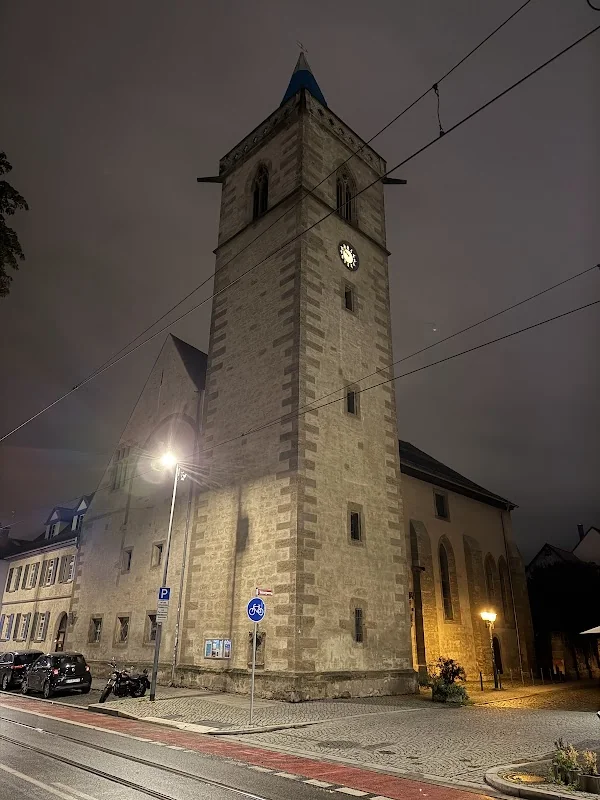
Architecturally, St. Andrew's Church is an impressive example of a Gothic church with older building elements and later additions. The current building preserves the Romanesque original core in the lower part of the square tower, while the tower is crowned by an octagonal spire made of sandstone. This tower particularly shapes the appearance in the Andreasviertel and is one of the building elements that make the church recognizable from afar. On the south side, there are further distinctive details, including the crucifixion relief and the apostle figures at the portal, which originate from a construction period around 1370. Such elements are not only art-historically relevant but also tell of the liturgical and symbolic significance of the building. Inside, the church received its currently visible form during the profound renewal of 1768/69. During this process, the walls were raised, the space was reorganized, and equipped with rectangular windows and a new spatial framing. The furnishings, such as the baptismal font, pulpit, and altar, partly date from the period between 1678 and 1710. This creates a space that unites medieval origins and later redesigns with unusual clarity. The building does not appear monumental in the sense of a huge cathedral but rather concentrated, closed, and very atmospheric. Precisely for this reason, it is suitable not only for Sunday services but also for musical formats, quiet visits, and city walks with a historical focus. Upon entering St. Andrew's Church, one experiences a space that does not conceal its history but openly displays it. The combination of tower, portal, interior furnishings, and restored substance gives the church a strong authenticity. For those seeking a church in Erfurt with historical depth, clear form language, and strong presence in the urban landscape, St. Andrew's Church is thus a particularly rewarding destination. ([erfurt.de](https://www.erfurt.de/ef/de/erleben/sehenswertes/dom/108131.html))
The architectural effect also includes the fact that St. Andrew's Church does not stand in isolation but is part of a developed ensemble. The Andreasviertel, with its narrow paths, historic houses, and proximity to the old town, enhances the impact of the building. The church thus acts as a calm anchor in a lively environment. While the city around it has developed over centuries, St. Andrew's Church has remained visible and legible as a spiritual center. Particularly exciting is the connection between building form and use: A church that was originally shaped by medieval structures is today also a place for community life, cultural events, and tourist interest. This multifunctionality requires an interior that is not only beautiful but also versatile in use. This is precisely reflected in the history of the 18th century when the space was fundamentally renewed. The tower, in turn, tells of both permanence and vulnerability, as its restoration in the late 20th century shows how important structural security is for such historic buildings. For searches for keywords like St. Andrew's Church Erfurt Tower, St. Andrew's Church Erfurt Old Town, or St. Andrew's Church Erfurt History, this connection is crucial: The building is not only an object of observation but an active part of the urban landscape and memory culture. Those who love architecture will find here a compact yet surprisingly rich example of the intertwining of Romanesque, Gothic, and later remodeling history. ([denkmalschutz.de](https://www.denkmalschutz.de/denkmal/andreaskirche-andreastr-14.html))
Services, Events, and Church Music
St. Andrew's Church is still a vibrant place for the Protestant community and represents not only history but also the present. On the community's website, services and events are explicitly considered, and the church is integrated into the church music life of Erfurt. The Protestant Church District refers to an event calendar for church music that consolidates concerts, choir work, and other musical formats. This shows: St. Andrew's Church is not a pure museum but a place where liturgical practice and cultural use complement each other. This mixture is particularly attractive to many visitors because they can experience a church not only as a building but as an acoustic and communal space. Sources from church work also indicate that formats such as music and texts for Reformation Day have taken place in St. Andrew's Church and that it has been part of the Long Night of Churches on special occasions. For such nights, the church was opened with tower visits and concerts, such as gospel rock programs. This makes it clear that St. Andrew's Church is also used for unusual, time-limited event formats, as long as they fit the content and organization of the place. For keyword analysis, terms like St. Andrew's Church Erfurt Events, St. Andrew's Church Erfurt Service, and St. Andrew's Church Erfurt Church Music are particularly relevant because they describe this multifunctionality. Therefore, those visiting the church should not only look for a building but also for the current program of the community and the church district. Thus, the historical place becomes a lively part of the cultural calendar of the city. Especially in a city like Erfurt, which is strongly shaped by church history, St. Andrew's Church thus unfolds a special role: it is spiritual, cultural, and urban at the same time. ([andreasgemeinde.wordpress.com](https://andreasgemeinde.wordpress.com/die-andreaskirche/))
Particularly important for music enthusiasts is the organ tradition of St. Andrew's Church. On the community's website, the so-called Kummer organ is described, which was installed in 1787 and extensively reconstructed between 1987 and 1989. During this process, the organ façade, part of the historical pipes, and large parts of the original organ work were preserved. The organ has two manuals, a pedal, and 25 stops, is mechanically built, and tuned in equal temperament. Such details are of interest to both experts and visitors who want to know why the church's acoustics are considered particularly suitable for services and concerts. The importance of church music in St. Andrew's Church is also evident from its close connection to the musical work of the church district. The church is thus not only a destination for visits but also for people specifically looking for concerts, choir projects, or church musical events in Erfurt. At the same time, the church can be excellently combined with a general city visit: architecture in the morning, a walk through the old town in the afternoon, and a musical format in the evening. This versatility makes the location particularly strong from a tourist perspective. For SEO terms like St. Andrew's Church Erfurt Organ or St. Andrew's Church Erfurt Events, this blend of historical organ culture and current program is the central added value. ([andreasgemeinde.wordpress.com](https://andreasgemeinde.wordpress.com/die-andreaskirche/))
Directions to St. Andrew's Church Erfurt and Parking in the Old Town
Those wishing to visit St. Andrew's Church benefit from its location in the heart of Erfurt's old town. The church is situated in the historical context of the Andreasviertel and thus in an area that is easily accessible on foot and ideally combined with a tour through the center. Particularly convenient is the direct connection to public transport: The stop Webergasse/St. Andrew's Church is served by tram line 3 and also by the night line N3. This makes the church easily accessible even if one wants to forgo the car. For visitors coming from the city center, the way is short and pleasant. Those starting from the Cathedral Square or the old town core reach the church in an area that is already among the culturally most exciting parts of Erfurt. For this reason, St. Andrew's Church is also a sensible focal point for day visitors who want to connect several attractions. For the keyword Directions to St. Andrew's Church Erfurt, it is important: The location is not remote but centrally urban, historically grown, and very well connected to public transport. The combination of the stop, old town location, and pedestrian paths makes getting there uncomplicated. Those planning their route can easily incorporate the church as part of a larger city tour rather than viewing it as an isolated destination. Especially for events, services, or evening concerts, the direct public transport connection is a clear advantage. It reduces the stress of getting there and facilitates spontaneous coming and going, which is particularly pleasant for church events. ([evag-erfurt.de](https://www.evag-erfurt.de/site/evag/get/documents/evag/isolitemp/afp/data24/afp_80_1_3.pdf))
Regarding parking, Erfurt follows the usual logic of a developed city center: Many parking spaces are managed, and the city explicitly refers to a parking space concept for the city center as well as a dynamic parking guidance system. For visitors to St. Andrew's Church, this means primarily that one should briefly inform oneself about the current parking situation in advance if coming by car. The city also recommends its P+R offers on the outskirts, which can be used free of charge and allow for further travel by tram. This way, one can bypass city traffic and still reach the center quickly. Erfurt mentions about ten P+R facilities with around 1,320 to 1,400 free parking spaces, depending on the current representation of the city pages. For guests wishing to visit several places in the city center, this is a very relaxed solution. Especially around the Cathedral Square and the old town, parking is often associated with time pressure, which is why P+R is a sensible alternative. Although St. Andrew's Church itself does not designate a separate visitor parking space, it is integrated into the general inner-city traffic and parking system due to its central location. For search queries like St. Andrew's Church Erfurt parking, the most important answer is: City center parking is possible but usually managed; more comfortable is often the combination of P+R and tram. Those wishing to arrive relaxed should plan their trip so that they experience the old town on foot and do not have to drive directly up to the church portal. This way, the visit remains stress-free and fits well with the character of the quarter. ([erfurt.de](https://www.erfurt.de/ef/de/leben/verkehr/mobil/auto/pr/index.html?utm_source=openai))
Pulpit Altar, Kummer Organ, and the Great Andreas Bell
Among the special treasures of St. Andrew's Church are several furnishings that make the visit worthwhile beyond just the architecture. A central element is the pulpit altar, which has been in the church since 1679. The altar and pulpit form a unity here, which is historically significant for Protestant church spaces. The altar made of fir wood is about nine meters high and five meters wide. Its central axis is emphasized by the medallion with depictions of Christ and the flanking full sculptures of Moses and John the Baptist. Such details show how consciously theology, art, and spatial effect were interconnected in St. Andrew's Church. Another notable piece is the Kummer organ, which is not only used liturgically but also plays an important role in concerts and musical formats. It represents the long musical tradition of the place and underscores that St. Andrew's Church can be thought of and experienced as a sound space. Additionally, there is the Great Andreas Bell, which has been ringing over the Andreasviertel since 1599. Its history is remarkable because it has survived occupations, fires, and wars and was put back into operation in 2007 after extensive repairs. For many visitors, this bell sound is part of the identity of the place. Bells, organ, and pulpit altar together tell of continuity, spiritual practice, and craftsmanship quality. St. Andrew's Church is therefore not only a beautiful historic building but a space whose individual pieces carry their own narrative. Those interested in church inventory will find several layers of significance here: liturgical, musical, and art-historical. This multilayeredness is the reason why terms like St. Andrew's Church Erfurt Organ, St. Andrew's Church Erfurt Bell, or St. Andrew's Church Erfurt Pulpit Altar fit so well with the location. They do not merely name objects but keys to understanding the place. ([andreasgemeinde.wordpress.com](https://andreasgemeinde.wordpress.com/die-andreaskirche/))
A particularly remarkable detail is the wooden model of the Luther grave slab, which is kept in St. Andrew's Church. It is considered the oldest known Luther monument. Its history connects the church with the Reformation era and the long memory of Martin Luther. The reference to Luther makes St. Andrew's Church additionally attractive for those interested in cultural and religious history, as here not only general Protestant tradition but a concrete object with its own provenance becomes visible. In Erfurt, a city with a strong Reformation and church memory, this piece fits seamlessly into the larger historical context. The picture is complemented by the location in the Andreasviertel, which itself is an important part of the old town's history. The quarter was significantly shaped by the church and has preserved its historical character despite urban upheavals. Therefore, St. Andrew's Church does not stand alone but is part of a web of memory, urban planning, community life, and tourist perception. This is valuable for visitors because it makes the place multifaceted: One comes for the architecture, stays for the history, perhaps listens to a concert evening, sees the tower, discovers the Luther slab, and leaves with a much deeper impression of Erfurt. Those looking for a church that is both quiet and rich in content will find exactly that in St. Andrew's Church. It is a place where the city's history remains visible and is simultaneously being written alive. ([andreasgemeinde.wordpress.com](https://andreasgemeinde.wordpress.com/die-andreaskirche/))
Why St. Andrew's Church Erfurt is Important for the Urban Landscape and Visitor Experience
St. Andrew's Church is important to Erfurt for several reasons. First, it is a historical point of orientation in one of the oldest and most characterful zones of the old town. Second, it shows how closely church, neighborhood, and urban development are interconnected. Third, it connects visitor interest and community life in a way that is no longer self-evident in many historical cities. This very mixture makes it attractive for today’s guests. Those interested in urban history receive here an authentic example of how a sacred building has asserted itself and changed over centuries. Those interested in music find an organ tradition, church musical programs, and special concert formats. Those seeking a quiet stop on their city tour get a church with strong presence but without tourist overload. Particularly in conjunction with the Andreasviertel, a harmonious experience emerges: short paths, historical building substance, small alleys, and a church that continues to shape the quarter to this day. From an SEO perspective, this is particularly valuable because search queries related to St. Andrew's Church Erfurt bundle very different expectations: Some seek history, others events, others directions or parking. St. Andrew's Church can meet all these needs because it is indeed a place with multiple access points. It is a monument and community place, urban space and sound space, a point of rest and event venue. Those who visit it experience not just a single building but a concentrated excerpt of Erfurt's identity. This is exactly why it is worthwhile to plan St. Andrew's Church not as a footnote but as an integral part of a visit to Erfurt. ([erfurt.de](https://www.erfurt.de/ef/de/erleben/sehenswertes/dom/108131.html))
St. Andrew's Church is particularly strong when viewed as part of a city walk. Its proximity to the Cathedral Square, the old town, and the Andreasviertel makes it a sensible stop for all who wish to discover Erfurt on foot. Due to its central location, the visit can be easily combined with other attractions without the need for additional paths or complicated transfers. Especially for travelers who do not seek the largest church or the loudest attraction but a place with depth and atmosphere, St. Andrew's Church is an excellent choice. It offers what many church visits in cities today make so appealing: a genuine historical core, visible layers of building history, vibrant use, and an environment that enhances the character of the place. Together with the good public transport connection and parking options in the city center or P+R offers, getting there is uncomplicated. St. Andrew's Church is thus a strong example of how to meaningfully combine history, music, and urban experience in Erfurt. So, if you are looking for a church that not only looks good in photos but also unfolds a convincing atmosphere on site, you should place St. Andrew's Church at the top of your list. ([evag-erfurt.de](https://www.evag-erfurt.de/site/evag/get/documents/evag/isolitemp/afp/data24/afp_80_1_3.pdf))
Sources:
Mehr anzeigenWeniger anzeigen
St. Andrew's Church Erfurt | Events & Directions
The St. Andrew's Church in Erfurt is much more than a prominent building in the old town. It is a historically significant place, a fixed point in the Andreasviertel, and a Protestant parish church whose silhouette has shaped the surroundings for centuries. Those who walk through Andreasstraße experience a church that is closely connected to the development of the district, the city, and its spiritual tradition. Its name has even inspired the naming of the Andreasviertel and the Andreas suburb, which already shows how deeply this place is embedded in the historical fabric of Erfurt. For visitors, the charm of a Gothic church combines with the atmosphere of a developed urban quarter, characterized by narrow alleys, old houses, and its immediate proximity to the Cathedral Square. St. Andrew's Church is thus a destination for people interested in history, architecture, spiritual spaces, church music, and events that connect a historical framework with contemporary vibrancy. It stands in a place that does not loudly advertise for attention but convinces through substance. This is exactly what makes its special allure. Anyone wanting to understand Erfurt cannot overlook St. Andrew's Church, as here architectural art, urban memory, and community life converge in a small space. ([erfurt.de](https://www.erfurt.de/ef/de/erleben/sehenswertes/dom/108131.html))
History of St. Andrew's Church in the Andreasviertel
The history of St. Andrew's Church dates back deep into the Middle Ages. The church was first mentioned in 1216, and its current building dates back to the 13th century. Early in its history, it was expanded and remodeled several times, which is typical for a church with a long usage history. In the 14th century, defining elements such as the crucifixion relief at the south portal and the apostle figures Peter and Andrew, which are dated around 1370, were created. In the late Middle Ages, the church was incorporated into the Benedictine convent on Cyriaksberg, which further changed its role as a spiritual place. This close connection between the community, the convent, and the city reflects the religious and social structure of old Erfurt. After the city fire of 1416, the church was partially damaged; shortly thereafter, in 1484, a new choir was consecrated for the nuns. In 1522, St. Andrew's Church became Protestant. This also marks the transition to a new church historical epoch that remains visible to this day. Later centuries brought further interventions, including the pulpit altar from the late 17th century and the profound renewal of 1768/69, which decisively shaped the current church space. Even in the 19th and 20th centuries, the church remained an object of care, restoration, and preservation. It is precisely this sequence of continuity and change that makes it so exciting: St. Andrew's Church is not just a monument from a specific year, but a building where Erfurt's history can be read in several layers. Standing here, one does not look at a static backdrop but at a place that has withstood fires, upheavals, changes of faith, and renovations. ([erfurt.de](https://www.erfurt.de/ef/de/erleben/sehenswertes/dom/108131.html))
What is particularly interesting is that St. Andrew's Church has repeatedly stood in close relation to the changes in the district. The Andreasviertel was not named after the church by chance, but developed around this sacred building as a historically grown quarter. The church thus serves as a visible point of orientation for the city’s history. It has also been structurally adapted several times to meet new requirements. Sources report on remodeling phases in the 15th, 17th, and 18th centuries, on a renewal after a fire, on changed window openings, and a form of the interior that received its current shape in the 18th century. At the same time, the medieval core remains recognizable. The current church building thus combines Romanesque, Gothic, and later Baroque or Neoclassical interventions into a multifaceted overall picture. This is precisely what makes St. Andrew's Church so appealing to those interested in cultural history: One can read not only how churches were built but also how ecclesiastical use and urban identity have intertwined over centuries. St. Andrew's Church is therefore an excellent example of a place where history is not only told but can be experienced spatially. For an SEO-oriented perspective, it is important: Those searching for the history of St. Andrew's Church Erfurt will find here not just a date but a narrative of renewal, adaptation, and preservation that has grown over several centuries. ([erfurt.de](https://www.erfurt.de/ef/de/erleben/sehenswertes/dom/108131.html))
Architecture, Tower, and Interior
Architecturally, St. Andrew's Church is an impressive example of a Gothic church with older building elements and later additions. The current building preserves the Romanesque original core in the lower part of the square tower, while the tower is crowned by an octagonal spire made of sandstone. This tower particularly shapes the appearance in the Andreasviertel and is one of the building elements that make the church recognizable from afar. On the south side, there are further distinctive details, including the crucifixion relief and the apostle figures at the portal, which originate from a construction period around 1370. Such elements are not only art-historically relevant but also tell of the liturgical and symbolic significance of the building. Inside, the church received its currently visible form during the profound renewal of 1768/69. During this process, the walls were raised, the space was reorganized, and equipped with rectangular windows and a new spatial framing. The furnishings, such as the baptismal font, pulpit, and altar, partly date from the period between 1678 and 1710. This creates a space that unites medieval origins and later redesigns with unusual clarity. The building does not appear monumental in the sense of a huge cathedral but rather concentrated, closed, and very atmospheric. Precisely for this reason, it is suitable not only for Sunday services but also for musical formats, quiet visits, and city walks with a historical focus. Upon entering St. Andrew's Church, one experiences a space that does not conceal its history but openly displays it. The combination of tower, portal, interior furnishings, and restored substance gives the church a strong authenticity. For those seeking a church in Erfurt with historical depth, clear form language, and strong presence in the urban landscape, St. Andrew's Church is thus a particularly rewarding destination. ([erfurt.de](https://www.erfurt.de/ef/de/erleben/sehenswertes/dom/108131.html))
The architectural effect also includes the fact that St. Andrew's Church does not stand in isolation but is part of a developed ensemble. The Andreasviertel, with its narrow paths, historic houses, and proximity to the old town, enhances the impact of the building. The church thus acts as a calm anchor in a lively environment. While the city around it has developed over centuries, St. Andrew's Church has remained visible and legible as a spiritual center. Particularly exciting is the connection between building form and use: A church that was originally shaped by medieval structures is today also a place for community life, cultural events, and tourist interest. This multifunctionality requires an interior that is not only beautiful but also versatile in use. This is precisely reflected in the history of the 18th century when the space was fundamentally renewed. The tower, in turn, tells of both permanence and vulnerability, as its restoration in the late 20th century shows how important structural security is for such historic buildings. For searches for keywords like St. Andrew's Church Erfurt Tower, St. Andrew's Church Erfurt Old Town, or St. Andrew's Church Erfurt History, this connection is crucial: The building is not only an object of observation but an active part of the urban landscape and memory culture. Those who love architecture will find here a compact yet surprisingly rich example of the intertwining of Romanesque, Gothic, and later remodeling history. ([denkmalschutz.de](https://www.denkmalschutz.de/denkmal/andreaskirche-andreastr-14.html))
Services, Events, and Church Music
St. Andrew's Church is still a vibrant place for the Protestant community and represents not only history but also the present. On the community's website, services and events are explicitly considered, and the church is integrated into the church music life of Erfurt. The Protestant Church District refers to an event calendar for church music that consolidates concerts, choir work, and other musical formats. This shows: St. Andrew's Church is not a pure museum but a place where liturgical practice and cultural use complement each other. This mixture is particularly attractive to many visitors because they can experience a church not only as a building but as an acoustic and communal space. Sources from church work also indicate that formats such as music and texts for Reformation Day have taken place in St. Andrew's Church and that it has been part of the Long Night of Churches on special occasions. For such nights, the church was opened with tower visits and concerts, such as gospel rock programs. This makes it clear that St. Andrew's Church is also used for unusual, time-limited event formats, as long as they fit the content and organization of the place. For keyword analysis, terms like St. Andrew's Church Erfurt Events, St. Andrew's Church Erfurt Service, and St. Andrew's Church Erfurt Church Music are particularly relevant because they describe this multifunctionality. Therefore, those visiting the church should not only look for a building but also for the current program of the community and the church district. Thus, the historical place becomes a lively part of the cultural calendar of the city. Especially in a city like Erfurt, which is strongly shaped by church history, St. Andrew's Church thus unfolds a special role: it is spiritual, cultural, and urban at the same time. ([andreasgemeinde.wordpress.com](https://andreasgemeinde.wordpress.com/die-andreaskirche/))
Particularly important for music enthusiasts is the organ tradition of St. Andrew's Church. On the community's website, the so-called Kummer organ is described, which was installed in 1787 and extensively reconstructed between 1987 and 1989. During this process, the organ façade, part of the historical pipes, and large parts of the original organ work were preserved. The organ has two manuals, a pedal, and 25 stops, is mechanically built, and tuned in equal temperament. Such details are of interest to both experts and visitors who want to know why the church's acoustics are considered particularly suitable for services and concerts. The importance of church music in St. Andrew's Church is also evident from its close connection to the musical work of the church district. The church is thus not only a destination for visits but also for people specifically looking for concerts, choir projects, or church musical events in Erfurt. At the same time, the church can be excellently combined with a general city visit: architecture in the morning, a walk through the old town in the afternoon, and a musical format in the evening. This versatility makes the location particularly strong from a tourist perspective. For SEO terms like St. Andrew's Church Erfurt Organ or St. Andrew's Church Erfurt Events, this blend of historical organ culture and current program is the central added value. ([andreasgemeinde.wordpress.com](https://andreasgemeinde.wordpress.com/die-andreaskirche/))
Directions to St. Andrew's Church Erfurt and Parking in the Old Town
Those wishing to visit St. Andrew's Church benefit from its location in the heart of Erfurt's old town. The church is situated in the historical context of the Andreasviertel and thus in an area that is easily accessible on foot and ideally combined with a tour through the center. Particularly convenient is the direct connection to public transport: The stop Webergasse/St. Andrew's Church is served by tram line 3 and also by the night line N3. This makes the church easily accessible even if one wants to forgo the car. For visitors coming from the city center, the way is short and pleasant. Those starting from the Cathedral Square or the old town core reach the church in an area that is already among the culturally most exciting parts of Erfurt. For this reason, St. Andrew's Church is also a sensible focal point for day visitors who want to connect several attractions. For the keyword Directions to St. Andrew's Church Erfurt, it is important: The location is not remote but centrally urban, historically grown, and very well connected to public transport. The combination of the stop, old town location, and pedestrian paths makes getting there uncomplicated. Those planning their route can easily incorporate the church as part of a larger city tour rather than viewing it as an isolated destination. Especially for events, services, or evening concerts, the direct public transport connection is a clear advantage. It reduces the stress of getting there and facilitates spontaneous coming and going, which is particularly pleasant for church events. ([evag-erfurt.de](https://www.evag-erfurt.de/site/evag/get/documents/evag/isolitemp/afp/data24/afp_80_1_3.pdf))
Regarding parking, Erfurt follows the usual logic of a developed city center: Many parking spaces are managed, and the city explicitly refers to a parking space concept for the city center as well as a dynamic parking guidance system. For visitors to St. Andrew's Church, this means primarily that one should briefly inform oneself about the current parking situation in advance if coming by car. The city also recommends its P+R offers on the outskirts, which can be used free of charge and allow for further travel by tram. This way, one can bypass city traffic and still reach the center quickly. Erfurt mentions about ten P+R facilities with around 1,320 to 1,400 free parking spaces, depending on the current representation of the city pages. For guests wishing to visit several places in the city center, this is a very relaxed solution. Especially around the Cathedral Square and the old town, parking is often associated with time pressure, which is why P+R is a sensible alternative. Although St. Andrew's Church itself does not designate a separate visitor parking space, it is integrated into the general inner-city traffic and parking system due to its central location. For search queries like St. Andrew's Church Erfurt parking, the most important answer is: City center parking is possible but usually managed; more comfortable is often the combination of P+R and tram. Those wishing to arrive relaxed should plan their trip so that they experience the old town on foot and do not have to drive directly up to the church portal. This way, the visit remains stress-free and fits well with the character of the quarter. ([erfurt.de](https://www.erfurt.de/ef/de/leben/verkehr/mobil/auto/pr/index.html?utm_source=openai))
Pulpit Altar, Kummer Organ, and the Great Andreas Bell
Among the special treasures of St. Andrew's Church are several furnishings that make the visit worthwhile beyond just the architecture. A central element is the pulpit altar, which has been in the church since 1679. The altar and pulpit form a unity here, which is historically significant for Protestant church spaces. The altar made of fir wood is about nine meters high and five meters wide. Its central axis is emphasized by the medallion with depictions of Christ and the flanking full sculptures of Moses and John the Baptist. Such details show how consciously theology, art, and spatial effect were interconnected in St. Andrew's Church. Another notable piece is the Kummer organ, which is not only used liturgically but also plays an important role in concerts and musical formats. It represents the long musical tradition of the place and underscores that St. Andrew's Church can be thought of and experienced as a sound space. Additionally, there is the Great Andreas Bell, which has been ringing over the Andreasviertel since 1599. Its history is remarkable because it has survived occupations, fires, and wars and was put back into operation in 2007 after extensive repairs. For many visitors, this bell sound is part of the identity of the place. Bells, organ, and pulpit altar together tell of continuity, spiritual practice, and craftsmanship quality. St. Andrew's Church is therefore not only a beautiful historic building but a space whose individual pieces carry their own narrative. Those interested in church inventory will find several layers of significance here: liturgical, musical, and art-historical. This multilayeredness is the reason why terms like St. Andrew's Church Erfurt Organ, St. Andrew's Church Erfurt Bell, or St. Andrew's Church Erfurt Pulpit Altar fit so well with the location. They do not merely name objects but keys to understanding the place. ([andreasgemeinde.wordpress.com](https://andreasgemeinde.wordpress.com/die-andreaskirche/))
A particularly remarkable detail is the wooden model of the Luther grave slab, which is kept in St. Andrew's Church. It is considered the oldest known Luther monument. Its history connects the church with the Reformation era and the long memory of Martin Luther. The reference to Luther makes St. Andrew's Church additionally attractive for those interested in cultural and religious history, as here not only general Protestant tradition but a concrete object with its own provenance becomes visible. In Erfurt, a city with a strong Reformation and church memory, this piece fits seamlessly into the larger historical context. The picture is complemented by the location in the Andreasviertel, which itself is an important part of the old town's history. The quarter was significantly shaped by the church and has preserved its historical character despite urban upheavals. Therefore, St. Andrew's Church does not stand alone but is part of a web of memory, urban planning, community life, and tourist perception. This is valuable for visitors because it makes the place multifaceted: One comes for the architecture, stays for the history, perhaps listens to a concert evening, sees the tower, discovers the Luther slab, and leaves with a much deeper impression of Erfurt. Those looking for a church that is both quiet and rich in content will find exactly that in St. Andrew's Church. It is a place where the city's history remains visible and is simultaneously being written alive. ([andreasgemeinde.wordpress.com](https://andreasgemeinde.wordpress.com/die-andreaskirche/))
Why St. Andrew's Church Erfurt is Important for the Urban Landscape and Visitor Experience
St. Andrew's Church is important to Erfurt for several reasons. First, it is a historical point of orientation in one of the oldest and most characterful zones of the old town. Second, it shows how closely church, neighborhood, and urban development are interconnected. Third, it connects visitor interest and community life in a way that is no longer self-evident in many historical cities. This very mixture makes it attractive for today’s guests. Those interested in urban history receive here an authentic example of how a sacred building has asserted itself and changed over centuries. Those interested in music find an organ tradition, church musical programs, and special concert formats. Those seeking a quiet stop on their city tour get a church with strong presence but without tourist overload. Particularly in conjunction with the Andreasviertel, a harmonious experience emerges: short paths, historical building substance, small alleys, and a church that continues to shape the quarter to this day. From an SEO perspective, this is particularly valuable because search queries related to St. Andrew's Church Erfurt bundle very different expectations: Some seek history, others events, others directions or parking. St. Andrew's Church can meet all these needs because it is indeed a place with multiple access points. It is a monument and community place, urban space and sound space, a point of rest and event venue. Those who visit it experience not just a single building but a concentrated excerpt of Erfurt's identity. This is exactly why it is worthwhile to plan St. Andrew's Church not as a footnote but as an integral part of a visit to Erfurt. ([erfurt.de](https://www.erfurt.de/ef/de/erleben/sehenswertes/dom/108131.html))
St. Andrew's Church is particularly strong when viewed as part of a city walk. Its proximity to the Cathedral Square, the old town, and the Andreasviertel makes it a sensible stop for all who wish to discover Erfurt on foot. Due to its central location, the visit can be easily combined with other attractions without the need for additional paths or complicated transfers. Especially for travelers who do not seek the largest church or the loudest attraction but a place with depth and atmosphere, St. Andrew's Church is an excellent choice. It offers what many church visits in cities today make so appealing: a genuine historical core, visible layers of building history, vibrant use, and an environment that enhances the character of the place. Together with the good public transport connection and parking options in the city center or P+R offers, getting there is uncomplicated. St. Andrew's Church is thus a strong example of how to meaningfully combine history, music, and urban experience in Erfurt. So, if you are looking for a church that not only looks good in photos but also unfolds a convincing atmosphere on site, you should place St. Andrew's Church at the top of your list. ([evag-erfurt.de](https://www.evag-erfurt.de/site/evag/get/documents/evag/isolitemp/afp/data24/afp_80_1_3.pdf))
Sources:
St. Andrew's Church Erfurt | Events & Directions
The St. Andrew's Church in Erfurt is much more than a prominent building in the old town. It is a historically significant place, a fixed point in the Andreasviertel, and a Protestant parish church whose silhouette has shaped the surroundings for centuries. Those who walk through Andreasstraße experience a church that is closely connected to the development of the district, the city, and its spiritual tradition. Its name has even inspired the naming of the Andreasviertel and the Andreas suburb, which already shows how deeply this place is embedded in the historical fabric of Erfurt. For visitors, the charm of a Gothic church combines with the atmosphere of a developed urban quarter, characterized by narrow alleys, old houses, and its immediate proximity to the Cathedral Square. St. Andrew's Church is thus a destination for people interested in history, architecture, spiritual spaces, church music, and events that connect a historical framework with contemporary vibrancy. It stands in a place that does not loudly advertise for attention but convinces through substance. This is exactly what makes its special allure. Anyone wanting to understand Erfurt cannot overlook St. Andrew's Church, as here architectural art, urban memory, and community life converge in a small space. ([erfurt.de](https://www.erfurt.de/ef/de/erleben/sehenswertes/dom/108131.html))
History of St. Andrew's Church in the Andreasviertel
The history of St. Andrew's Church dates back deep into the Middle Ages. The church was first mentioned in 1216, and its current building dates back to the 13th century. Early in its history, it was expanded and remodeled several times, which is typical for a church with a long usage history. In the 14th century, defining elements such as the crucifixion relief at the south portal and the apostle figures Peter and Andrew, which are dated around 1370, were created. In the late Middle Ages, the church was incorporated into the Benedictine convent on Cyriaksberg, which further changed its role as a spiritual place. This close connection between the community, the convent, and the city reflects the religious and social structure of old Erfurt. After the city fire of 1416, the church was partially damaged; shortly thereafter, in 1484, a new choir was consecrated for the nuns. In 1522, St. Andrew's Church became Protestant. This also marks the transition to a new church historical epoch that remains visible to this day. Later centuries brought further interventions, including the pulpit altar from the late 17th century and the profound renewal of 1768/69, which decisively shaped the current church space. Even in the 19th and 20th centuries, the church remained an object of care, restoration, and preservation. It is precisely this sequence of continuity and change that makes it so exciting: St. Andrew's Church is not just a monument from a specific year, but a building where Erfurt's history can be read in several layers. Standing here, one does not look at a static backdrop but at a place that has withstood fires, upheavals, changes of faith, and renovations. ([erfurt.de](https://www.erfurt.de/ef/de/erleben/sehenswertes/dom/108131.html))
What is particularly interesting is that St. Andrew's Church has repeatedly stood in close relation to the changes in the district. The Andreasviertel was not named after the church by chance, but developed around this sacred building as a historically grown quarter. The church thus serves as a visible point of orientation for the city’s history. It has also been structurally adapted several times to meet new requirements. Sources report on remodeling phases in the 15th, 17th, and 18th centuries, on a renewal after a fire, on changed window openings, and a form of the interior that received its current shape in the 18th century. At the same time, the medieval core remains recognizable. The current church building thus combines Romanesque, Gothic, and later Baroque or Neoclassical interventions into a multifaceted overall picture. This is precisely what makes St. Andrew's Church so appealing to those interested in cultural history: One can read not only how churches were built but also how ecclesiastical use and urban identity have intertwined over centuries. St. Andrew's Church is therefore an excellent example of a place where history is not only told but can be experienced spatially. For an SEO-oriented perspective, it is important: Those searching for the history of St. Andrew's Church Erfurt will find here not just a date but a narrative of renewal, adaptation, and preservation that has grown over several centuries. ([erfurt.de](https://www.erfurt.de/ef/de/erleben/sehenswertes/dom/108131.html))
Architecture, Tower, and Interior
Architecturally, St. Andrew's Church is an impressive example of a Gothic church with older building elements and later additions. The current building preserves the Romanesque original core in the lower part of the square tower, while the tower is crowned by an octagonal spire made of sandstone. This tower particularly shapes the appearance in the Andreasviertel and is one of the building elements that make the church recognizable from afar. On the south side, there are further distinctive details, including the crucifixion relief and the apostle figures at the portal, which originate from a construction period around 1370. Such elements are not only art-historically relevant but also tell of the liturgical and symbolic significance of the building. Inside, the church received its currently visible form during the profound renewal of 1768/69. During this process, the walls were raised, the space was reorganized, and equipped with rectangular windows and a new spatial framing. The furnishings, such as the baptismal font, pulpit, and altar, partly date from the period between 1678 and 1710. This creates a space that unites medieval origins and later redesigns with unusual clarity. The building does not appear monumental in the sense of a huge cathedral but rather concentrated, closed, and very atmospheric. Precisely for this reason, it is suitable not only for Sunday services but also for musical formats, quiet visits, and city walks with a historical focus. Upon entering St. Andrew's Church, one experiences a space that does not conceal its history but openly displays it. The combination of tower, portal, interior furnishings, and restored substance gives the church a strong authenticity. For those seeking a church in Erfurt with historical depth, clear form language, and strong presence in the urban landscape, St. Andrew's Church is thus a particularly rewarding destination. ([erfurt.de](https://www.erfurt.de/ef/de/erleben/sehenswertes/dom/108131.html))
The architectural effect also includes the fact that St. Andrew's Church does not stand in isolation but is part of a developed ensemble. The Andreasviertel, with its narrow paths, historic houses, and proximity to the old town, enhances the impact of the building. The church thus acts as a calm anchor in a lively environment. While the city around it has developed over centuries, St. Andrew's Church has remained visible and legible as a spiritual center. Particularly exciting is the connection between building form and use: A church that was originally shaped by medieval structures is today also a place for community life, cultural events, and tourist interest. This multifunctionality requires an interior that is not only beautiful but also versatile in use. This is precisely reflected in the history of the 18th century when the space was fundamentally renewed. The tower, in turn, tells of both permanence and vulnerability, as its restoration in the late 20th century shows how important structural security is for such historic buildings. For searches for keywords like St. Andrew's Church Erfurt Tower, St. Andrew's Church Erfurt Old Town, or St. Andrew's Church Erfurt History, this connection is crucial: The building is not only an object of observation but an active part of the urban landscape and memory culture. Those who love architecture will find here a compact yet surprisingly rich example of the intertwining of Romanesque, Gothic, and later remodeling history. ([denkmalschutz.de](https://www.denkmalschutz.de/denkmal/andreaskirche-andreastr-14.html))
Services, Events, and Church Music
St. Andrew's Church is still a vibrant place for the Protestant community and represents not only history but also the present. On the community's website, services and events are explicitly considered, and the church is integrated into the church music life of Erfurt. The Protestant Church District refers to an event calendar for church music that consolidates concerts, choir work, and other musical formats. This shows: St. Andrew's Church is not a pure museum but a place where liturgical practice and cultural use complement each other. This mixture is particularly attractive to many visitors because they can experience a church not only as a building but as an acoustic and communal space. Sources from church work also indicate that formats such as music and texts for Reformation Day have taken place in St. Andrew's Church and that it has been part of the Long Night of Churches on special occasions. For such nights, the church was opened with tower visits and concerts, such as gospel rock programs. This makes it clear that St. Andrew's Church is also used for unusual, time-limited event formats, as long as they fit the content and organization of the place. For keyword analysis, terms like St. Andrew's Church Erfurt Events, St. Andrew's Church Erfurt Service, and St. Andrew's Church Erfurt Church Music are particularly relevant because they describe this multifunctionality. Therefore, those visiting the church should not only look for a building but also for the current program of the community and the church district. Thus, the historical place becomes a lively part of the cultural calendar of the city. Especially in a city like Erfurt, which is strongly shaped by church history, St. Andrew's Church thus unfolds a special role: it is spiritual, cultural, and urban at the same time. ([andreasgemeinde.wordpress.com](https://andreasgemeinde.wordpress.com/die-andreaskirche/))
Particularly important for music enthusiasts is the organ tradition of St. Andrew's Church. On the community's website, the so-called Kummer organ is described, which was installed in 1787 and extensively reconstructed between 1987 and 1989. During this process, the organ façade, part of the historical pipes, and large parts of the original organ work were preserved. The organ has two manuals, a pedal, and 25 stops, is mechanically built, and tuned in equal temperament. Such details are of interest to both experts and visitors who want to know why the church's acoustics are considered particularly suitable for services and concerts. The importance of church music in St. Andrew's Church is also evident from its close connection to the musical work of the church district. The church is thus not only a destination for visits but also for people specifically looking for concerts, choir projects, or church musical events in Erfurt. At the same time, the church can be excellently combined with a general city visit: architecture in the morning, a walk through the old town in the afternoon, and a musical format in the evening. This versatility makes the location particularly strong from a tourist perspective. For SEO terms like St. Andrew's Church Erfurt Organ or St. Andrew's Church Erfurt Events, this blend of historical organ culture and current program is the central added value. ([andreasgemeinde.wordpress.com](https://andreasgemeinde.wordpress.com/die-andreaskirche/))
Directions to St. Andrew's Church Erfurt and Parking in the Old Town
Those wishing to visit St. Andrew's Church benefit from its location in the heart of Erfurt's old town. The church is situated in the historical context of the Andreasviertel and thus in an area that is easily accessible on foot and ideally combined with a tour through the center. Particularly convenient is the direct connection to public transport: The stop Webergasse/St. Andrew's Church is served by tram line 3 and also by the night line N3. This makes the church easily accessible even if one wants to forgo the car. For visitors coming from the city center, the way is short and pleasant. Those starting from the Cathedral Square or the old town core reach the church in an area that is already among the culturally most exciting parts of Erfurt. For this reason, St. Andrew's Church is also a sensible focal point for day visitors who want to connect several attractions. For the keyword Directions to St. Andrew's Church Erfurt, it is important: The location is not remote but centrally urban, historically grown, and very well connected to public transport. The combination of the stop, old town location, and pedestrian paths makes getting there uncomplicated. Those planning their route can easily incorporate the church as part of a larger city tour rather than viewing it as an isolated destination. Especially for events, services, or evening concerts, the direct public transport connection is a clear advantage. It reduces the stress of getting there and facilitates spontaneous coming and going, which is particularly pleasant for church events. ([evag-erfurt.de](https://www.evag-erfurt.de/site/evag/get/documents/evag/isolitemp/afp/data24/afp_80_1_3.pdf))
Regarding parking, Erfurt follows the usual logic of a developed city center: Many parking spaces are managed, and the city explicitly refers to a parking space concept for the city center as well as a dynamic parking guidance system. For visitors to St. Andrew's Church, this means primarily that one should briefly inform oneself about the current parking situation in advance if coming by car. The city also recommends its P+R offers on the outskirts, which can be used free of charge and allow for further travel by tram. This way, one can bypass city traffic and still reach the center quickly. Erfurt mentions about ten P+R facilities with around 1,320 to 1,400 free parking spaces, depending on the current representation of the city pages. For guests wishing to visit several places in the city center, this is a very relaxed solution. Especially around the Cathedral Square and the old town, parking is often associated with time pressure, which is why P+R is a sensible alternative. Although St. Andrew's Church itself does not designate a separate visitor parking space, it is integrated into the general inner-city traffic and parking system due to its central location. For search queries like St. Andrew's Church Erfurt parking, the most important answer is: City center parking is possible but usually managed; more comfortable is often the combination of P+R and tram. Those wishing to arrive relaxed should plan their trip so that they experience the old town on foot and do not have to drive directly up to the church portal. This way, the visit remains stress-free and fits well with the character of the quarter. ([erfurt.de](https://www.erfurt.de/ef/de/leben/verkehr/mobil/auto/pr/index.html?utm_source=openai))
Pulpit Altar, Kummer Organ, and the Great Andreas Bell
Among the special treasures of St. Andrew's Church are several furnishings that make the visit worthwhile beyond just the architecture. A central element is the pulpit altar, which has been in the church since 1679. The altar and pulpit form a unity here, which is historically significant for Protestant church spaces. The altar made of fir wood is about nine meters high and five meters wide. Its central axis is emphasized by the medallion with depictions of Christ and the flanking full sculptures of Moses and John the Baptist. Such details show how consciously theology, art, and spatial effect were interconnected in St. Andrew's Church. Another notable piece is the Kummer organ, which is not only used liturgically but also plays an important role in concerts and musical formats. It represents the long musical tradition of the place and underscores that St. Andrew's Church can be thought of and experienced as a sound space. Additionally, there is the Great Andreas Bell, which has been ringing over the Andreasviertel since 1599. Its history is remarkable because it has survived occupations, fires, and wars and was put back into operation in 2007 after extensive repairs. For many visitors, this bell sound is part of the identity of the place. Bells, organ, and pulpit altar together tell of continuity, spiritual practice, and craftsmanship quality. St. Andrew's Church is therefore not only a beautiful historic building but a space whose individual pieces carry their own narrative. Those interested in church inventory will find several layers of significance here: liturgical, musical, and art-historical. This multilayeredness is the reason why terms like St. Andrew's Church Erfurt Organ, St. Andrew's Church Erfurt Bell, or St. Andrew's Church Erfurt Pulpit Altar fit so well with the location. They do not merely name objects but keys to understanding the place. ([andreasgemeinde.wordpress.com](https://andreasgemeinde.wordpress.com/die-andreaskirche/))
A particularly remarkable detail is the wooden model of the Luther grave slab, which is kept in St. Andrew's Church. It is considered the oldest known Luther monument. Its history connects the church with the Reformation era and the long memory of Martin Luther. The reference to Luther makes St. Andrew's Church additionally attractive for those interested in cultural and religious history, as here not only general Protestant tradition but a concrete object with its own provenance becomes visible. In Erfurt, a city with a strong Reformation and church memory, this piece fits seamlessly into the larger historical context. The picture is complemented by the location in the Andreasviertel, which itself is an important part of the old town's history. The quarter was significantly shaped by the church and has preserved its historical character despite urban upheavals. Therefore, St. Andrew's Church does not stand alone but is part of a web of memory, urban planning, community life, and tourist perception. This is valuable for visitors because it makes the place multifaceted: One comes for the architecture, stays for the history, perhaps listens to a concert evening, sees the tower, discovers the Luther slab, and leaves with a much deeper impression of Erfurt. Those looking for a church that is both quiet and rich in content will find exactly that in St. Andrew's Church. It is a place where the city's history remains visible and is simultaneously being written alive. ([andreasgemeinde.wordpress.com](https://andreasgemeinde.wordpress.com/die-andreaskirche/))
Why St. Andrew's Church Erfurt is Important for the Urban Landscape and Visitor Experience
St. Andrew's Church is important to Erfurt for several reasons. First, it is a historical point of orientation in one of the oldest and most characterful zones of the old town. Second, it shows how closely church, neighborhood, and urban development are interconnected. Third, it connects visitor interest and community life in a way that is no longer self-evident in many historical cities. This very mixture makes it attractive for today’s guests. Those interested in urban history receive here an authentic example of how a sacred building has asserted itself and changed over centuries. Those interested in music find an organ tradition, church musical programs, and special concert formats. Those seeking a quiet stop on their city tour get a church with strong presence but without tourist overload. Particularly in conjunction with the Andreasviertel, a harmonious experience emerges: short paths, historical building substance, small alleys, and a church that continues to shape the quarter to this day. From an SEO perspective, this is particularly valuable because search queries related to St. Andrew's Church Erfurt bundle very different expectations: Some seek history, others events, others directions or parking. St. Andrew's Church can meet all these needs because it is indeed a place with multiple access points. It is a monument and community place, urban space and sound space, a point of rest and event venue. Those who visit it experience not just a single building but a concentrated excerpt of Erfurt's identity. This is exactly why it is worthwhile to plan St. Andrew's Church not as a footnote but as an integral part of a visit to Erfurt. ([erfurt.de](https://www.erfurt.de/ef/de/erleben/sehenswertes/dom/108131.html))
St. Andrew's Church is particularly strong when viewed as part of a city walk. Its proximity to the Cathedral Square, the old town, and the Andreasviertel makes it a sensible stop for all who wish to discover Erfurt on foot. Due to its central location, the visit can be easily combined with other attractions without the need for additional paths or complicated transfers. Especially for travelers who do not seek the largest church or the loudest attraction but a place with depth and atmosphere, St. Andrew's Church is an excellent choice. It offers what many church visits in cities today make so appealing: a genuine historical core, visible layers of building history, vibrant use, and an environment that enhances the character of the place. Together with the good public transport connection and parking options in the city center or P+R offers, getting there is uncomplicated. St. Andrew's Church is thus a strong example of how to meaningfully combine history, music, and urban experience in Erfurt. So, if you are looking for a church that not only looks good in photos but also unfolds a convincing atmosphere on site, you should place St. Andrew's Church at the top of your list. ([evag-erfurt.de](https://www.evag-erfurt.de/site/evag/get/documents/evag/isolitemp/afp/data24/afp_80_1_3.pdf))
Sources:
Upcoming Events
No events found
Frequently Asked Questions
Reviews
Erica Frolova
9. June 2022
Ancient church
Maris H
27. June 2025
Discovered by chance as a tourist. A very nice and helpful volunteer took the time to answer our questions about the presentation of Martin Luther's grave slab.
Gabriele Gliem
31. December 2022
Andreas Church on Andreas Street near the Cathedral Square. It's very worth seeing. We were there on Christmas Eve for the children's service as we are every year. The children and youth of the community perform the nativity play there every year.
Jacob Schäfer
25. October 2020
I was at the church on Saturday with my girlfriend. We looked at the beautiful exhibition about Jesus and his miracles, which we really liked. There was an older woman volunteering who first unsolicitedly told us about her problems, her deceased husband, and the church festivals. The crowning moment was her comments about the terrible foreigners and how Erfurt has been declining since 2015 because their children scream so loudly and you still have to pay taxes for them. Even if you only represent the church as a volunteer, you stand for it in that moment. The comments were clearly racist and prejudiced. In the Christmas story, Mary and Joseph are also seeking asylum and the "evil innkeeper" chases away the "riffraff"... We couldn't notice any true inner Christianity.
Alexander W
20. September 2023
A very lovely community. If you're nearby, you should definitely take a look inside. A beautiful old house of worship.