
Caravan (Jazzstandard)
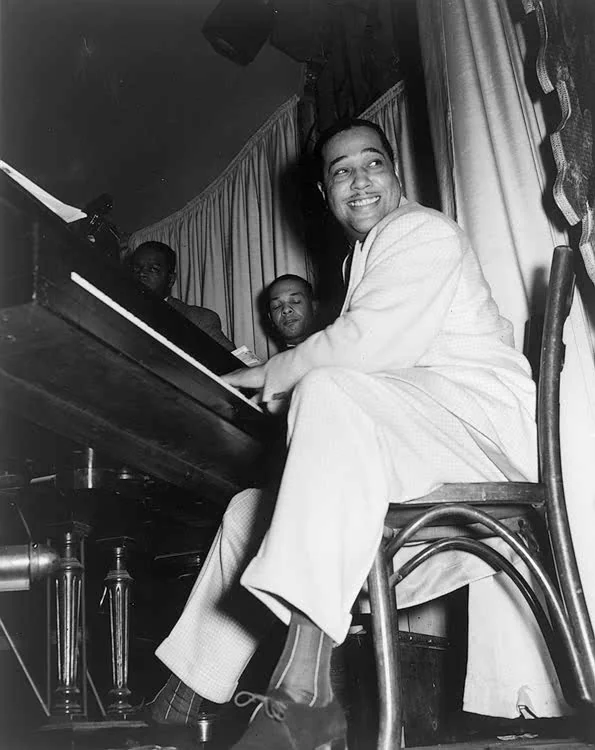
Image from Wikipedia
Image from Wikipedia
Caravan: The Jazz Standard That Immortalized Duke Ellington's Orchestra
A Piece of Jazz History Between Desert, Swing, and Master Arrangement
“Caravan” is no ordinary jazz piece, but a musical myth: a standard that originated from an improvisational idea by Juan Tizol and took its final form through Duke Ellington's arrangement. The title was first recorded by Barney Bigard in 1936 and by the Duke Ellington Orchestra in 1937, quickly becoming one of the defining works of the Ellington cosmos. With its distinctive, exotically appealing sound, often associated with Middle Eastern colors, “Caravan” remains one of the most recognized compositions in the jazz repertoire to this day. ([de.wikipedia.org](https://de.wikipedia.org/wiki/Caravan_%28Jazzstandard%29))
Origins: From a Musician's Idea to a Classic
The genesis of “Caravan” follows a typical Ellingtonian principle: An idea from the ensemble evolves under the bandleader's hand into a larger whole. According to historical accounts, the musical core can be traced back to trombonist Juan Tizol; Ellington elaborated on the material and shaped it into the arrangement that still defines the character of the piece today. Irving Mills later wrote the lyrics and was involved as a manager and rights holder in the publication, illustrating the business and artistic intertwining in Ellington's environment. ([jazzstandards.com](https://www.jazzstandards.com/compositions-0/caravan.htm))
The first significant step in the piece's career was the recording by Barney Bigard & His Jazzopaters on December 19, 1936, in Los Angeles. Shortly thereafter, the Duke Ellington Orchestra recorded the piece in 1937, which gave the title that final shine that led it to become a permanent fixture in the repertoire. It became clear early on: “Caravan” was not just a new piece, but a musical concept with high recognition value, a distinct atmosphere, and strong improvisational potential. ([classicjazzstandards.com](https://www.classicjazzstandards.com/songs/caravan/))
The Breakthrough: A Hit That Shaped the Charts and Band History
For Duke Ellington, “Caravan” became one of the greatest successes of his career. The orchestra's recording reached number four on the US charts on July 3, 1937, and stayed on the charts for 18 weeks; at the same time, the title established itself as a staple of the band's repertoire. This chart position is noteworthy because it documents the rare bridge between sophisticated jazz art and broad popularity. ([oe1.orf.at](https://oe1.orf.at/programm/20170803/483782/Duke-Ellingtons-groesster-Hit))
The significance of the piece also lies in its reinforcement of Ellington's reputation as an arranger and sound architect. The Wikipedia source cites the assessment by Ellington biographer James Lincoln Collier, who claims that the arrangement is what made the title a true “Ellington” piece. This is where the historical point lies: “Caravan” is not just a composition but an example of how arrangement, instrumentation, and interpretative imagination in jazz create a distinctive form. ([de.wikipedia.org](https://de.wikipedia.org/wiki/Caravan_%28Jazzstandard%29))
Musical Language: Minor Charm, Groove, and Exotic Colors
Musically, “Caravan” thrives on a tense connection of minor key, dancing pulse, and a melodic structure that immediately evokes images of movement and distance. The jazz standards analysis describes the original in F minor, with an A-A-B-A form and a characteristic middle section that harmonically opens towards a quintal descent. The impression of a “Middle Eastern beat” arises not from mere decoration but from the clever linking of rhythm, harmony, and instrumental color. ([jazzstandards.com](https://www.jazzstandards.com/compositions-0/caravan.htm))
This very mixture made the piece a magnet for soloists. The piece offers a stable form but ample room for improvisation, tension, and expansion. Thus, in jazz history, “Caravan” is among those standards where musicians could demonstrate their technique, tone, and harmonic understanding without losing the atmospheric core of the song. ([jazzstandards.com](https://www.jazzstandards.com/compositions-0/caravan.htm))
Discography and Notable Interpretations
The discography of “Caravan” is extraordinarily dense and extends far beyond the early Ellington recordings. Sources mention recordings by Art Blakey and His Jazz Messengers, Ella Fitzgerald, Dizzy Gillespie, Freddie Hubbard, Thelonious Monk, Art Pepper, Oscar Peterson, Wes Montgomery, Chucho Valdés, and Gonzalo Rubalcaba, among others. This list shows how intergenerationally influential the piece has been and how stylistically diverse it has been interpreted. ([de.wikipedia.org](https://de.wikipedia.org/wiki/Caravan_%28Jazzstandard%29))
Particularly influential was the early, more modern version by Freddie Hubbard with Art Blakey's band in the early 1960s; the source also highlights the 1986 recording by Wynton Marsalis, whose impact on later generations is described as significant. Additionally, film uses in Woody Allen films and in “Whiplash” extend the cultural reach of the piece beyond the jazz domain. “Caravan” is thus not only a concert standard but also a recurring sonic sign in popular culture. ([jazzstandards.com](https://www.jazzstandards.com/compositions-0/caravan.htm))
Critical Reception: The Standard as a Reference Point of Jazz
Critics recognized “Caravan” early on as a key work. The Wikipedia source labels the title as a successful jazz standard with countless interpretations, while ORF reporting describes it as a great jazz hit and emphasizes its later enduring presence in the repertoire. In its reception, “Caravan” is thus not just a popular piece but a reference point to exemplarily discuss issues of arrangement, swing aesthetics, and orchestral color. ([de.wikipedia.org](https://de.wikipedia.org/wiki/Caravan_%28Jazzstandard%29))
The historical perspective of the piece also remains intriguing: It connects the early studio work of the 1930s with a long afterhistory in jazz clubs, concert halls, film compositions, and modern reinterpretations. The fact that the title continues to be regularly recorded and interpreted speaks to its structural openness and high musical identity. Anyone who hears the standard immediately recognizes the signature of an era in which Ellington rethought the orchestra as a colorful instrument. ([jazzstandards.com](https://www.jazzstandards.com/compositions-0/caravan.htm))
Cultural Influence: From Band Hit to World Symbol of Jazz
“Caravan” became far more than just a successful piece of the Duke Ellington Orchestra. The title traversed through jazz history, being reinterpreted in swing, bebop, modern jazz, and later stylistic contexts while always remaining unmistakable. It was particularly the “exotic” sound character that made it instantly recognizable to listeners and attractive to musicians who wanted to work with atmosphere, dynamics, and modal tension. ([de.wikipedia.org](https://de.wikipedia.org/wiki/Caravan_%28Jazzstandard%29))
The cultural scope is also evident in its appropriation beyond jazz: film uses, popular cover versions, and later sampling underscore its lasting recognition value. Thus, “Caravan” exemplifies the power of a jazz standard that grows out of a specific big band situation and remains alive in musical memory for decades. The piece is among those recordings that not only document the language of jazz but have actively shaped it. ([de.wikipedia.org](https://de.wikipedia.org/wiki/Caravan_%28Jazzstandard%29))
Conclusion: Why “Caravan” Continues to Captivate
“Caravan” fascinates because here composition, arrangement, and interpretation merge into a single, brilliantly radiant idea. The title carries the signature of Juan Tizol, Duke Ellington, and Irving Mills, yet its true greatness unfolds in its adaptability: from the first recording to chart successes to the countless later interpretations. Anyone who hears this standard experiences jazz history in concentrated form — elegant, rhythmically electrifying, and full of adventurous spirit. ([de.wikipedia.org](https://de.wikipedia.org/wiki/Caravan_%28Jazzstandard%29))
For this reason, it is worthwhile to closely follow every new interpretation of “Caravan.” The piece shows how alive a classic can remain when illuminated anew by strong musical personalities. Anyone wanting to fully understand jazz in its depth should not only know “Caravan” but also experience it live time and again. ([de.wikipedia.org](https://de.wikipedia.org/wiki/Caravan_%28Jazzstandard%29))
Official Channels of Caravan (Jazz Standard):
- Instagram: No official profile found
- Facebook: No official profile found
- YouTube: No official profile found
- Spotify: No official profile found
- TikTok: No official profile found