Discovering Industrial Culture & Architecture in Erfurt
Industrial Culture & Architecture in Erfurt: Your Search for Traces in the Coming Months
This page helps you plan your next discovery tour of Erfurt's industrial architecture: as a walk, photo walk, family outing, or themed route. The focus is deliberately on what you can experience during a future visit and how to best prepare for it.
For whom: Visitors, locals, architecture and photography enthusiasts, school and project groups
Why Industrial Culture in Erfurt is Worthwhile for Your Next Visit
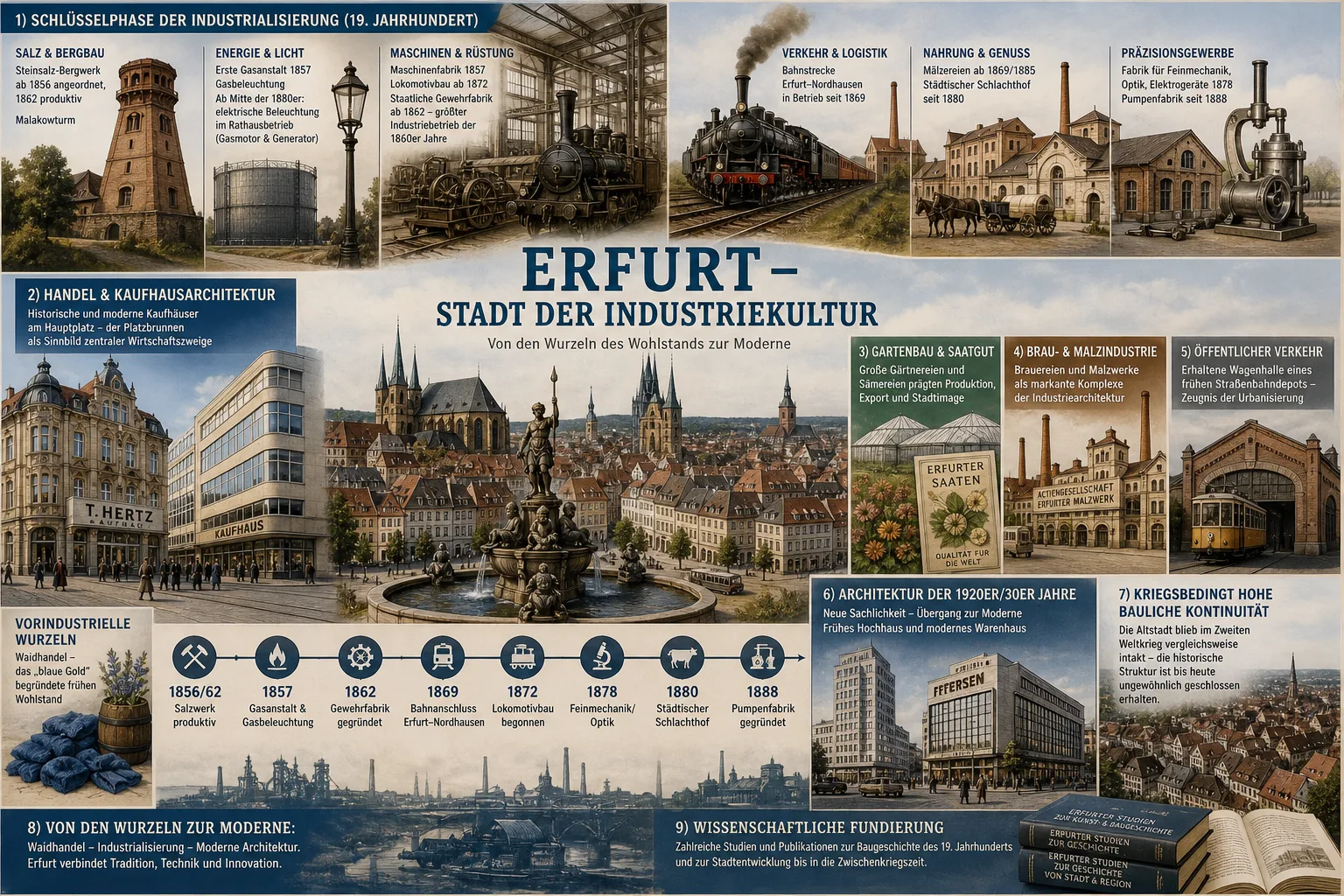
If you explore Erfurt soon, you will be able to discover a second narrative layer alongside the well-known old town: buildings and urban spaces conceived from production, energy supply, transport, and trade. These places often appear sober, sometimes surprisingly monumental – and they tell stories through material, proportion, facade rhythm, and location within the urban fabric.
- Learning to read architecture: You can learn how function translates into form (e.g., halls, warehouses, administrative buildings).
- Understanding urban development: You will be able to comprehend why some districts appear more "technical" than others.
- New perspectives: You can experience Erfurt from viewpoints that often escape classic sightseeing routes.
How to Plan Your Future Route: 3 Proven Approaches
1) The Compact Photo Walk (60–90 Minutes)
If you are looking for strong subjects in a short time, plan a route with clear contrasts: brick vs. plaster, round arches vs. functional window bands, historic track areas vs. newly used sites. For your next tour, it is worthwhile to specifically include the following subjects:
- long facades with uniform axis grids (ideal for line and perspective photography)
- visible supporting structures (steel/concrete-wood combinations) and large gate openings
- chimney and tower silhouettes as landmarks in the urban space
- details: riveted components, old inscriptions, brick ornamentation, ventilation grilles
2) The Family and Beginner Route (2–3 Hours)
For a next outing with children or as a beginner, a route that combines movement, breaks, and "aha" moments works well. Plan short stops where questions can be easily explained:
- "How do you recognize a hall?" (spans, gates, roof shapes)
- "What is a warehouse?" (smaller windows, massive walls, clear loading logic)
- "How is transport connected to industry?" (routes, depots, shunting areas, path relationships)
For the upcoming tour, it makes sense to plan a weatherproof alternative (e.g., an indoor offer or a shorter circular route) in case rain or heat changes the schedule.
3) The Themed Route "Transport & Supply" (Half Day)
If you want to pursue a clear theme on your next visit, "Transport & Supply" is a good choice. Here you pay attention to places where urban technology becomes visible: energy, depot or operational architecture, technical ancillary buildings, functional courtyards, and access axes. For your future routing, these guiding questions help:
- Which buildings are located near important routes (rail/road/public transport) – and why?
- Where are transitions visible: from operation to neighborhood, from production to service?
- Which traces of technology are still readable (loading ramps, wide driveways, facility remains)?
What to Look Out for Architecturally on Your Next Search for Traces
Industrial architecture often appears "self-evident" during a future city walk – until you know what to look for. Use this checklist as a companion:
- Material: clinker/brick, natural stone bases, steel beams, concrete additions
- Window logic: uniform grids for work light, larger openings for assembly/logistics
- Roof shapes: sawtooth or shed roof impressions, flat roofs of modernism, large spans
- Signage & typography: old lettering, numbering, technical pictograms
- Urban space: courtyards, driveways, shunting areas, transitions to residential quarters
If you want to document your upcoming route, a short note per location helps: What was the probable function? How is the building accessed? Which details explain the use?
Respect & Safety During Future Visits
Many industrial cultural sites are now repurposed or located in areas that may still be operational, inhabited, or relevant to safety. For your next visit, the following applies:
- Stay on public paths and respect barriers as well as private property.
- Take photos mindfully: In residential or work environments, personal rights must be observed.
- Plan barrier-free options if people with wheelchairs, strollers, or limited mobility are coming along (curbs, surfaces, gradients).
- Weather & light: For photography and architectural perception, early or late times of day are often advantageous; in midsummer, plan for shade and water breaks.
How to Deepen Your Experience in the Coming Weeks
If you want to turn a one-time tour into a repeatable project, you can structure your next visits according to a simple pattern:
- Visit 1 (Orientation): 10–20 minutes per location, focus on overall form, location, and accessibility.
- Visit 2 (Details): specifically document facades, entrances, windows, supporting structure, courtyard situations.
- Visit 3 (Context): consult maps and monument lists/publications to reliably assign terms and building types.
For better classification, it is worthwhile to look up basic terms on industrial architecture (building types, materials science, monument protection principles) before your next tour.