Authors from Erfurt: Discover Local Literature
Authors from Erfurt: Discover Local Literature in the Coming Months and Years
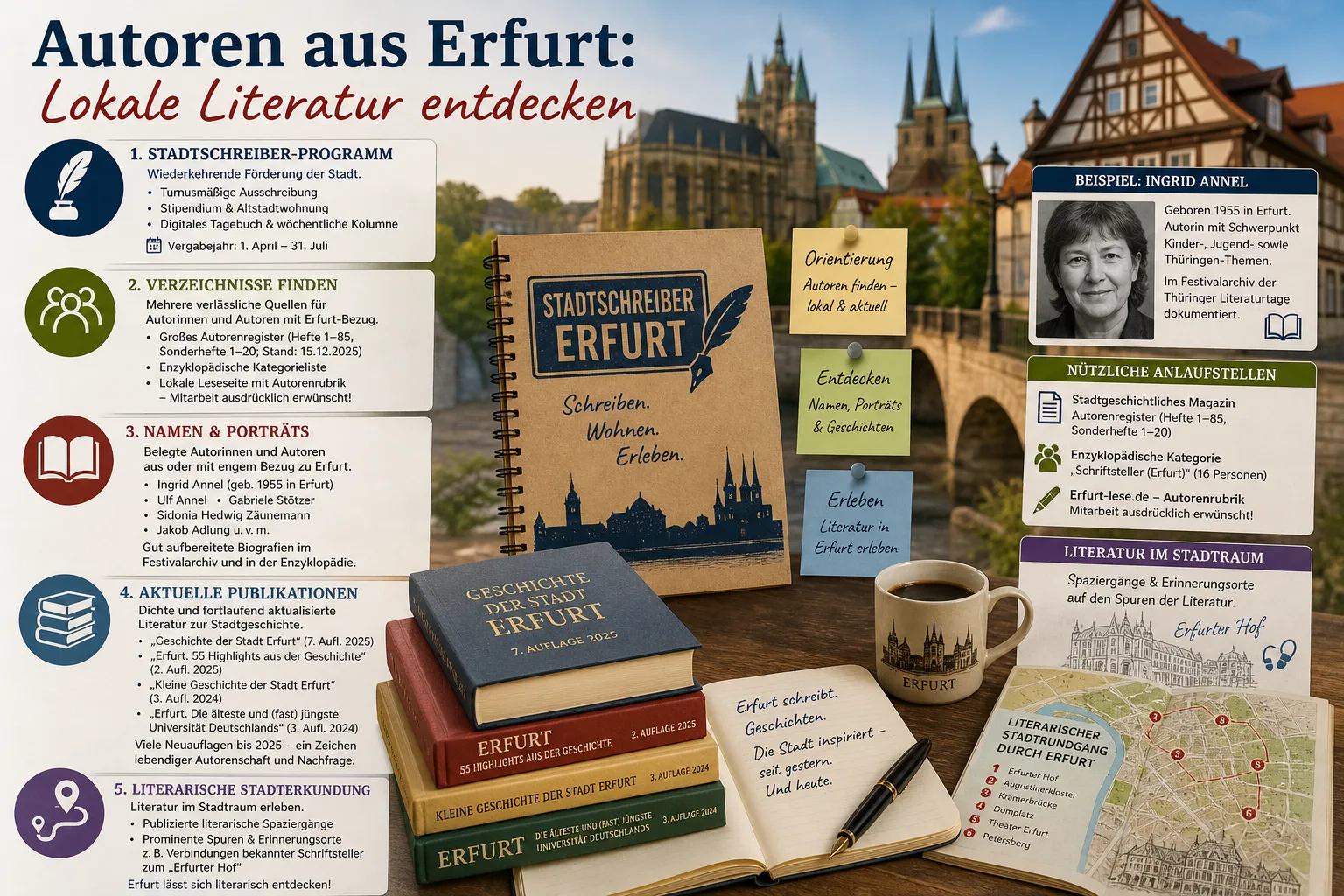
If you want to experience Erfurt in the future not only through its sights but also through texts, you will find many points of connection in the coming months: new city writer contributions, upcoming readings, digital author directories, and literary city walks that can be planned well in advance. This article bundles concrete, reliable ways for you to build your personal Erfurt reading list and your own literature routes for upcoming visits or the next season.
Why Local Voices Matter for Your Next Erfurt Experience
In the coming months, Erfurt will once again become a stage for many people: cultural programs start the next season, new texts appear online, and event series are updated. Local literature is a particularly helpful compass because it not only describes paths, places, and neighborhoods but also interprets them: What mood is present in an alley in the evening? What conflicts or hopes shape a district today? What do outsiders notice that locals overlook?
When preparing your next visit or your next weeks in Erfurt, literature can be used in a targeted way:
- As a planning tool: Texts provide motives for routes (e.g., “Old Town in the Morning,” “South District in the Evening,” “River and Bridge Views”).
- As a conversation starter: Readings and columns provide topics that you can pursue further on site in cafés, bookstores, or cultural centers.
- As a memory anchor: If you connect places with passages, city impressions remain more sustainable—especially with recurring visits.
City Writer Erfurt: How to Follow the Next Round
The city writer format is particularly practical for the future because it is plannable: As soon as the next call for applications or the next term is published, you have a clear source for fresh texts with a direct Erfurt connection. For your preparation, it is worthwhile to set up a system now that allows you to find new content immediately—without having to research anew each time.
This is how you stay permanently up-to-date from now on
- Monitor official city and culture pages: New calls for applications, terms of office, readings, or accompanying programs are typically announced there.
- Subscribe to digital diaries/blog formats: When new contributions appear, you can add them directly to your reading list.
- Translate the texts into a route: When reading, note places that are mentioned (squares, bridges, streets) and build a map for your next walk from them.
Digital Directories as a Compass for Your Future Reading
So that your discovery does not depend on chance, digital directories are the most important basis: They help you to specifically search for authors with an Erfurt connection in the coming weeks, without having to fight through unreliable hit lists.
Which directories are suitable for your next research
- Author registers of local publications: Ideal if you want to search thematically (e.g., architecture, everyday culture, urban development, biographies). This is especially useful if you want to align a future walk with a specific topic.
- Encyclopedic overview pages (category lists): Good for a quick start to collect names that you can then follow up specifically via libraries, publishers, or event programs.
- Local reading pages and participation portals: These are suitable if you also want to read shorter texts or contribute something yourself in the coming months (e.g., your own impressions after a walk or a review of a reading).
This is how you use directories with a future orientation: Create three lists from each find: (1) “Read Next,” (2) “Visit On Site” (places you want to see), (3) “Observe” (authors/projects whose new publications you want to follow in the future).
Literary City Walks: How to Plan Your Route for the Next Visit
Literary walks are particularly future-proof because they work independently of fixed dates: You can do them at any time in the coming weeks—alone, in pairs, or as a private “reading collective.” All you need is a collection of texts (e.g., columns, diary entries, essays) and a clear route.
A plan that works in every season
- Choose a guiding theme for the next walk: “Bridges & Transitions,” “Markets & Voices,” “Courtyards & Interiors.”
- Set 5 stops: Prefer fewer places, but with time to read on site.
- Plan two reading modes: (a) short passages on the go, (b) longer texts at home afterwards that arise from the observations.
- Record results: Photo (only where allowed), note, mini-quote. This way, your own “Erfurt reading archive” grows with every future walk.
Guiding question for your next visit: “Which spot in Erfurt would I see differently tomorrow if I read a text about it today?”
Readings & Dates: How to Reliably Find Upcoming Events
If you are looking for readings, discussion rounds, or festivals for the near future, reliability is crucial. Good sources are official event calendars from the city, cultural offices, libraries, and larger cultural institutions, as well as the programs of local bookstores and literary houses. These pages are typically updated continuously and are therefore better suited for your future planning than one-off announcements on social networks.
Checklist for scheduling (so you don't plan twice)
- Check the event source: Is there an official calendar or a program PDF with an update date?
- Clarify location & admission: Address, start time, accessibility, ticket/registration requirement.
- Secure content: Is the book/text mentioned? Is there a short description or a program theme?
- Define plan B: If an event is canceled, you already have an alternative route (e.g., literary walk) in your pocket.
Your 30–60–90 Day Roadmap (plannable, without guesswork)
To turn interest into a concrete project, a short roadmap for the next few weeks helps. It is deliberately designed to work without specific date assumptions.
In the next 30 days: Lay the foundation
- Choose one author directory as a starting point and collect 10 names/entries.
- Start a reading list with 5 texts (short is enough) and note suitable places in Erfurt.
- Subscribe to/mark 2–3 official culture or event calendars that are updated regularly.
In the next 60 days: Build Erfurt as a text map
- Plan a literary walk with 5 stops and a reading time of 60–120 minutes.
- Create a mini-route “indoors/outdoors”: a place to read outside + a place to reread (library, bookstore, quiet café—depending on availability).
- Write down 3 questions you would ask at a future reading (e.g., “Which places did you actually visit while writing?”).
In the next 90 days: Participation & Deepening
- Attend an announced literary event or replace it with a second walk if dates do not fit.
- Write a short personal note (300–600 words) about a place in Erfurt you want to see again in the future, and link it to a passage you have read.
- Update your lists: What will you continue to follow? What has proven to be “not suitable”? This way, research will be faster and more precise in the future.